Best Guide to Mining Conveyor Pulley Rubber Lining Friction
- Introduction to Mining Conveyor Pulley Rubber Lining
- 1. What Is Mining Conveyor Pulley Rubber Lining and How Does It Work?
- 2. Why Is Mining Conveyor Pulley Rubber Lining Essential for Drive Friction?
- 3. What Types of Rubber Lining Materials Are Available?
- 4. How Do Engineers Calculate Drive Pulley Power Transmission and Belt Slip?
- 5. How Is Mining Conveyor Pulley Rubber Lining Applied in Heavy Industry?
- 6. Frequently Asked Questions (FAQ)
- 7. References and Engineering Standards
Technical Analysis of Mining Conveyor Pulley Rubber Lining: Engineering Protocols, Friction Optimization, and Operational Lifespan
Introduction to Mining Conveyor Pulley Rubber Lining
Mining conveyor pulley rubber lining is a vital protective component designed to increase friction between the conveyor belt and the pulley shell, prevent belt slippage, and shield the metal pulley structure from severe mechanical wear and corrosion. In heavy industrial environments, raw drive pulleys operating without lagging experience continuous material buildup, shell erosion, and insufficient traction, leading to unscheduled downtime and premature belt failure.
By applying high-strength rubber compounds or ceramic-embedded rubber matrixes to drive, tail, snub, and bend pulleys, plant engineers significantly improve power transmission efficiency. High-performance mining conveyor pulley rubber lining solutions developed by Haihui are engineered specifically for high-tonnage bulk handling applications across heavy industrial networks, including paper mills, metallurgy plants, coal processing units, steel mills, mining sites, power generation stations, hydroelectric power plants, chemical production facilities, light industry manufacturing plants, bulk material handling ports, cement plants, and petroleum refineries.
Note: Haihui specializes exclusively in heavy-duty industrial conveyor systems and does not manufacture or service portable, light-duty commercial, or shopping mall conveyor belts.
1. What Is Mining Conveyor Pulley Rubber Lining and How Does It Work?
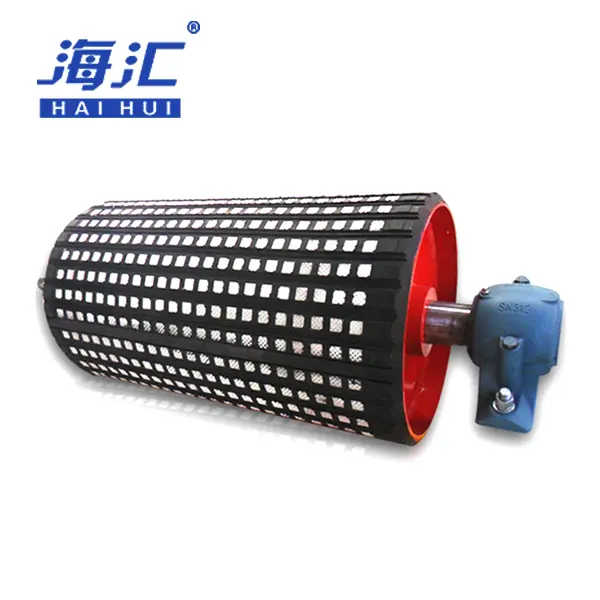
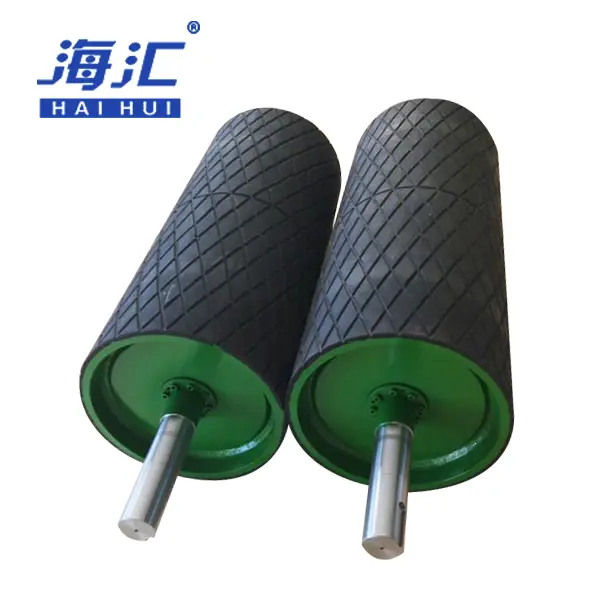
Mining conveyor pulley rubber lining involves bonding an elastomeric layer—often grooved with diamond or herringbone patterns—directly onto the cylindrical steel shell of a conveyor pulley. The fundamental objective is to elevate the coefficient of friction ($\mu$) between the bottom cover of the conveyor belt and the rotating pulley surface.
       [ Belt Tension T1 (Tight Side) ]
                  │
                  ▼
         ┌─────────────────┐
         │   Rubber Lag    │
         │   (Grooved)     │
    ─────┼─────────────────┼─────► [ Drive Pulley Shell ]
         │  Steel Shell    │
         └─────────────────┘
                  ▲
                  │
       [ Belt Tension T2 (Slack Side) ]
When heavy bulk materials like wet coal, iron ore, or crushed limestone are transported, moisture and fine particles act as lubricants between the belt and pulley. The grooved patterns in Haihui rubber lining channel away water and slurry, allowing the rubber profile to deform elastically under belt pressure and maintain intimate mechanical contact.
2. Why Is Mining Conveyor Pulley Rubber Lining Essential for Drive Friction?
Without adequate traction at the drive pulley, the conveyor belt will slip under peak start-up torque or heavy loading conditions. Continuous friction sliding causes extreme thermal generation, burning the rubber belt carcass and galling the steel pulley face.
Key Performance Benefits of Rubber Lagging
- Higher Coefficient of Friction: Increases traction from a baseline of $\approx 0.20$ (bare steel in wet conditions) up to $0.45$–$0.70$ (grooved rubber or ceramic-infused matrix).
- Extended Equipment Lifespan: Protects the structural steel shell from abrasive wear and shell thinning.
- Effective Water and Slurry Shedding: Diamond and herringbone grooving force liquids away from the contact patch.
- Reduced Belt Wear: Eliminates abrasive slip and uneven stress distribution along the belt’s bottom cover.
| Pulley Surface Condition | Friction Coefficient (μ) – Dry | Friction Coefficient (μ) – Wet / Muddy | Operational Risk Level |
| Bare Steel Shell | $0.35$ | $0.10 – 0.15$ | Critical Risk of Slippage |
| Smooth Rubber Lining | $0.45$ | $0.20 – 0.25$ | Moderate Risk under Wet Loads |
| Diamond/Herringbone Rubber | $0.50$ | $0.35 – 0.40$ | Low Risk / Standard Industrial |
| Direct-Bonded Ceramic-Rubber Matrix | $0.70$ | $0.50 – 0.60$ | Minimal Risk under Extreme Tonnage |
3. What Types of Rubber Lining Materials Are Available?
Selecting the right elastomer matrix depends on environmental moisture, material lump size, belt tension, and operating speed.
                  [ Rubber Lining Selection ]
                               │
         ┌─────────────────────┴─────────────────────┐
         ▼                                           ▼
[ Cold-Bonded Natural Rubber ]             [ Vulcanized Ceramic Rubber ]
  - Flexible On-Site Repair                  - Extreme Abrasive Mining
  - High Tensile Strength                    - Wet Slurry & High-Tension
Material Categories
- Natural Rubber (NR): Offers exceptional tear resistance, high elasticity, and superior tensile strength. Ideal for general bulk handling in cement plants, paper mills, and coal distribution networks.
- Neoprene / Chloroprene (CR): Provides flame-resistant and oil-resistant properties required in underground coal mines and petroleum refining plants.
- Styrene-Butadiene Rubber (SBR): Excellent abrasion resistance for dry bulk handling in metallurgy and steel mills.
- Ceramic Tile Infused Rubber Matrix: High-alumina ceramic tiles embedded into a vulcanized rubber backing. Used on primary drive pulleys in heavy mining and port facilities carrying highly abrasive ores.
4. How Do Engineers Calculate Drive Pulley Power Transmission and Belt Slip?
To verify that a drive pulley can transmit motor power without slipping, application engineers apply Euler’s classical drive equation (Eytelwein formula) for belt friction.
Euler’s Drive Equation
The maximum ratio of tight-side belt tension ($T_1$) to slack-side belt tension ($T_2$) before slip occurs is defined as:
$$\frac{T_1}{T_2} \le e^{\mu \cdot \theta}$$
Where:
- $T_1$ = Tight-side belt tension ($\text{N}$)
- $T_2$ = Slack-side belt tension ($\text{N}$)
- $e$ = Base of natural logarithms ($\approx 2.71828$)
- $\mu$ = Effective coefficient of friction between pulley lining and belt cover
- $\theta$ = Angle of wrap around the pulley ($\text{rad}$)
Effective Transmitted Drive Power
The net drive force ($F_U$) and required motor shaft power ($P_{drive}$) are derived as follows:
$$F_U = T_1 – T_2$$
$$P_{drive} = \frac{F_U \cdot v}{1000 \cdot \eta}$$
Where:
- $P_{drive}$ = Required drive mechanical power ($\text{kW}$)
- $v$ = Belt linear velocity ($\text{m/s}$)
- $\eta$ = Mechanical drive efficiency ($\approx 0.90 – 0.95$)
Engineering Calculation Example: Consider a heavy overland conveyor in a coal mine running at $v = 4.5\text{ m/s}$ with a wrap angle $\theta = 210^\circ$ ($3.665\text{ rad}$). If using a bare steel pulley under wet conditions ($\mu = 0.15$), $\frac{T_1}{T_2} \le e^{0.15 \times 3.665} = 1.73$. Upgrading the drive unit to a Haihui grooved mining conveyor pulley rubber lining increases the wet friction coefficient to $\mu = 0.40$, yielding $\frac{T_1}{T_2} \le e^{0.40 \times 3.665} = 4.33$. This substantially higher ratio prevents belt slip under full-load start-up without requiring excessive counterweight tension.
5. How Is Mining Conveyor Pulley Rubber Lining Applied in Heavy Industry?
Proper installation ensures long bonding durability and prevents lining debonding during high-shear operations.
Installation Protocols
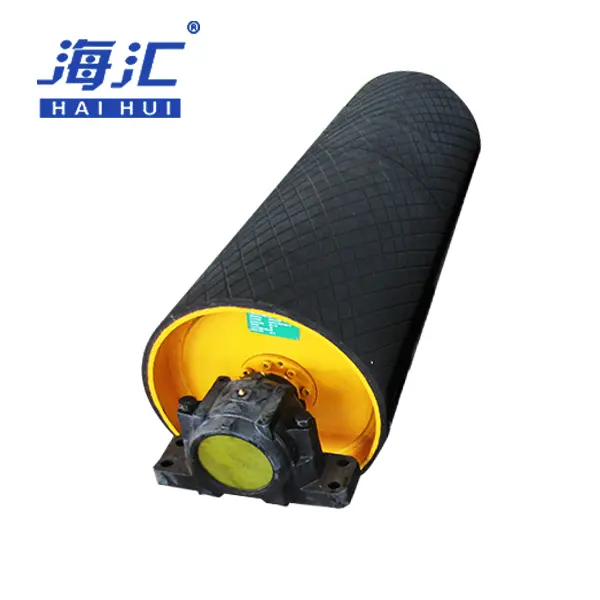
- Hot Vulcanization: The rubber compound is cured directly onto the prepared sandblasted steel shell inside a pressurized autoclave. This creates a chemical bond strength exceeding $12\text{ N/mm}$, ideal for extreme tension applications.
- Cold Bonding: High-grade rubber sheets with a semi-vulcanized bonding layer (BL layer) are cold-bonded using specialized two-component cement directly on-site, minimizing plant operational downtime.
Heavy Industrial Applications
Haihui industrial conveyor components and rubber lining solutions operate reliably in challenging industrial settings:
- Mining & Coal Processing: Resists severe impact and slurry erosion on primary drive pulleys.
- Metallurgy & Steel Mills: Handles heavy metallic loads and high thermal exposure.
- Ports & Cement Plants: Maintains continuous high-tonnage handling under dusty and humid coastal environments.
- Power Plants & Hydroelectric Stations: Ensures consistent fuel feeding to boilers and crushing units.
- Chemical, Petroleum & Light Industry: Resists chemical spills and oil contamination.
- Paper Mills & Wood Processing: Provides non-slip handling of high-moisture organic materials.
6. Frequently Asked Questions (FAQ)
Q1: How does rubber lining prevent conveyor belt misalignment?
Grooved rubber lining (especially diamond or double-herringbone patterns) helps center the drive friction profile across the width of the pulley face. By shedding water, fine particulates, and mud evenly on both sides, the lining ensures equal driving forces across the belt, preventing tracking deviations.
Q2: What is the average operating lifespan of rubber pulley lining?
In continuous heavy industrial service, a hot-vulcanized rubber lining typically achieves an operational lifespan of $30,000$ to $50,000$ running hours depending on material abrasiveness, belt tension, and speed. Ceramic-embedded lagging in extreme mining environments can exceed $60,000$ operating hours.
Q3: Can Haihui rubber lagging be applied on-site without removing the pulley?
Yes. Using cold-bonding rubber lagging sheets featuring semi-vulcanized bonding layers and specialized cold-curing adhesives, technicians can install or repair pulley lagging directly within the conveyor structure during scheduled maintenance outages.
Q4: Does Haihui produce conveyor equipment for commercial or shopping mall uses?
No. Haihui exclusively designs and manufactures heavy-duty industrial conveyor systems, pulleys, and protective lagging for industrial applications such as mines, power plants, ports, and processing facilities. We do not manufacture portable, light-commercial, or shopping mall conveyances.
7. References and Engineering Standards
- DIN 22101:2011-12: Continuous Conveyors – Belt Conveyors for Loose Bulk Materials – Basics for Calculation and Dimensioning.
- CEMA Belt Conveyors for Bulk Materials (7th Edition): Conveyor Equipment Manufacturers Association – Chapter 5: Belt Tension, Power, and Drive Engineering.
- ISO 284:2012: Conveyor Belts – Electrical Conductivity – Specification and Test Method.
- ISO 4649:2017: Rubber, Vulcanized or Thermoplastic – Determination of Abrasion Resistance Using a Rotating Cylindrical Drum Device.
 English
 العربية
 Português do Brasil
 Русский
 Español