Engineered Conveyor Pulleys:Cut Downtime & Boost Reliability
Engineered conveyor pulleys dictate whether a belt runs true or fails catastrophically. The right pulley style ensures performance, regulatory compliance, and cost-efficiency without disrupting crushing and screening lines.
3 Common Engineered Conveyor Pulley Styles
Engineered conveyor pulleys may appear simple, yet precision engineering dictates belt tracking, torque transfer, and safety. From drive pulleys to tail pulleys and take-up assemblies, these structural details are critical.
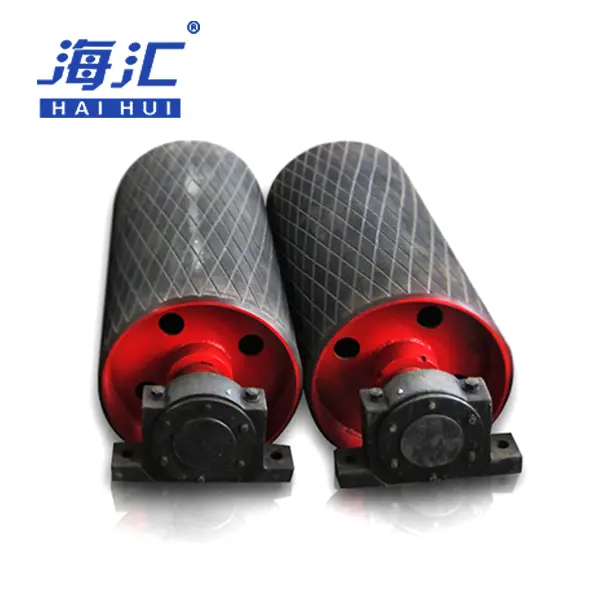
Standard Fabricated Drive Pulley
For general aggregate and quarry applications, the fabricated drive pulley is the functional core. This style integrates a rolled steel shell, end plates, and shaft into a single unit optimized for torque transfer.
Core Functional Layer
- Torque Interface – Welded end plates (full penetration) for a direct torque path from shaft to shell
- Shaft alignment – Induction-hardened bearing seats (HRC 50-55) for long-term concentricity
Force Control
- Balanced tension distribution
- Reduced bearing stress for enhanced service life
Design & Fit
- Shell Structure – S355 steel, rolled and welded
- Lagging – Vulcanized rubber (optional) for traction
For products requiring high starting torque, this pulley design provides necessary mechanical strength and fatigue reduction.
Engineered Forged Shaft Pulley
For high-torque or long overland conveyors, engineered forged shaft pulleys are the heavy-lifting workhorse. The shaft acts as the structural backbone, providing strength essential for high-tension applications.
Core Strength Layer
- Shaft Integrity – Forged 42CrMo4 steel; precise hardening profile for fatigue resistance
- Bearing Interface – Tight h7 or h6 tolerances for secure inner ring fit
Fatigue Control
- High-strength steel resists cyclic loading
- Reduced risk of keyway wallow or shaft scoring
Design & Fit
- Shaft Diameter – Sized to starting torque (not running torque)
- Keyway Geometry – Proper radius to eliminate stress risers
Haihui engineers its forged pulleys with safety factors well above minimum industry standards.
Ceramic Lagged Drive Pulley
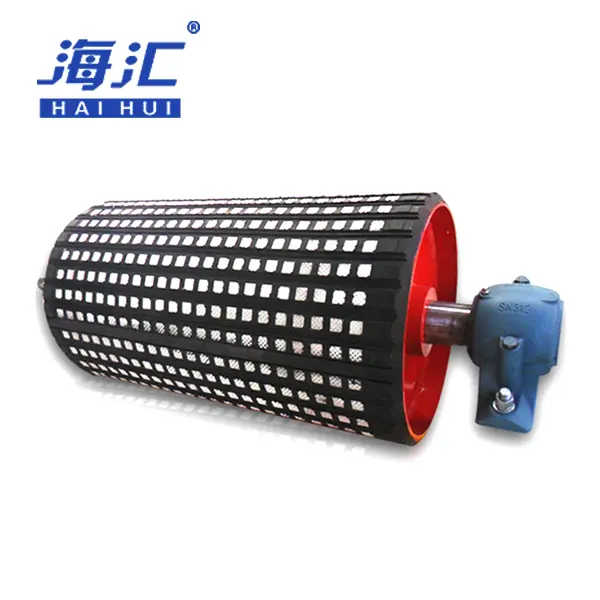
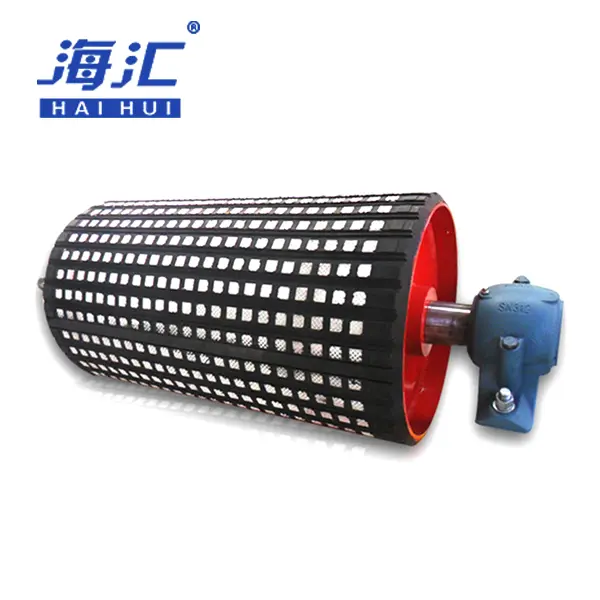
For extreme traction in wet, muddy, or icy conditions, the ceramic lagged pulley is the specialist. This style integrates ceramic tiles (92-95% Al₂O₃) embedded in rubber, providing grip where rubber alone fails.
Traction Layer
- Ceramic Tiles – High alumina content; precise pattern for water shedding
- Grip Coefficient – 0.5-0.6 vs. 0.4-0.5 for rubber, 0.1-0.2 for bare steel
Water Evacuation
- Herringbone grooves channel moisture to pulley edges
- Maintains grip in wet or muddy conditions
Design & Fit
- Tile Coverage – 60-80% depending on application
- Bond Strength – Vulcanized ≥12 N/mm peel strength
For wet or inclined conveyors, this engineered design provides necessary traction and slip prevention.
💡 Need Engineered Pulleys for Your Next Project? With over 15 years of mining and aggregate expertise, Haihui provides customized conveyor pulleys, including fabricated shells, forged shafts, and ceramic lagging. Explore our Pulley Solutions or Contact Us for a 1-day solution proposal.
Materials For Engineered Pulley Construction
The metallurgy behind each engineered conveyor pulley dictates structural strength, fatigue life, and environmental resistance.
Steel Grades: S355 vs. 42CrMo4 vs. Stainless
Selecting materials for engineered pulleys primarily involves comparing structural steel for shells, alloy steel for shafts, and stainless for corrosive environments.
Core material properties
- S355 (Shell Steel) – High yield strength (355 MPa), excellent weldability, good formability for rolling.
- 42CrMo4 (Shaft Alloy) – Ultra-high strength, induction-hardenable (HRC 50-55 bearing seats), excellent fatigue resistance under cyclic torque.
- 304/316 Stainless – Superior corrosion resistance, non-magnetic, ideal for chemical or washdown applications.
Performance in engineered pulleys
- Fit retention on bearing housings
- Resistance to bending under peak belt tension
- Long-term reliability in wet or abrasive environments
For brands like Haihui, selecting between these steels means balancing S355’s weldability with 42CrMo4’s fatigue strength to ensure pulleys remain compatible across standard CEMA duty classifications.
Shell Construction: Rolled vs. Cast
When cast shell integrity is the priority, rolled and welded construction is optimal for most applications.
Step 1: Evaluate required shell concentricity for belt tracking (≤0.5 mm TIR).
Step 2: Measure needed weld penetration for full-strength joints.
Step 3: Test toughness and elasticity under impact loading.
Rolled plate construction (S355) absorbs torsional stress better than cast, preventing shell cracking in cold logistics chains. Its welded joints ensure a reliable end plate attachment despite minor dimensional variations.
Shaft Metallurgy: Forged vs. Bar Stock
Regulatory frameworks are driving adoption of forged shafts for high-cycle applications.
- Forged 42CrMo4 – Aligned grain flow; up to 3x fatigue life of bar stock.
- Induction hardening – HRC 50-55 at bearing seats, case depth 3-5 mm.
Recent industry reporting notes that demand for forged shafts aligns with CEMA standards for high-tension pulleys, pushing mining houses toward verifiable fatigue data.
*“The transition toward engineered forged components is accelerating across bulk handling in 2024, with fatigue-rated shafts becoming a baseline expectation.”*
Integrating these into pulley orders must not compromise lead times. Haihui strictly manages material sourcing, ensuring engineered pulleys maintain mechanical thresholds while advancing mine uptime.
Bearing Housings for Wet Environments
Manufacturers are increasingly adopting stainless or ductile iron housings for engineered pulleys.
- Ductile iron – Impact-resistant, cost-effective, good corrosion resistance with coating.
- Stainless steel – Maximum corrosion resistance for chemical or washdown applications.
In practice:
- Source certified housing castings.
- Verify mounting bolt patterns with existing frames.
- Assess full environmental impact.
Engineered correctly, stainless housings offer identical performance with legitimate corrosion benefits, providing a quantifiable reduction in unplanned downtime.
🌱 Commit to Reliability with Haihui. Looking for high-durability pulleys? We integrate S355 shells, forged 42CrMo4 shafts, and corrosion-resistant coatings, fully supporting your uptime goals. Learn more about our Customization Capabilities.
Why Choose Engineered vs. Standard Pulleys?
Selecting engineered conveyor pulleys requires balancing material science, required torque tolerances, and total cost of ownership.
Engineered Pulleys
When mines and quarries choose engineered pulleys, the primary drivers are fatigue life and operational reliability.
Material & Engineering Core
- Base Material – Forged 42CrMo4 shafts offer high fatigue strength, reducing unplanned downtime.
- Manufacturing Method – Induction hardening enables tight hardness tolerances (HRC 50-55). Robotic welding supports massive output.
Functional Design Layers
- User Safety – CEMA-classified designs for predictable failure modes. MSHA-approved flame-resistant lagging for underground coal.
- Custom Appeal – Fully customizable shaft diameters and face widths. Strong design flexibility for special lagging patterns.
Market Fit
- Higher tooling cost.
- Longer production cycles.
- Ideal for high-tension, high-cycle programs supported by Haihui.
Engineered pulleys deliver structural reliability and highly scalable fatigue performance.
Standard (Off-the-Shelf) Pulleys
Standard pulleys provide lower upfront cost and faster availability, though performance hinges on application limits.
Material Structure Comparison
| Property | Engineered Pulley (Haihui) | Standard Pulley | Notes |
|---|---|---|---|
| Shaft material | Forged 42CrMo4 | C45 bar stock | Fatigue life |
| Hardness (HRC) | 50-55 (induction) | As-rolled (15-25) | Bearing seat wear |
| Weld inspection | 100% NDT (UT/MPI) | Sample only | Shell integrity |
| Balancing | G-16 min (G-6.3 optional) | G-40 typical | Tracking smoothness |
Performance Attributes
- Strength – High fatigue endurance suits long overland conveyors.
- Surface & Protection – Epoxy or polyurethane coatings for corrosion resistance. MSHA-approved lagging for underground.
- Delivers a true reliability feel.
Cost & Branding Angle
- Higher engineering and development cost.
- Longer setup cycles due to forging and hardening processes.
- Ideal for long-life, high-uptime positioning, where Haihui ensures structural durability meets operational demands.
The choice between engineered and standard pulleys ultimately relies on required service life, uptime targets, and budget.
🏭 Ready to Scale Your Bulk Handling Operation? Whether you require high-torque engineered drive pulleys or cost-effective standard designs, Haihui supports your high-volume programs with robotic welding cells capable of producing pulleys up to 2000mm diameter. Discover our complete Pulley Solutions.
Industrial Mining & Aggregate: Durable Pulley Demands
Industrial applications subject pulleys to extreme stress. When pulleys drive long overland conveyors or crusher feeders, failure risks hazardous downtime and lost production.
Abrasion Resistance and Fatigue Strength
Industrial pulleys battle belt tension cycles and abrasive dust. To ensure material stability, specific steel grades and additive hardening treatments (like induction hardening) are deployed against cyclic fatigue.
Key risk factors:
- High starting torque (200% of running torque)
- Abrasive dust infiltration at bearing seals
- Moisture ingress in wet pits
Steel selection via fatigue charts
- Lab simulation – Rotating beam fatigue testing (10⁶-10⁷ cycles)
- Surface hardness checks – Hardness traverse for case depth verification
Performance Snapshot
| Test Item | Exposure (cycles) | Hardness Retention (%) | Structural Change |
|---|---|---|---|
| Forged 42CrMo4 | 10⁷ | 98 | None |
| C45 bar stock | 10⁶ | 85 | Keyway wallow |
| Induction-hardened seat | 10⁷ | 100 | None |
This strict testing ensures engineered pulleys remain structurally sound during rough field use.
Seal Integrity for Harsh Environments
A tight seal integrity system—often utilizing EPDM or Viton seals—protects the bearing housing under high pressure, extreme temperature, and continuous vibration.
Pulley structure
- Inner locking ring on bearing housing
- Reinforced seal gland
- Optional labyrinth or contact seals
Environmental risks
- -20°C storage in northern mines
- 50°C transport in shipping containers
- Coastal corrosion at port facilities
Haihui engineers pulleys that seal precisely over the shaft, mitigating contamination ingress and maintaining bearing life during high-impact shipping.
Tooling Development and Quality Assurance
Reliability requires rigorous process control.
- Forging dies mapped precisely to shaft specs.
- Precision induction hardening control.
- Rapid prototype validation for custom designs.
Quality path:
- Dimensional scan of shell and shaft.
- Functional fit test with bearing housing.
- Automated NDT weld inspection (ultrasonic or dye-penetrant).
- Ongoing statistical process control.
This protocols drive high defect prevention. For bulk pulley orders, standardized tooling guarantees predictable lead times.
Custom Fabrication with Cradle-to-Grave Traceability
Haihui executes precise fabrication systems for dimensional accuracy while concurrently integrating material traceability and quality management.
Quality focus includes:
- Lower warranty claim rates.
- Measured lifecycle assessment data.
- Stronger material circularity via calculated eco-design.
Industrial users secure necessary durability, mines achieve CEMA-accurate specifications, and production aligns with lower downtime footprints.
FAQs about Engineered Conveyor Pulleys
What makes Engineered Pulleys suitable for high-tension mining applications?
Engineered Pulleys are designed for controlled torque transfer and reliable belt tracking on long overland conveyors.
Precision control
- Forged 42CrMo4 shaft with induction-hardened bearing seats (HRC 50-55).
- Balanced tension distribution reducing bearing stress.
Secure fit
- Exact match to bearing housing and frame mounting.
- Tight fit (h7/h6) aligned with CEMA specifications.
Material strength
- S355 steel shell for impact resistance and weldability.
- Epoxy or polyurethane coating preserves surface finish in outdoor storage.
Manufactured with statistical process control, these pulleys guarantee structural integrity on high-tonnage production lines.
How do weld procedures and NDT maintain pulley safety?
NDT (non-destructive testing) physically validates weld integrity during fabrication, ensuring engineered pulleys remain fully dependable.
- UT (Ultrasonic Testing) – Detects internal porosity in full-penetration welds.
- MPI (Magnetic Particle Inspection) – Reveals surface cracks in end plate welds.
- Dye-Penetrant – Checks visual indications.
These methods guarantee container compatibility across varied shell profiles. Strict quality assurance ensures material traceability for bulk buyers.
Which materials are best for durable and long-life engineered pulleys?
Material selection dictates fatigue thresholds and carbon footprint.
Performance-focused steels
- S355 – High strength, weldability, and formability for shells.
- 42CrMo4 – Extreme fatigue resistance under cyclic torque.
- 304/316 Stainless – Corrosion resistance for chemical or washdown environments.
Sustainable options
- Recycled steel – Up to 74% energy savings, supporting circular economy principles.
- Lightweighting design – Reduced material usage while maintaining strength.
Modern tooling development enables custom shaft diameters while preserving optimal fatigue capacity. The result: engineered pulleys that harmonize industrial strength, reliability, and sustained uptime.
Ready to Perfect Your Conveyor System?
Choosing the right pulley is just the beginning. As a leading manufacturer with over 15 years of experience, Haihui is your trusted global partner for complete engineered conveyor solutions.
We proudly offer:
- Rapid Turnaround – Receive custom solution proposals in 1 day and engineering drawings in ≈10 days.
- Flexible Scaling – MOQs starting from just 5 pieces to support both pilot and production runs.
- Unmatched Quality – 100% NDT weld inspection, induction hardness testing, and ISO 9001 compliance.
- Global Reach – Serving mines and quarries across North America with seamless export and responsive support.
Don’t let the wrong pulley disrupt your production line. Contact Haihui Today to speak with our engineers and elevate your plant’s reliability.
References
- CEMA – Conveyor Equipment Manufacturers Association standards
- ASTM A370 – Mechanical testing of steel products
- ASTM E18 – Rockwell hardness testing
- ASTM E709 – Magnetic particle inspection
- AWS D1.1 – Structural welding code
- ISO 9001 – Quality management systems
- MSHA – Mine Safety and Health Administration
- Haihui – Internal engineering specifications for engineered conveyor pulleys

 English
 العربية
 简体中文
简体中文 Nederlands
 Français
 Deutsch
 Bahasa Indonesia
 Italiano
 日本語
日本語 한국어
한국어 Bahasa Melayu
 Polski
 Português do Brasil
 Русский
 Español
 Türkçe