Power Plant Conveyor Components:Stop Bearing Failure & Downtime
- Why Component Choice Matters In Power Plant Conveyors
- 4 Idler Types Every Power Plant Engineer Should Know
- CEMA D/E vs. Impact Idlers: Which Wins?
- Prevent Bearing Seizure In Conveyors—3 Simple Fixes
- Field Replacement—Compact Component Picks
- Which Component Yields The Finest Belt Tracking?
- FAQs about Power Plant Conveyor Components
- References
On a coal-fired conveyor line, power plant conveyor components operate like precision instruments: one mismatched idler results in belt wander, edge fraying, or cover damage that turns a routine run into a costly do-over. That small component is the make-or-break element for uptime efficiency, belt life extension, and minimal rework.
For plant-scale procurement, success requires sticking to documented conveyor mechanics—idler spacing, bearing seal specifications, shaft concentricity, and belt tension acting as an integrated unit. The priority isn’t aesthetics; it is identifying the component type that maintains stable tracking, resists dust ingress, distributes load evenly, and supports the belt without sagging under high tonnage.
Why Component Choice Matters In Power Plant Conveyors
If power plant conveyors yield inconsistent tracking or premature bearing failure, the component setup is usually the culprit. Understanding the synergy between idler hardware, belt tension, and load dynamics is vital for flawless material handling.
Matching Idler Type to Desired Belt Support
With power plant conveyors, the idler translates belt tension (typically 15-35 kN/m) into stable tracking. Misalign this, and the belt wanders into the structure, disrupting load distribution and causing edge damage.
Hardware fitment inside power plant conveyors:
- Idler choice – Trough angle (20°, 35°, 45°) sets material capacity and belt stability. Steeper angles increase capacity but require higher belt tension.
- Bearing seal pairing – Seal type (labyrinth vs. contact) dictates dust ingress protection at a given belt speed. Too little seal causes bearing contamination; too much seal causes drag and heat buildup.
- Belt + load balance – Belt tension must align with idler spacing to prevent sag between idlers.
Haihui engineers tune the idler spacing and bearing seal combination to maintain consistent tracking across maximum tonnage.
How Load and Material Density Influence Belt Support
In power plant conveyors, material density provides the load profile, while lump size manages impact energy. Load distribution determines whether the belt troughs properly or spills material. When idler spacing is incorrect, belt sag or material rollback occurs, compromising load stability and leaving coal scattered along the return side.
| Parameter (power plant conveyor) | Lower value effect | Higher value effect |
|---|---|---|
| Idler spacing (m) | Belt sag, material spillage | Higher cost, over-supported belt |
| Trough angle (degrees) | Lower capacity, belt stability | Higher capacity, belt edge stress |
| Seal gap (mm) | Higher drag, potential overheating | Dust ingress, bearing failure |
Impact on Bearing Life and Belt Tracking
On power plant conveyors, component performance dictates belt support—the foundation of tracking stability following proper alignment.
Coverage and load support on power plant conveyors:
- Load control – Targeting proper idler spacing prevents sag that compromises belt integrity.
- Excessive spacing – causes belt sag, trapping material and reducing tracking accuracy.
- Edge behavior – Misaligned idlers create uneven wear patterns, destroying belt edge life.
Practical outcomes for power plant conveyors:
- Superior support on conveyor structures maximizes belt tracking.
- Consistent idler alignment prevents belt wander, ensuring long-term belt durability.
Haihui prioritizes stable idler alignment so tracking integrity is systematically guaranteed, not reliant on installation luck.
4 Idler Types Every Power Plant Engineer Should Know
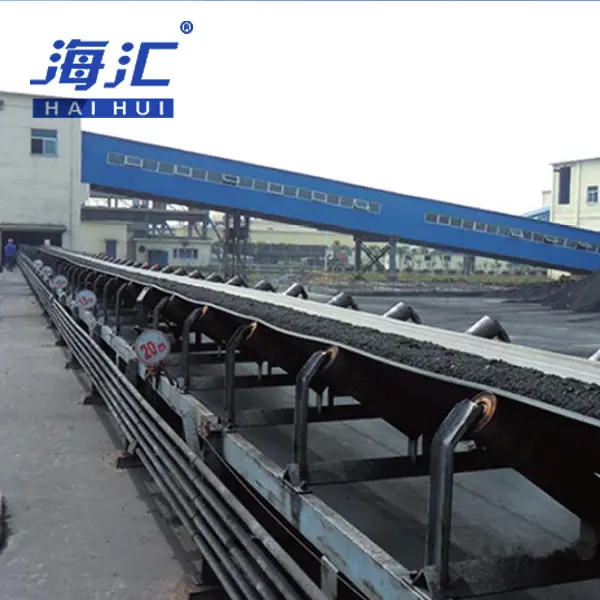
Selecting the precise idler dictates whether power plant conveyors deliver decades of service or inconsistent tracking.
CEMA B / C Idlers for Coal Handling
CEMA B/C idlers deliver reliable support—providing standard load capacity (10-20 tons per hour per idler)—while offering moderate belt speed capability. Hardware must also exhibit adequate seal protection to withstand coal dust exposure.
Dial-in checklist for coal dust + load feel:
- Tracking and support – If the belt wanders, check idler alignment before adjusting belt tension. If material spills, increase trough angle rather than adding idlers.
- Dust exposure and seal protection – Ensure labyrinth seals resist fine coal infiltration; seal protection relies on proper gap tolerance (≤0.3mm).
Quick numbers to sanity-check conveyor behavior (typical targets):
| Setup goal | Idler spacing (m) | Belt speed (m/s) | Trough angle (deg) |
|---|---|---|---|
| Smooth tracking | 1.2 | 2.5 | 35 |
| High capacity | 1.0 | 3.5 | 45 |
| Maximum belt life | 1.5 | 2.0 | 20 |
For Haihui power plant conveyors, utilize the controlled CEMA B/C idler design, tuning spacing rather than over-supporting the belt.
CEMA D / E Idlers for High-Tonnage Mainlines
CEMA D/E idlers with heavy-duty orings deliver high-capacity support on long overland conveyors, sustaining belt loads under steady tension.
- Target uniform load support – Maintain consistent idler spacing across the conveyor length.
- Balance the belt – Precision load distribution prevents belt sag.
- Control belt tension – Optimized tensioning mitigates edge build without trapping material.
- Verify idler alignment – Repeatable concentricity is mandatory for consistent belt tracking.
Haihui engineers power plant conveyors to sustain steady loads, requiring plant operators to manage belt tension to prevent gravity-induced sag.
Impact Idlers for Crusher Feeder Transfers
Impact idlers utilize rubber-ring or garland designs to deliver shock absorption. This ensures consistent load distribution, achieving even belt support and a smooth transfer, which is critical for high-drop applications.
Build even support on purpose, not hope:
- Control the idler geometry – Maintain parallel alignment; misalignment alters load distribution.
- Maintain strict spacing – Prevent belt sag between idlers.
- Keep rings intact – Thorough inspection prevents rubber loss from settling in power plant conveyors.
- Match idler rating – Optimized impact rating ensures uniform absorption and abrasion resistance.
Haihui’s impact idlers for power plant conveyors force shock loads to distribute evenly, eliminating belt cupping.
Self-Aligning Idlers for Long Overland Belts
Self-aligning idlers (producing up to ±5° of pivot) are engineered for long overland conveyors, ensuring controlled tracking with virtually zero belt wander.
Where detailed alignment pays off:
- Long belt runs and curves – Deploy self-aligning idlers at 300m intervals to avoid belt edge rub.
- Material safety – Minimize belt edge stress to protect belt carcass and prevent splice fatigue.
- Light adjustments – Gentle steering ensures tracking transitions on long overland conveyors.
Haihui power plant conveyors equipped with self-aligning idlers offer surgical tracking precision for long overland and curved belt lines.
Upgrade Your Power Plant Conveyor Line Today > Looking for precision conveyor solutions? With over 15 years of manufacturing expertise, Haihui offers a complete range of OEM conveyor idlers engineered for flawless tracking. We provide 1-day solution proposals and flexible MOQs starting at just 50 pieces. Contact Us to design your custom components!
CEMA D/E vs. Impact Idlers: Which Wins?
Selecting between CEMA D/E high-capacity idlers and impact idlers for power plant conveyors depends entirely on balancing load support against impact protection and belt life.
CEMA D/E High-Capacity Idlers
CEMA D/E heavy-duty idlers (supporting 20-50 tons per hour per idler) push maximum load, mimicking mainline conveyor requirements.
Material delivery and belt support:
- Coverage – Rapid support on long overland belt sections.
- Speed – Ideal for high-belt-speed (3-4 m/s) mainlines.
Load and consistency headaches:
- Requires strict idler alignment to prevent variable tracking across different power plant conveyors.
- Support risks you can’t ignore – Excessive spacing and high belt tension induce belt sag.
Where Haihui earns its keep:
- Haihui matches idler spacing to belt tension, keeping belt support mathematically predictable.
Impact Idlers
Impact idlers prioritize shock absorption over brute load capacity, optimizing belt protection at load zones.
- Adjust spacing to cover the impact zone without excessive support.
- Monitor evenness on ring wear to prevent metal-to-belt contact.
- Apply rubber rings to aid absorption and ensure the belt surface remains undamaged.
When they shine:
- Crusher feed / load zones – Superior control prevents belt penetration.
- Heavy drop applications – Promotes even impact distribution.
For power plant engineers using Haihui power plant conveyors, impact idlers perfectly pair spacing and load capacity to yield seamless load zone protection.
Prevent Bearing Seizure In Conveyors—3 Simple Fixes
Bearing seizure in power plant conveyors is an engineering failure, not luck. Mitigating bearing failure requires precise component and seal integration.
Choose Bearing Housings with Dust-Tight Seals
Select bearing housings integrated with triple labyrinth or contact seals to prevent fine coal dust ingress.
- Housing design – Eliminate sharp internal geometries that trap dust.
- Seal coating – Ensure seal compatibility with coal dust to maintain bearing performance.
- Conveyor components – Specify exact shaft-to-seal tolerances to support seizure prevention across all power plant conveyors.
Haihui supplies sealed, dust-tight bearing housings to guarantee long-term reliability.
Adjust Grease Type and Relubrication Interval
Seizure frequently stems from grease degradation or washout. Tune the grease type (using lithium-complex as baseline index) and relubrication schedule to prevent bearing scoring.
- Balance grease fill to ensure bearings are lubricated but not overheated.
- Fine-tune grease type to prevent washout in wet coal applications.
- Validate bearing temperature after a 72-hour run test.
Bench targets (example form for tracking conveyor chemistry drift):
| Test point (operating temp) | Target range | Action if out of range |
|---|---|---|
| Bearing temp rise (°C above ambient) | 15-30 | Adjust grease type ±1 grade |
| Grease bleed after 7 days (%) | 5-10 | Relube frequency, check seal |
| Housing temp variance after load (Δ°C) | ≤5 | Verify bearing alignment, check shaft |
Enforce Batch Consistency Through Material Traceability
Random bearing seizure usually traces back to manufacturing drift. Implement ISO 9001-level material traceability to lock in batch consistency.
- Raw material tracking – Log exact lot IDs for bearings, seals, and grease to ensure formulation integrity.
- Quality control – Monitor hardness (HRC 50-55) and case depth; track seal leak rates to expose manufacturing process deviations.
- Production standards – Freeze shaft straightness and concentricity specs to ensure absolute batch consistency.
Haihui implements strict material traceability, eliminating batch-to-batch behavioral swings in power plant conveyors.
Stop Bearing Seizure Before It Starts > Lock in batch consistency with Haihui. We provide 100% shaft hardness testing and supply premium sealed bearings designed to resist coal dust ingress. Need top-tier hardware? Explore our full range of conveyor components today.
Field Replacement—Compact Component Picks
For localized belt damage, the replacement component dictates the success of the repair. Haihui engineers compact options specifically for these high-stakes field repairs.
Quick-Change Idlers for Tight Access Areas
Belt splice or localized damage repairs demand extreme access.
- Target control – Prioritize light weight over a small access area with idler design tuned for quick installation.
- Alignment – Ensure simple mounting to maximize belt support and long-term tracking stability.
| Idler type | Weight (kg) | Typical access width (cm) |
|---|---|---|
| Compact impact | 15 | 60-80 |
| Compact CEMA C | 25 | 80-100 |
| Standard CEMA D | 45 | 120-150 |
Drop-In Replacement Idlers for Quick Change-Out
Achieving a flat foundation over existing mounting frames requires controlled replacement.
- Modulate the quick-change bracket for narrow access; use standard frames for wider replacements.
- Ensure rigorous alignment to activate belt tracking.
- Apply a uniform belt load via even support to prevent edge stress.
Impact Bars for Crusher Discharge
Coal lumps can aggressively attack impact idlers.
- Load behavior – impact bar delivery of continuous support yields soft belt protection.
- Compatibility – Utilize low-friction UHMW face; select bars formulated for abrasion resistance and impact durability.
- Belt safety – Minimized impact stress ensures vital belt protection.
Which Component Yields The Finest Belt Tracking?
The final tracking result is a direct calculation of idler geometry, spacing, belt tension, and load dynamics.
Evaluating Idler Spacing for Flawless Belt Support
Flawless tracking requires mathematically stable idler spacing from your power plant conveyors.
- Load support – Verify uniform idler spacing; excessive spacing ruins belt support.
- Spacing consistency – Fluctuating idler spacing indicates poor installation, destroying tracking stability.
- Uniformity – Irregular spacing creates uneven belt sag, resulting in severe edge wear and material spillage.
Haihui idlers maintain strict spacing uniformity when installed with consistent intervals.
Balancing Belt Tension with Load Profile
Belt tension and load profile must be perfectly synchronized.
- High tension anomalies – Produces belt stretch. Remedy by adjusting idler alignment or load distribution.
- Low tension anomalies – Results in belt sag and erratic tracking. Remedy by increasing take-up tension.
Haihui stabilizes belt tension recommendations, requiring plants only to respect load limits.
Ensuring Belt Life via Controlled Loading
Belt life relies on proper load support. Power plant conveyors that over-load the belt stunt this mechanical reliability.
- load zone design – Uneven loading weakens the belt edge, directly degrading belt life.
- loading and material handling – Strict adherence to center loading ensures the belt reaches full service potential.
| Setting | Loading method | Load zone length (m) | Expected belt life (years) |
|---|---|---|---|
| Poorly designed chute | Off-center loading | 1.0 | 3 |
| Standard chute with liner | Center loading | 1.5 | 5 |
| Engineered hood and spoon | Centered, controlled | 2.0 | 8 |
| Soft-start feeder | Regulated, even | 3.0 | 10+ |
Haihui power plant conveyors deliver controlled loads that perfectly match scheduled loading cycles or feeder calibration.
FAQs about Power Plant Conveyor Components
1) Why does idler choice matter in power plant conveyors for plant procurement?
The idler spacing controls belt sag; the trough angle determines how material loads on the belt. Misaligned idlers destroy tracking stability.
- Precise alignment helps the belt track rapidly, optimizing load characteristics.
- Controlled support prevents thin spots on belt edges, maximizing belt life and abrasion resistance.
2) What idler type and spacing should we standardize for reliable tracking?
Standardize the trough angle + idler spacing alongside the belt tension as a locked ecosystem.
| Spec to lock | What it controls in operation | What it protects |
|---|---|---|
| Idler spacing | Belt sag, material spillage | Belt tension stability, load capacity sensitivity |
| Trough angle | Material capacity, belt edge stress | Belt support, load distribution |
| Belt tension (take-up) | “Feel” from head to tail | Tailing, sagging, load characteristics |
| Idler alignment + spacing window | Tracking and sag as tension varies | Belt edge stability, abrasion resistance consistency |
3) How do load and material density influence tracking and belt life?
Material density dictates belt load profile. Lump size and impact energy determine idler impact rating requirements. Poor idler spacing causes edge wear. Excessive belt sag degrades abrasion resistance, rendering idler alignment ineffective.
4) For mainline support, when should we choose CEMA D/E vs impact idlers?
- CEMA D/E – Ideal for rapid load support on long overland belts; requires absolute idler alignment and belt tension consistency.
- Impact – Optimizes load zone support, yielding superior load distribution and belt protection. Long-term storage – Select configuration with proven service life stability.
5) What quality-control checkpoints reduce belt complaints across large power plant conveyor programs?
- Material traceability – Link idler tubes, bearings, seals, and grease lots directly to supplier qualification records.
- In-plant controls – Mandate idler alignment audits, load distribution logs, and test seal compatibility.
- Component specifications audits – Prevent idler damage during freight forwarding.
- Compliance paperwork – Maintain CEMA standards, hazard material classification, and MSHA compliance to secure just-in-time delivery.
Ready to Partner with Haihui?
From standard CEMA idlers to high-precision impact idlers, Haihui is a trusted supplier for power plant conveyors. We provide a complete one-stop OEM/ODM solution—from design and prototyping to mass production.
- Fast Turnarounds: 1-day solution proposals & samples in ≈10 days.
- Premium Quality: ISO 9001 certified, CEMA compliant, and 100% hardness testing.
- Flexible Orders: Production lines supporting MOQs from 50 pieces.
Take your power plant conveyor reliability to the next level. Browse our full Conveyor Components Catalog or Contact the Haihui team today to start your custom project!
References
- CEMA – Conveyor Equipment Manufacturers Association standards
- ISO 9001 – iso.org
- ASTM D3359 – Adhesion testing
- ASTM E18 – Rockwell hardness testing
- MSHA – Mine Safety and Health Administration
- PTFE seal materials – wikipedia.org
- n-Butyl acetate – pubchem.ncbi.nlm.nih.gov
- IR curing – pfonline.com
- Global Harmonized System (GHS) – unece.org
- DOT shipping regulations – phmsa.dot.gov
- CARB – arb.ca.gov
- REACH compliance – echa.europa.eu
- FDA compliance – fda.gov
 English
 العربية
 Português do Brasil
 Русский
 Español