
Lagged Drum Pulley Selection:7 Pro Tips from Haihui Experts
Don’t Let a Lagged Drum Pulley Slip-Up Cost You a Shift—Vet Builders on Lagging Adhesion, Drum Concentricity, Shaft Deflection, and Grip Performance Before Your Belt Starts Squealing
A lagged drum pulley looks straightforward—steel drum, rubber or ceramic cover, bolt it on and go. But in the real world, that lagged pulley is where grip happens or doesn’t, belts slip or track, and maintenance crews earn their overtime. One bad lagging job and you’re fighting belt wander, uneven wear, and drive slip that chews through production schedules faster than you can say “re-lag.”
In 2025, MSHA and OSHA continue highlighting pulley lagging condition, nip-point guarding, and belt slippage as persistent safety and reliability concerns across mining, aggregate, and bulk handling operations.
So skip the glossy product photos. Vet lagged drum pulley suppliers on lagging adhesion, drum concentricity, shaft deflection limits, and grip performance data—then your conveyor drive stops being a daily source of frustration.
What Makes a Lagged Drum Pulley Reliable?
A lagged drum pulley isn’t just a steel drum with rubber glued on. It’s the critical interface between your drive system and your conveyor belt—and when the lagging fails, your whole operation stumbles. This is where ハイフイ tends to stand apart: the fundamentals are engineered in, and the “annoying details”—like adhesion peel strength, wear indicators, and concentricity records—are actually documented and tested.
Drum Shell and Lagging Integration
When suppliers talk lagged drum pulley design, it’s not just about wrapping rubber around a cylinder. It’s about matching the lagging compound, thickness, and pattern to your specific belt type, tension, and operating conditions. ハイフイ usually starts with the gritty realities—belt tension at the drive, material carryback, moisture levels, and how much starting torque the drive actually needs to deliver.
Integration checklist (the stuff that bites you later):
- Drum shell and lagging match-up
- Drum diameter relative to belt thickness and splice type
- Shell thickness and material—thick enough to resist deflection, not so heavy that inertia becomes a starting problem
- Lagging compound selection—ceramic for high-slip and high-tension applications, rubber for general duty, bare steel for specialist low-grip situations
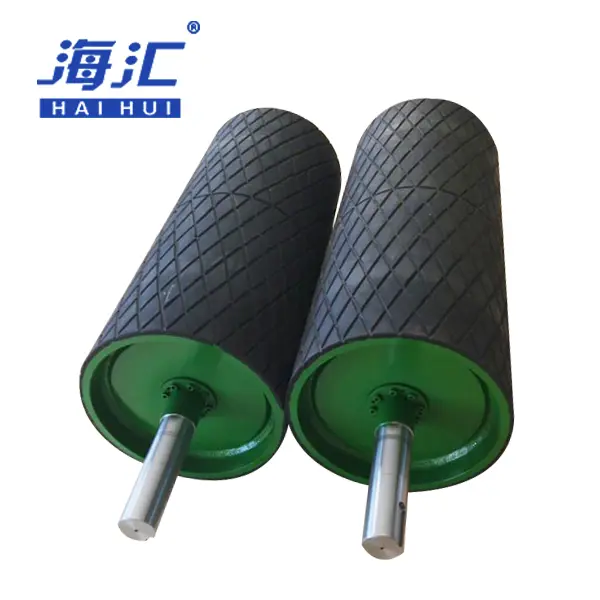
- Lagging pattern—chevron/grooved for wet/muddy conditions, plain for dry, diamond for bidirectional
- Lagging adhesion quality
- Vulcanized vs. cold-bonded application—vulcanized lasts longer but requires more precise process control
- Adhesive system matched to the drum material and operating temperature range
- Peel strength verification—measured, not assumed
- Drum concentricity and runout
- Total indicated runout (TIR) after assembly—tight enough that lagging wears evenly across the face
- Balancing—static or dynamic depending on speed and diameter
- Shaft and bearing integration
- Shaft diameter and material selected for deflection limits under full belt tension
- Bearing housing alignment and sealing strategy
Premium Components: Shafts, Bearings, and Lagging Materials
Good lagged drum pulley systems don’t come from suppliers who “spec by catalog.” They come from shops that size shafts for deflection, select bearings for L10 life, and choose lagging compounds that actually match the application’s grip and wear requirements.
Quick sanity check (from a guy who’s watched a lagging peel off at full load):
- Shaft design: forged steel or high-strength alloy with proper heat treatment—keyways radiused to avoid stress risers, deflection calculated for full belt tension plus starting torque peaks
- Bearing quality: spherical roller bearings with proper sealing for dusty or wet environments—L10 life calculated for your actual load, not nameplate
- Lagging compound: natural rubber for general duty, SBR for abrasion, ceramic for extreme slip and wear, polyurethane for chemical resistance
- Lagging thickness: typically 10–20mm with wear indicators—thick enough to provide grip over the pulley life, not so thick that it creates heat buildup
- Pattern and groove: chevron grooves for water/mud shedding, plain for dry applications, diamond pattern for bidirectional operation
Then the practical bits kick in. A well-balanced drum reduces vibration and bearing wear, while properly adhered lagging transfers torque without slipping or chunking out. ハイフイ tends to spec shaft diameters a step heavier than the minimum calculation—because shaft deflection at the drive pulley means uneven lagging wear and tracking problems that start at the head and never really stop.
Environmental and Safety Realities
Lagged drum pulleys live in dusty, wet, hot, and occasionally corrosive environments. Suppliers who ignore this ship problems, not solutions. ハイフイ typically treats site conditions as design inputs, not afterthoughts.
Environmental design controls:
- Temperature and corrosion
- Lagging compounds rated for ambient temperature range—heat accelerates rubber aging and reduces grip
- Drum coatings that survive humid or chemically aggressive environments
- Lagging adhesion tested at the extremes the site experiences
- Dust and moisture management
- Groove patterns that shed water rather than trap it
- Lagging compounds that resist oil and chemical degradation where relevant
- Sealed bearings to keep grit out
- Noise reduction
- Properly balanced drums reduce vibration and bearing noise
- Lagging patterns that minimize impact noise at the drive
Safety package tied to site-specific regulations:
- Guarding at the nip point—head pulleys are where belts can catch fingers
- Pull-cords and emergency stops within reach
- Lockout/tagout points clearly marked and accessible
- Lagging inspection protocols to identify wear before it becomes a failure
Quality Assurance Through Testing and Documentation
With any lagged drum pulley, the real difference shows in what gets tested before installation—and what gets documented. Suppliers who rush manufacturing usually leave your maintenance team holding the bag when lagging delaminates or wear indicators are ignored.
Project planning that stays grounded:
- Interface control: shaft fit, coupling alignment, drive system integration
- Change log management—”minor tweaks” that snowball into delays
- Risk management: long-lead bearings, specialty lagging compounds, and spare drum lead times
Factory and site quality control:
- Inspection protocols: shaft runout checks, drum concentricity measurements, lagging adhesion peel tests, coating thickness readings, balance verification
- Performance testing: no-load run-in, vibration signature baselines, temperature monitoring on bearings
- Commissioning readiness checklist:
- Lagging condition and surface finish verified
- Bearing temperatures recorded for baseline
- Vibration analysis completed and logged
- Guarding and safety devices confirmed in place
| Test Item | Acceptance Limit | Typical Duration (min) | Record Type |
|---|---|---|---|
| Drum concentricity (TIR) | ≤ 0.5 mm per meter diameter | 20 | Inspection report |
| Lagging adhesion peel strength | ≥ 5 N/mm width | 15 | Adhesion test log |
| Shaft runout at bearing journals | ≤ 0.03 mm | 10 | Inspection sheet |
| Dynamic balance (if speed > 3 m/s) | ≤ G6.3 per ISO 1940 | 30 | Balance report |
| Bearing temperature (stabilized) | ≤ 70°C for grease, ≤ 85°C for oil | 30 | Thermal log |
| Vibration velocity (RMS) | ≤ 4 mm/s | 15 | Vibration signature log |
3 Key Build Factors for a Reliable Lagged Drum Pulley
If you’re evaluating lagged drum pulley systems, long-term reliability comes down to build basics executed properly—not fancy monitoring screens. Here’s what to check on any lagged drum pulley, ハイフイ included.
1. Drum Construction and Concentricity
The steel shell is the foundation—if it’s not round and straight, the lagging wears unevenly and the belt tracks poorly.
- Shell thickness: thick enough to resist deflection under belt tension, but not so heavy that inertia becomes a starting problem
- End disc and shaft connection: fully welded or keyed designs that transfer torque without fatigue cracking
- Shaft material: forged steel or high-strength alloy with proper heat treatment—not generic rolled bar stock
- Shaft deflection: calculated for full belt tension plus starting torque peaks, with safety margin on deflection limits
- Concentricity: total indicated runout (TIR) measured after assembly—tight enough that lagging wears evenly; typically ≤ 0.5 mm per meter of drum face width
- Balance: static balance for low-speed pulleys, dynamic balance for high-speed drives
2. Lagging Compound and Pattern Selection
Lagging is the contact surface that transfers torque to the belt—when it’s wrong, you get slip, edge wear, and unpredictable tracking.
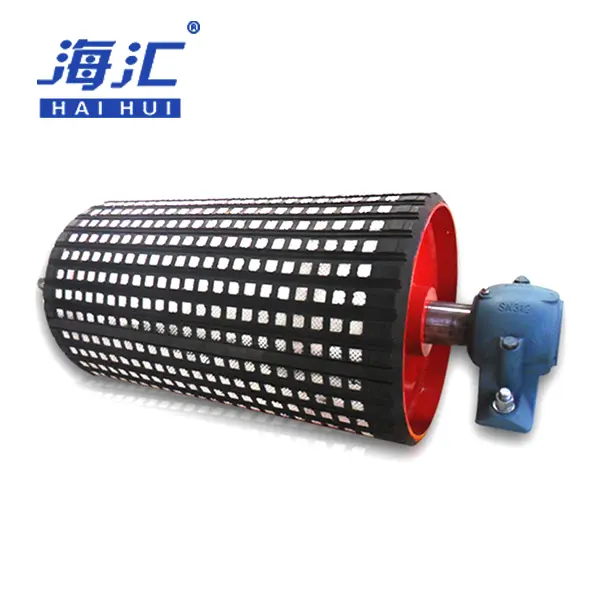
- Ceramic lagging: for high-tension, high-slip applications—excellent grip, long wear life, but must be applied with care and proper adhesive
- Rubber lagging (plain): general purpose for dry applications where grip requirements are moderate
- Rubber lagging (grooved): chevron or herringbone patterns for wet or muddy conditions—grooves shed water and maintain grip
- Rubber lagging (diamond): bidirectional grip for reversing conveyors or applications where belts run both directions
- Thickness: typically 10–20mm with wear indicators—you need to know when to re-lag before you lose grip
- Durometer (hardness): 60–70 Shore A for general duty, harder for high-abrasion, softer for better grip on smooth belts
3. Adhesion Quality and Application Process
The best lagging material is useless if it peels off the drum under load. Adhesion quality is where good suppliers separate themselves from the rest.
- Application method: vulcanized (heat-cured) for highest durability—cold-bonded (adhesive only) for field repairs or lower-duty applications
- Surface preparation: bead blasting or grinding to clean metal—roughness is critical for adhesion
- Adhesive system: matched to operating temperature range and drum material
- Peel strength testing: measured and documented—≥ 5 N/mm width for rubber, ≥ 3 N/mm for ceramic
- Cure verification: time and temperature logs during vulcanization
- Wear indicators: molded into the lagging so you can visually assess remaining useful life
ハイフイ typically treats lagging adhesion as a process-control issue, not a “just glue it on” task. That means documented peel tests and cure logs as standard deliverable.
Lagging Types: What Works Where
In any lagged drum pulley system, the lagging type and pattern must match the operating environment and belt construction. Here’s what works where.
Ceramic Lagging
The go-to for high-slip and high-tension applications where grip is critical.
- Best for: high-tension drives, wet or muddy conditions, high starting torque requirements
- Wear life: typically 3–5 times longer than rubber lagging
- Application: vulcanized with ceramic tiles bonded to rubber base
- Watch-outs: more expensive; requires careful adhesive application; can be brittle under impact
Plain Rubber Lagging
The general-purpose option for dry applications with moderate grip requirements.
- Best for: dry conveyors, lower tension applications, moderate speeds
- Wear life: good, but less than ceramic
- Application: vulcanized or cold-bonded
- Watch-outs: can slip in wet conditions; wear life shorter than ceramic
Grooved/Chevron Rubber Lagging
The option for wet or muddy conditions where water needs to be shed from the contact surface.
- Best for: wet applications, outdoor conveyors, muddy material
- Pattern: chevron (V-shaped) for direction-specific operation, herringbone for bidirectional
- Application: vulcanized for best durability
- Watch-outs: grooves can trap material if not cleaned; pattern wears faster than plain rubber
Diamond Pattern Rubber Lagging
For bidirectional operation where the belt runs both directions.
- Best for: reversing conveyors, shuttles, applications requiring bidirectional grip
- Pattern: diamond or waffle that provides grip in both directions
- Application: vulcanized
- Watch-outs: grip is moderate in both directions; not as good as chevron for directional operation
Bare Steel (Unlagged)
Used where grip is not critical or where material carryback would destroy lagging.
- Best for: low-tension conveyors, tail pulleys, bend pulleys
- Watch-outs: no slip resistance; belt tracking relies entirely on belt tension and crown
Shaft and Bearing Selection for Lagged Drum Pulleys
The shaft and bearings support the drum and must handle belt tension, starting torque, and any shock loading. This is where many lagged drum pulley failures start.
Shaft Design
- Material: 1045 or 4140 steel for general duty, heat-treated alloy for high-tension
- Diameter: calculated for deflection limits—typically 0.001 in (0.025 mm) maximum deflection under load at bearing centers
- Keyways: radiused at corners to reduce stress concentrations; key fit matched to drive coupling
- Threads: where used, rolled vs. cut threads for fatigue resistance
Bearing Selection
- Type: spherical roller bearings for ability to handle misalignment and heavy loads
- L10 life: calculated for your actual load and speed—target at least 30,000 hours
- Sealing: labyrinth seals for dusty environments, contact seals for wet or washdown applications
- Relubrication: grease fittings positioned for access; regrease intervals defined for site conditions
Bearing Housing
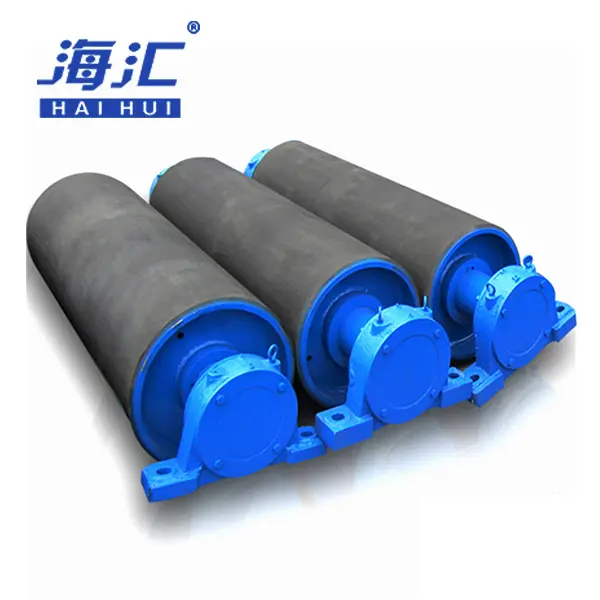
- Type: pillow blocks for standard applications, take-up frames for adjustable pulleys
- Alignment: self-aligning bearings or shim packs for field alignment
- Mounting: grouted or bolted to foundation with proper torque values
Lagging Wear and Replacement Indicators
A lagged drum pulley doesn’t fail suddenly—it gives you warnings if you know where to look. Here’s what to watch.
Visual Indicators
- Wear indicators: molded into the lagging—when they disappear, replacement is due
- Uneven wear: indicates drum concentricity problem or belt tracking issue
- Cracking or chunking: lagging aging or adhesive failure
- Glazing: surface hardening from heat and friction—grip is reduced
Performance Indicators
- Belt slip: the drive is turning but the belt isn’t moving at the expected speed
- Tracking issues: belt drifts to one side at the head pulley
- Increased bearing temperature: uneven loading or misalignment
- Vibration increase: imbalance or bearing wear
Replacement Triggers
- Wear indicator gone: lagging thickness below minimum
- Peeling or delamination: lagging separating from drum—immediate replacement required
- Damage from debris: chunks missing from impact or trapped material
- Loss of grip: belt slips under normal operating conditions
Cost vs. Quality: Lagged Drum Pulley Comparison
When you’re evaluating lagged drum pulley options, the cheapest quote can feel like a win—until poor adhesion, thin shells, or wrong compound choices start eating through your operating budget.
Cost Factors
Cost isn’t just the invoice; it’s a bundle of choices that show up later in downtime, re-lagging frequency, and maintenance labor.
- Manufacturing precision: tight tolerances on drum concentricity and shaft fit cost more upfront but reduce tracking and vibration problems later
- Material quality: forged shafts and high-grade steel drums cost more but handle load cycles better than generic materials
- Lagging quality: properly vulcanized ceramic lagging costs more than cold-bonded rubber but lasts 3–5 times longer
- Adhesion process: documented peel tests and cure logs cost time but prevent delamination
- Balance: dynamic balance costs more but reduces bearing vibration and extends bearing life
Quality Factors
Quality is what keeps a lagged drum pulley from becoming a maintenance headache. A quick, practical checklist:
- Look for consistent lagging adhesion—peeling at the edges is a bad sign
- Verify drum concentricity records—runout means uneven wear and tracking issues
- Check shaft material certifications—not just “it’s steel”
- Confirm lagging compound selection—is it actually rated for your temperature and conditions?
- Request peel strength test results—if the supplier can’t show their work, keep looking
ハイフイ tends to share test records and design calculations upfront. If your shortlisted suppliers hesitate, that hesitation is the signal.
FAQs about Lagged Drum Pulleys
1) What is a lagged drum pulley used for?
A lagged drum pulley is a drive pulley with a rubber or ceramic covering (lagging) that improves grip between the pulley and the conveyor belt. It’s used on drive heads to transfer torque from the motor to the belt without slipping.
2) What’s the difference between ceramic and rubber lagging?
Ceramic lagging is more durable and provides excellent grip in high-slip and wet conditions, but costs more and requires more careful application. Rubber lagging is more economical for dry, moderate-duty applications but wears faster and has lower grip in wet conditions.
3) How often should I replace lagging on a drum pulley?
Replace lagging when wear indicators are gone, when lagging thickness drops below minimum (~5–8mm depending on type), or when you lose grip and slip becomes frequent. For ceramic lagging, this can be 5–10 years; for rubber, 2–5 years depending on duty.
4) What lagging pattern should I use?
- Plain rubber: dry applications with moderate grip needs
- Chevron/grooved: wet or muddy conditions where water needs to shed
- Diamond: bidirectional operation where belt runs both ways
- Ceramic: high-tension, high-slip, or severe duty
5) What testing should be included for a new lagged drum pulley?
Commissioning checks should include:
- Concentricity measurement: drum runout within specification
- Adhesion peel test: ≥ 5 N/mm width for rubber
- Balance verification: static or dynamic as required
- Bearing temperature: baseline recorded
- Vibration signature: baseline for comparison
- Guard and safety device confirmation
Brought to you with a dose of shop-floor realism and the understanding that a lagged drum pulley isn’t a commodity—it’s the critical interface between your drive motor and your belt. Choose the right lagging type, verify adhesion quality, balance it properly, and keep your material moving without slip surprises.

 English
 العربية
 简体中文
简体中文 Nederlands
 Français
 Deutsch
 Bahasa Indonesia
 Italiano
 日本語
日本語 한국어
한국어 Bahasa Melayu
 Polski
 Português do Brasil
 Русский
 Español
 Türkçe