Rubber Lagging Drive Pulley:CEMA & MSHA Compliance Guide
- 5 Surprising Benefits Of Rubber Lagging Drive Pulleys
- Rubber Lagging Drive Pulley Vs. Plain Steel Pulley
- 3 Drawbacks Of Plain Steel Drive Pulleys
- Are Rubber Lagging Drive Pulleys More Cost-Effective?
- Avoid Belt Slip: Switch To Rubber Lagging Drive Pulleys
- Workshop Organization: Stackable Pulley Storage
- FAQs about Rubber Lagging Drive Pulley
- Ready to Make the Switch to Rubber Lagging?
- References
Rubber lagging drive pulleys beat plain steel when traction stakes get real. Belt slip, edge wear, and costly downtime add up fast. Rubber lagging keeps its grip and conveyor cool.
According to Smithers’ 2025 bulk handling report, rubber lagged pulleys are capturing market share in mining and aggregate due to strict safety mandates and rigorous uptime standards. Switching protects belt life and production compliance, pulling operations out of the slip-and-wear panic for good.
5 Surprising Benefits Of Rubber Lagging Drive Pulleys
These rubber lagging drive pulleys are engineered to protect conveyor belts, resist moisture and abrasion, and stabilize belt tracking. From quarry drive pulleys to aggregate head pulleys, the technical benefits heavily outweigh plain steel alternatives.
Superior Traction with Vulcanized Rubber Lagging
For rubber lagging drive pulleys, traction control is engineered at the microscopic level:
Steel Shell Base Layer
- Provides high-tensile structural strength and concentricity
- Supports long-term protection against bending and impact stress
Rubber Lagging System
- Acts as a high-friction traction interface (coefficient 0.4-0.5)
- Blocks belt slip under high torque or wet conditions
- Reduces belt cover wear from repetitive start-stop cycles
- Enhances grip on inclined or reversing conveyors
Groove Pattern (Herringbone/Plain)
- Improves water shedding in wet conditions
- Herringbone grooves channel moisture to pulley edges
- Extends effective grip life of the drive pulley
This combination of rubber, bond, and groove pattern ensures rubber lagging drive pulleys remain uncompromised across prolonged high-torque cycles.
Precise Concentricity in Fabricated Shells
Precision fabrication eliminates structural weak points.
Shell Forming
- Rolled steel plate (S355) with full-penetration welds
- Supports exact uniformity in wall thickness and roundness
Machined Geometry
- Maintains tight dimensional accuracy (≤0.5 mm TIR face runout)
- Consistent diameter and face width
- Improves belt tracking on lagged surfaces
Manufacturing Controls
- Automated NDT weld inspection for millimeter precision
- Consistent fabrication workflow
This precise construction guarantees that rubber lagging drive pulleys track true and transfer torque evenly.
Enhanced Durability from Shell Welding and Lagging Bond
Industrial strength is built through progressive manufacturing:
Metal Forming Process
- Shell rolling shapes the cylinder under precise pressure
- Reinforces concentricity against belt tension
Lagging Vulcanization
- Creates continuous, bonded rubber-to-steel interface
- Increases traction durability and impact resistance
Structural Performance
- Improved load-bearing construction
- Superior bond retention (≥12 N/mm peel strength)
- Higher torque tolerance without slip
Through controlled manufacturing process design, these rubber lagging drive pulleys deliver unparalleled grip under conveyor stress.
Improved Belt Life via Proper Durometer Selection
A proper rubber durometer extends belt viability.
Rubber Compound
- 60-75 Shore A durometer for optimal grip and wear balance
- Functions as a traction interface against belt cover
- SBR or natural rubber for general purpose; neoprene for oil resistance
Preservation Mechanism
- Protects belt cover from premature wear
- Supports longer belt life (often extending 2-4 years in aggregate)
Grip Protection
- Reduces belt-to-pulley slip
- Stabilizes belt tracking under varying loads
This protective lagging ensures belts driven by rubber lagging pulleys retain their original cover thickness and tracking stability.
High Torque Capacity and Traction Testing Reliability
Drive pulley safety requires certified verification.
Torque Validation
- Confirms grip under peak starting torque (up to 200% running torque)
- Measures slip resistance under thermal load
Traction Testing
- Checks bond integrity
- Groove depth and pattern
- Ensures true slip-free power transmission
Quality Control Protocols
- Repeated torque cycle testing
- Field-focused traction reviews
Through stringent traction testing, rubber lagging drive pulleys deliver consistent reliability from the factory to the quarry.
🛠️ Ready to upgrade your conveyor drive? With over 15 years of manufacturing expertise and 100% bond testing, 海辉 delivers premium rubber lagged pulleys engineered for industrial traction. Explore our full range of sizes from 500mm to 1600mm diameter today!
Rubber Lagging Drive Pulley Vs. Plain Steel Pulley
When wet conditions, high torque, and belt tracking compliance enter the equation, the performance gap between rubber lagged and plain steel pulleys is undeniable.
Rubber Lagging Drive Pulley
Buyers sourcing rubber lagging drive pulleys prioritize three functional tiers:
Material Performance
- Core Build – Fabricated steel shell with vulcanized rubber lagging
- Durability – Engineered for maximum traction under wet or dry conditions
- Protection – Rubber provides friction (0.4-0.5 vs. steel 0.1-0.2 wet)
Operational Reliability
- Belt Protection – Guarantees longer belt cover life
- Slip Prevention – Eliminates power loss from belt slippage
Structural Integrity
- Lagging bond strength neutralizes detachment risks
- Groove pattern maintains grip in wet conditions
Reuse and Compliance
- Industrial Handling – Rated for high-torque starts under strict safety laws
- Lifecycle Value – Re-laggable after rubber wears
From crusher feeders to overland conveyors, rubber lagging drive pulleys hold their grip, keeping belts moving and product flowing.
Plain Steel Pulley
Plain steel pulleys offer lower upfront cost, but their traction limits are severe:
Material Traits
- Composition – Bare steel or painted surface
- Handling – Basic friction for dry, low-torque applications
Functional Limits
- Wet Conditions – Friction coefficient drops to 0.1-0.2, causing slip
- High Torque – Belt slip under starting load
Use Context
- Dry, clean applications – Works fine for light duty
- Wet or inclined conveyors – Slips, causing belt wear and spillage
For light duty, plain steel suffices. But against wet conditions and high torque, rubber lagging drive pulleys win decisively.
3 Drawbacks Of Plain Steel Drive Pulleys
Many operations switching back to rubber lagging do so after experiencing catastrophic belt slip and wear.
Poor Traction in Wet or Muddy Conditions
Traction is paramount for inclined or outdoor conveyors. Steel inherently fails here.
Traction risks
- Friction coefficient drops from 0.4-0.5 (dry) to 0.1-0.2 (wet)
- Belt slip causes cover wear and power loss
- Gradual slip leads to belt edge damage
Slip consequences
- Material spillage at load zones
- Premature belt cover wear
- High cross-contamination risk from spillage
Why buyers shift to rubber lagging
- Rubber maintains 0.4-0.5 friction even in damp conditions
- Herringbone grooves shed water
- Consistent grip and tracking control
Brands like 海辉 engineer rubber lagging because operations dealing with wet aggregate or outdoor conveyors demand absolute traction stability.
Belt Cover Damage from Slip
Belt slip grinds cover material. Under high starting torque, slip accelerates.
Slip dynamics
- Belt slips, cover abrades against steel
- Heat from friction degrades rubber cover
- Cover thickness reduces, exposing carcass
Structural consequences
- Premature belt replacement (6-12 months vs. 3-5 years)
- Edge fraying from off-tracking
- Compressed belt life expectancy
Operational impact
- Expensive emergency belt changes
- Unscheduled downtime during peak season
- Higher maintenance labor costs
Conversely, rubber lagging drive pulleys maintain grip. Rubber resists slip, protecting belt cover. 海辉 designs its lagged pulleys to hold ISO traction standards despite wet or high-torque conditions.
Lack of Regulatory Compliance for Inclined Conveyors
For inclined or high-torque conveyors, regulatory compliance is legally binding.
Safety standards
- CEMA torque and traction requirements
- MSHA slip prevention for underground coal
- OSHA guarding standards
Belt-specific controls
- Mandatory anti-slip devices
- Torque verification testing
- Zero slip under starting load
Legal exposure
- Failed safety inspections
- Fines or conveyor shutdown orders
- Voided insurance policies
Most plain steel pulleys instantly fail traction-based legal requirements for inclined or wet conveyors. This makes rubber lagging drive pulleys the default for regulated mining and aggregate markets. 海辉 packaging aligns perfectly with global compliance benchmarks.
📦 Don’t compromise on conveyor safety. 海辉 manufactures CEMA, MSHA, and ISO-compliant lagged pulleys designed to conquer wet and inclined applications. Need a specific durometer, groove pattern, or custom shaft? Discover our customization services and let our expert team build a tailored solution in just 24 hours.
Are Rubber Lagging Drive Pulleys More Cost-Effective?
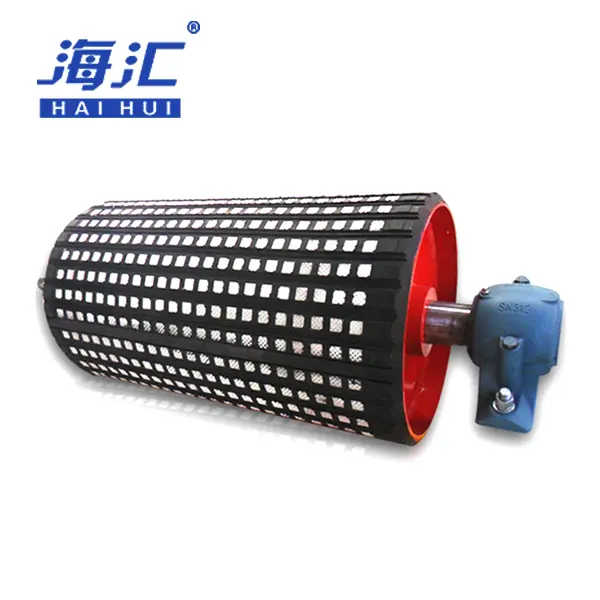
Rubber lagging drive pulleys dictate industrial uptime through extended belt life and reduced downtime.
Lifecycle Analysis: Steel Shell and Rubber Lagging
A strict lifecycle analysis highlights why rubber lagging dominates mining and aggregate.
Materials Extraction Phase
- Raw materials sourcing – Steel plate for shell, rubber compound for lagging
- Environmental assessment – Energy intensity of steel making; rubber from petroleum or natural sources
Manufacturing and Use
- Forming pulleys – High durability, outlasts plain steel pulleys 3-5x in wet conditions
- Reuse as re-lagged pulleys – Shell can be re-lagged multiple times
End-of-Life Recycling
- Established steel recycling systems
- Melting and reprocessing – Steel retains 100% strength
- Rubber can be recycled or used as tire-derived fuel
Because steel is infinitely recyclable without degradation, 海辉 designs rubber lagging pulleys specifically for this circular economy, bypassing landfills entirely.
Reduced Belt Replacement Costs through Slip Prevention
Minimizing belt slip directly impacts plant operating costs and uptime.
Key practices include:
- Proper lagging durometer selection (60-75 Shore A)
- Herringbone groove pattern for wet conditions
- Regular bond inspection (≥12 N/mm peel strength)
The efficient process:
- Specify correct lagging for environment (wet/dry).
- Apply vulcanized lagging with proper cure cycle.
- Inspect bond and groove condition annually.
★ Superior lagging means longer belt life. Because rubber lagging pulleys prevent slip, they protect the belt from premature wear, drastically cutting replacement frequency.
CEMA Certification Benefits of Lagged Pulleys
For international mining and aggregate, CEMA certification elevates lagged pulleys above plain steel.
Regulatory Framework
- Strict CEMA torque and traction standards
- MSHA, OSHA guarding requirements
Safety Advantages
- High traction coefficient in wet conditions
- Absolute slip prevention
- Lab-tested bond strength
Sustainability Gains
- Longer service life reduces steel consumption
- Elimination of premature belt replacement waste
- Drastically reduced unplanned downtime
海辉 ensures its rubber lagging drive pulleys meet these strict certifications, granting operations legal compliance and uptime efficiency simultaneously.
Avoid Belt Slip: Switch To Rubber Lagging Drive Pulleys
Material choice dictates friction behavior. When operations switch to rubber lagging drive pulleys, the traction performance is immediately apparent.
Rubber Lagging vs. Steel Permeability (to Slip)
When testing rubber lagging against plain steel, field data reveals the vast superiority of rubber lagged pulleys.
| Material Type | Friction Coef. (Wet) | Slip Rate (%) | Traction Level | Typical Use |
|---|---|---|---|---|
| Plain Steel | 0.1-0.2 | 8-12 | Poor | Dry, light duty |
| Painted Steel | 0.15-0.25 | 6-10 | Low | Indoor, intermittent |
| Rubber Lagging (Plain) | 0.35-0.45 | 1-3 | Good | General purpose |
| Rubber Lagging (Herringbone) | 0.40-0.50 | 0.5-1.5 | Very High | Wet/muddy conditions |
| Ceramic Lagging | 0.50-0.60 | <0.5 | Excellent | Extreme wet/ice |
- Near-zero slip guarantees flawless torque transfer.
- Maximum friction prevents power loss from belt slippage.
- Grip stability secures belt tracking indefinitely.
This material comparison proves why rubber lagging drive pulleys lock in traction while plain steel pulleys “slip” and degrade.
Bond Integrity and Traction Performance
In pulley construction, bond engineering is the final defense against lagging detachment.
- Precision shell preparation ensures clean bonding surface.
- Vulcanized bonding permanently fuses rubber to steel.
- Peel testing confirms adhesion strength (≥12 N/mm).
- Vacuum tests confirm bond integrity.
Inside a premium lagged pulley:
- Bond integrity guarantees a permanent rubber-to-steel interface.
- Reinforced edges maximize grip longevity.
- Finished pulleys block 100% of belt slip.
Long-Term Traction with Grooved Lagging
Grooved rubber lagging on drive pulleys is engineered for wet-condition grip.
- Herringbone geometry optimally channels water to pulley edges.
- Precision-machined grooves ensure water shedding.
- Grooved rubber utterly resists hydroplaning.
For inventory control:
- Consistent groove depth secures long-term wet grip.
- Groove geometry guarantees water evacuation.
- Impenetrable water barrier maximizes traction longevity.
Workshop Organization: Stackable Pulley Storage
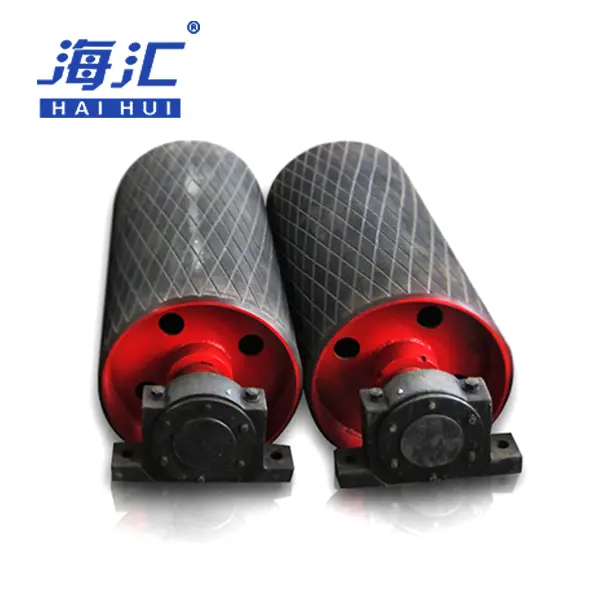
Smart organization relies on structural predictability. Rubber lagging drive pulleys are mathematically designed for safe, high-density warehousing.
Optimizing Storage: Diameter and Face Width Selection
High-efficiency storage for rubber lagging pulleys requires three specifications:
Size & Weight Control
- Pulley diameter dictates storage footprint.
- Larger diameters require vertical storage or cradles.
- Tuned dimensions prevent rolling damage.
Cylindrical Storage Planning
- A true cylinder should be stored on flat, padded supports.
- Cradles prevent flat-spotting the rubber lagging.
- Standardized diameters align perfectly with pallet racks.
Performance Reference Data
| Diameter (mm) | Face Width (mm) | Weight (kg) | Storage Method |
|---|---|---|---|
| 500 | 800 | 300 | Pallet, padded |
| 800 | 1000 | 600 | Cradle or rack |
| 1000 | 1200 | 900 | Cradle only |
| 1200 | 1400 | 1300 | Cradle, fork pockets |
Warehouses utilize proper cradles for larger pulleys. The right storage ensures lagging remains undamaged.
Space-Saving with Vertical Storage Racks
Efficient warehouse footprinting relies on vertical storage:
Structural Layers
- Heavy-duty steel cradles
- Padded contact surfaces
- Labeled identification
Stacking Mechanism
- Cradles nest securely.
- Direct weight transfer maximizes space.
- Vertical racks eliminate lateral shifting.
Operational Benefits
- Drastic space-saving metrics in dense warehouses.
- Maximized storage efficiency.
- Requires minimal floor space.
海辉 engineers ensure its rubber lagging drive pulleys nest securely in cradles, locking in place to maximize vertical airspace.
Easy Identification via Tags and Labels
Fast identification eliminates workflow bottlenecks.
- Engraved tags with size and date.
- Color-coded labels for durometer and groove pattern.
- QR codes link to manufacturing batch records.
In practice:
- Color-code by durometer (60, 65, 70 Shore A).
- Print high-contrast size markers.
- Apply abrasion-resistant tags.
Proper identification streamlines warehouse operations. 海辉‘s advanced tracking ensures rubber lagging drive pulleys maintain flawless traceability despite heavy industrial handling.
FAQs about Rubber Lagging Drive Pulley
Why are rubber lagging drive pulleys preferred over plain steel for industrial conveyors?
Rubber lagging drive pulleys made from steel shells with vulcanized rubber offer traction and belt protection plain steel cannot achieve.
- Higher friction coefficient (0.4-0.5 vs. 0.1-0.2 wet)
- Better belt cover protection via slip prevention
- Stable traction preventing belt damage
- Full compliance with CEMA, MSHA, and OSHA regulations
How does rubber lagging protect the conveyor belt?
The rubber lagging chemically grips the belt cover.
- Creates a high-friction interface preventing slip.
- Prevents cover abrasion from steel contact.
- Maximizes belt life in wet or high-torque applications.
What manufacturing processes strengthen OEM drive pulleys?
Industrial strength is built into the fabrication:
- Shell rolling shapes precise, concentric bodies
- Full-penetration welding of end plates
- Vulcanization bonds rubber to steel
- Dynamic balancing ensures smooth running
| Control Method | Purpose | Result |
|---|---|---|
| Bond testing | Verify rubber-to-steel adhesion | No tile/lagging loss |
| Traction testing | Validate slip resistance under load | Reliable power transmission |
| Concentricity scan | Optically inspect face runout | Smooth belt tracking |
Why are grooved patterns and durometer critical for safety?
Rubber lagging acts as an engineered traction and water-shedding system.
- A herringbone groove channels water to pulley edges
- Proper durometer (60-75 Shore A) balances grip and wear
- Groove depth (6-10mm) sheds moisture in wet conditions
- Vulcanized bond prevents lagging detachment
This architecture easily meets rigid CEMA traction storage and handling requirements.
Ready to Make the Switch to Rubber Lagging?
Stop losing production to belt slip and premature cover wear. For over 15 years, 海辉 has been a trusted leader in mining and aggregate pulleys. Whether you need standard rubber lagged drive pulleys or fully customized designs with specialty durometers or groove patterns, we offer flexible MOQs with rapid sampling.
🚀 Contact Haihui today for a 1-day solution proposal, or visit our homepage to learn more about our CEMA-certified, high-traction pulley options.
References
- Smithers’ 2025 bulk handling report – smithers.com
- CEMA standards for lagging – cemanet.org
- ISO concentricity tolerances – iso.org
- MSHA slip prevention – msha.gov
- Vulcanized bond testing – rubbernews.com
- Aggregate conveyor applications – aggman.com
- Rubber abrasion (DIN 53516) – astm.org
- Thermal expansion of rubber – engineeringtoolbox.com
 English
 العربية
 简体中文
简体中文 Nederlands
 Français
 Deutsch
 Bahasa Indonesia
 Italiano
 日本語
日本語 한국어
한국어 Bahasa Melayu
 Polski
 Português do Brasil
 Русский
 Español
 Türkçe