Premium Guide Roller for Belt Conveyor Applications
- Core Functions of Guide Roller for Belt Conveyor
- Main Types of Guide Roller for Belt Conveyor
- Guide Roller Performance & Scenario Comparison Table
- 4 Core Classification Standards for Guide Roller for Belt Conveyor
- Common Wrong Selection & Matching Solutions for Guide Roller
- Step-by-Step Selection Guide for Guide Roller for Belt Conveyor
- FAQs about Guide Roller for Belt Conveyor
A high-performance belt conveyor system relies not only on motors and belts but also on tiny yet critical components: guide rollers for belt conveyor. Many factory operators overlook the value of standard guide rollers, mistakenly believing that all rollers deliver identical performance. In reality, mismatched or low-quality guide rollers cause frequent belt deviation, abnormal wear, loud operating noise, unplanned downtime, and even shortened belt service life. As a professional industrial conveyor manufacturer, Haihui has summarized years of on-site operation experience to systematically explain the core functions, mainstream types, structural advantages, and scientific selection rules of guide roller for belt conveyor.
2026 global industrial conveyor operation reports show that more than 70% of belt conveyor deviation and wear failures stem from unreasonable guide roller matching or aging roller performance. Standardized selection and regular maintenance of guide roller for belt conveyor can effectively reduce conveyor failure rates, extend belt service life by 30%–50%, and cut long-term equipment maintenance costs for enterprises.
Investing in high-quality, scenario-matched guide roller for belt conveyor is a low-cost, high-return optimization for stable and efficient conveyor operation.
Core Functions of Guide Roller for Belt Conveyor
Guide rollers are the core guiding and supporting components of belt conveyors. Unlike ordinary load-bearing rollers, guide roller for belt conveyor focuses on directional correction, stable limit, and operational protection. It solves common pain points such as belt wandering, offset friction, and unstable operation during long-distance and high-speed conveying. Each functional design targets actual industrial operation problems to stabilize the overall conveying system.
1. Precise Belt Deviation Correction
Belt deviation is the most common fault in conveyor operation, easily caused by uneven material feeding, equipment vibration, and uneven rack stress. Professional guide roller for belt conveyor adopts optimized curved and tapered structural design, which can automatically sense belt offset and generate directional correction tension. It continuously pulls the deviated belt back to the center position without manual intervention, ensuring linear and stable belt operation.
This core function avoids long-term unilateral friction between the belt and the rack, effectively preventing belt edge wear, tearing, and aging damage, and greatly reduces the risk of sudden shutdown caused by belt deviation.
2. Stable Limit & Operational Positioning
During high-speed operation, material impact and equipment vibration will cause lateral displacement of the belt. The guide roller for belt conveyor is installed on both sides of the conveyor belt to form a stable limit structure. It restricts the lateral movement range of the belt, ensures consistent conveying track, and avoids material spilling and scattering caused by belt offset.
For inclined conveying, curved conveying, and long-distance horizontal conveying scenarios, the limit positioning function of guide rollers is particularly critical, which can maintain the stable running posture of the belt under complex working conditions.
3. Reduce Friction & Lower Operating Noise
High-quality guide roller for belt conveyor is equipped with high-precision bearings and smooth anti-wear surface. It replaces hard friction between the belt and the rack with flexible rolling friction, greatly reducing operating resistance. While saving motor power consumption, it effectively lowers operating noise and realizes low-noise and energy-saving operation of the conveyor.
Haihui’s polished guide roller surface avoids scratch damage to the belt, further optimizing the overall operating smoothness of the conveying system.
4. Protect Conveyor Structure & Extend Service Life
Long-term belt deviation and friction will cause irreversible damage to the conveyor frame, rollers, and belt body. The guide roller for belt conveyor bears and buffers lateral friction stress, protects the main structure of the conveyor from abnormal impact and friction, reduces component loss, and comprehensively extends the overall service life of the conveyor equipment.
Main Types of Guide Roller for Belt Conveyor
According to structural design, functional positioning, material characteristics, and applicable working conditions, guide roller for belt conveyor has a complete industrial classification. Different types of guide rollers have obvious differences in correction ability, limit effect, wear resistance, and service scenarios. Selecting targeted types according to actual working conditions is the key to giving full play to the guiding performance. Below are the six most practical mainstream types.
1. Tapered Guide Roller
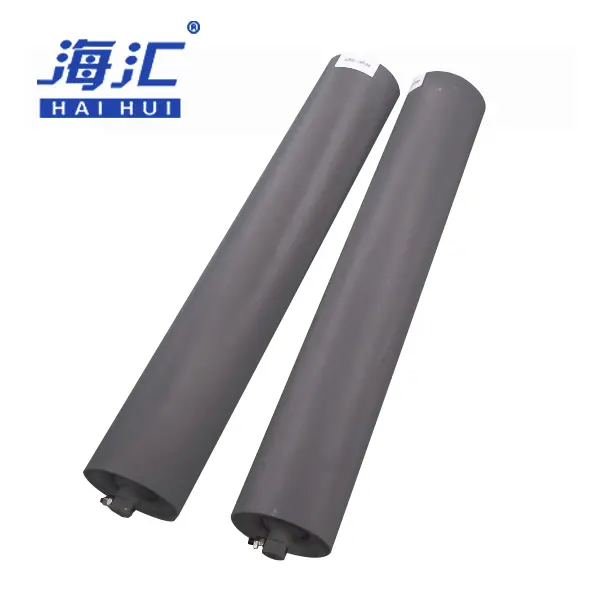
Tapered guide roller is the most widely used universal type of guide roller for belt conveyor. It adopts a symmetrical tapered structure with thickened middle and thin ends, featuring automatic centering and passive correction functions. It is suitable for most conventional light and medium-duty belt conveyors.
Structural Advantages
Integrated tapered forming design, no complex assembly parts. The roller surface is uniformly stressed, with flexible rotation and sensitive correction response. It can automatically adapt to slight belt offset and realize real-time centering adjustment.
Applicable Scenarios
Factory assembly line conveyors, logistics sorting conveyors, food and pharmaceutical light-duty conveying equipment, and conventional horizontal belt conveyor systems.
Performance Characteristics
Low operating resistance, low noise, stable correction effect, and cost-effective. It is the standard matching accessory for daily conventional conveyor maintenance and replacement.
Haihui’s tapered guide rollers adopt one-piece casting and fine polishing technology, with uniform taper and stable correction performance, avoiding jamming and insensitive adjustment.
2. Curved Guide Roller
Curved guide roller for belt conveyor is professionally designed for curved conveying and large-angle offset working conditions. The integral arc structure fits the belt operation track perfectly, solving the problem of difficult correction and easy deviation of the belt during turning and inclined conveying.
Structural Advantages
Smooth arc transition design, no sharp corners or edges. It fits the bending radian of the belt during operation, realizes seamless fitting guidance, and avoids local stress concentration and belt scratching.
Applicable Scenarios
Curve belt conveyors, closed-loop circulating conveying lines, multi-angle turning conveying systems, and workshop space-limited special conveying equipment.
Performance Characteristics
Strong adaptive ability for curved tracks, stable limit effect, and no belt slipping. It effectively solves the long-term deviation problem of turning conveyors.
Haihui customizes arc radian according to customer equipment parameters to ensure 100% matching with on-site conveyor operation track.
3. Heavy-Duty Mining Guide Roller
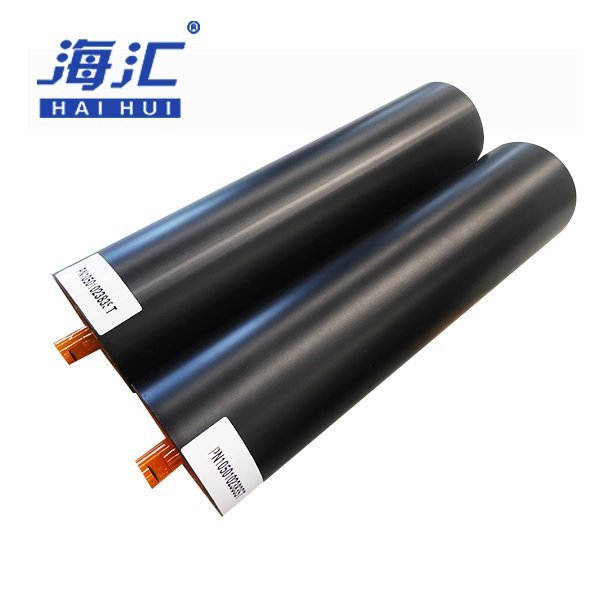
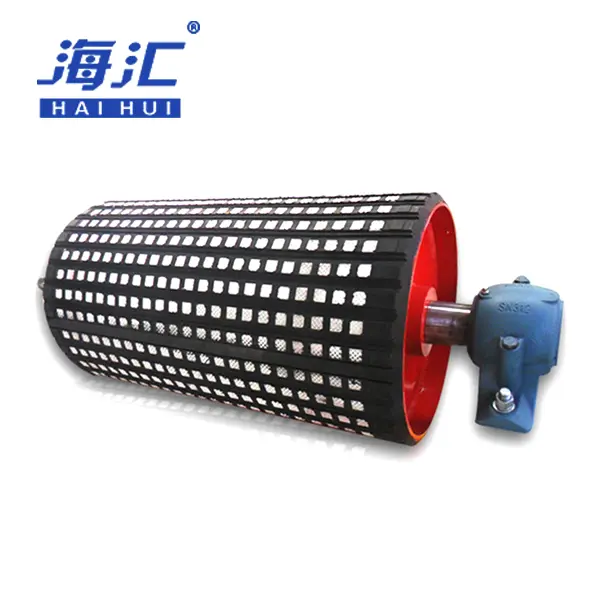
Heavy-duty mining guide roller is a reinforced customized type of guide roller for belt conveyor, tailored for harsh working conditions such as mines, quarries, cement plants, and ports. It focuses on impact resistance, wear resistance, and dust-proof and anti-corrosion performance.
Structural Advantages
Thickened steel pipe matrix + reinforced bearing structure, with strong impact resistance and pressure resistance. Equipped with multi-layer sealing device, it can effectively isolate dust, mud, and moisture, preventing bearing jamming and roller stuck.
Applicable Scenarios
Mining belt conveyors, port bulk cargo conveying equipment, building material heavy-duty conveying lines, and high-dust and high-load industrial conveying systems.
Performance Characteristics
Super wear-resistant, anti-corrosion, dust-proof, and long service life. It can operate stably for a long time in harsh environments without frequent maintenance.
Haihui’s heavy-duty guide rollers adopt mine-standard sealing technology, which greatly reduces failure rate in high-dust and humid working conditions.
4. Rubber-Coated Guide Roller
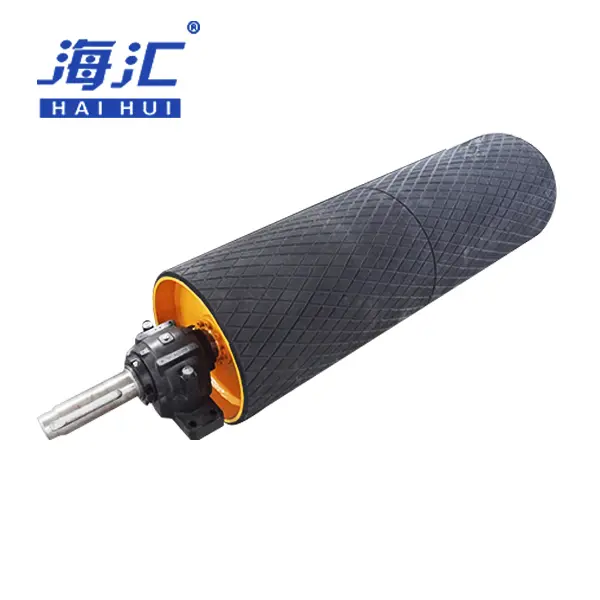
Rubber-coated guide roller for belt conveyor is a protective optimized type, with a layer of high-elastic wear-resistant rubber wrapped on the metal roller surface. It focuses on protecting the belt while realizing guiding and correction functions.
Structural Advantages
The rubber coating layer has high friction and buffer performance. It increases the fitting friction with the belt, improves correction efficiency, and avoids hard friction and scratch damage to the belt surface.
Applicable Scenarios
Food processing, electronic precision parts conveying, lightweight packaging product conveying, and scenarios requiring high belt protection.
Performance Characteristics
Anti-slip, shock-absorbing, low noise, and belt-friendly. It effectively reduces belt wear and prolongs the service life of lightweight conveyor belts.
Haihui uses high-elastic anti-aging rubber coating, which is not easy to peel and age, maintaining long-term stable anti-slip and protective performance.
5. Stainless Steel Anti-Corrosion Guide Roller
Stainless steel guide roller for belt conveyor is a special anti-corrosion customized type, made of 304/316 stainless steel material, solving the corrosion and rust problems of guide rollers in humid and corrosive environments.
Structural Advantages
Integral stainless steel forming, no rust, no oxidation. The surface is smooth and easy to clean, with excellent acid and alkali corrosion resistance.
Applicable Scenarios
Food and pharmaceutical clean workshops, chemical corrosive material conveying, aquatic product processing humid environment conveying, and outdoor open-air conveying equipment.
Performance Characteristics
Corrosion-resistant, high-temperature resistant, clean and hygienic, no residual dirt, meeting clean production standards.
Haihui’s stainless steel guide rollers have fine polished surface, no dead corners, easy to clean and maintain, fully adapting to high-cleanliness production scenarios.
6. Adjustable Guide Roller
Adjustable guide roller for belt conveyor is a flexible functional type with adjustable installation position and angle. It can adapt to different belt widths and offset degrees, realizing personalized guiding adjustment.
Structural Advantages
Equipped with adjustable fixed bracket and angle locking structure. Workers can fine-tune the roller position and angle according to on-site belt deviation conditions, with flexible operation and strong adaptability.
Applicable Scenarios
Multi-model mixed production conveying lines, frequently adjusted process lines, and conveying equipment with unstable belt operation status.
Performance Characteristics
Strong flexibility, wide adaptation range, one-time installation and multi-scene adjustment, reducing equipment modification costs.
Haihui’s adjustable guide rollers adopt precise locking structure, no displacement after adjustment, ensuring long-term stable guiding effect.
Guide Roller Performance & Scenario Comparison Table
Different types of guide roller for belt conveyor have obvious differences in material performance, correction capability, environmental adaptability, and service life. The following comparison table intuitively sorts out the core parameters and applicable scenarios of all mainstream models, helping users quickly complete accurate model selection and avoid mismatching failures.
| Guide Roller Type | Core Performance Advantage | Main Material | Adaptable Working Condition | Service Life Feature |
| Tapered Guide Roller | Automatic centering, sensitive correction | Carbon Steel | Conventional light & medium-duty conveying | Stable daily service, low maintenance |
| Curved Guide Roller | Perfect fit for curved track, no belt scratch | High-precision Carbon Steel | Curve & closed-loop conveying lines | Long-term stable turning operation |
| Heavy-Duty Mining Guide Roller | Impact-resistant, dust-proof, anti-corrosion | Thickened Alloy Steel | Mine, port, building material harsh scenarios | Ultra-long service life in harsh environments |
| Rubber-Coated Guide Roller | Anti-slip buffer, belt protection | Carbon Steel + Rubber Coating | Precision & fragile material conveying | Reduce belt loss, extend belt life |
| Stainless Steel Guide Roller | Anti-corrosion, clean and hygienic | 304/316 Stainless Steel | Clean workshop & corrosive environment | No rust, stable long-term use |
| Adjustable Guide Roller | Flexible angle adjustment, wide adaptability | High-strength Carbon Steel | Variable process & multi-scene mixed production | One-time installation, multi-scene reuse |
All Haihui guide rollers are produced with standardized processes and can be customized in size, material, and structure according to customer on-site working conditions, ensuring zero mismatch with the conveyor system.
4 Core Classification Standards for Guide Roller for Belt Conveyor
Many users confuse the types of guide roller for belt conveyor and cannot accurately select matching products. Industrial guide rollers have clear classification dimensions. Mastering the following four classification standards can quickly clarify selection logic and avoid blind procurement.
1. Classification by Structural Function
Divided into fixed correction type, limit positioning type, and adjustable flexible type. Fixed type is suitable for stable conventional production lines; limit type focuses on anti-deviation and anti-spilling; adjustable type adapts to variable working conditions with frequent process changes.
2. Classification by Load Working Condition
Including light-duty, medium-duty, and heavy-duty types. Light-duty guide rollers match food, electronics, and logistics lightweight conveying; medium-duty types adapt to general industrial production; heavy-duty types are specially used for mine and port high-load bulk material conveying.
3. Classification by Manufacturing Material
Covering ordinary carbon steel, alloy steel, rubber-coated composite, and stainless steel materials. Different materials determine the wear resistance, corrosion resistance, impact resistance, and environmental adaptability of guide rollers.
4. Classification by Application Environment
Divided into conventional environment type, high-dust anti-dust type, humid anti-corrosion type, and clean sanitary type. Targeted environmental adaptation design ensures stable operation of guide rollers in different complex scenarios.
Common Wrong Selection & Matching Solutions for Guide Roller
Most conveyor belt deviation, wear, and noise faults are caused by wrong selection of guide roller for belt conveyor, not equipment quality problems. Summarizing common wrong matching cases helps enterprises avoid operation losses and maintenance troubles.
Wrong Selection 1: Ordinary carbon steel guide rollers for corrosive environments
Ordinary carbon steel guide rollers are prone to rust and oxidation in humid and chemical corrosive environments, leading to roller jamming, belt scratching, and reduced correction effect. Solution: Adopt 304/316 stainless steel guide rollers for corrosive and humid scenarios to ensure long-term anti-rust and anti-corrosion performance.
Wrong Selection 2: Light-duty guide rollers for heavy-load mining working conditions
Light-duty guide rollers have insufficient impact resistance and structural strength, which are easily deformed and damaged under long-term heavy material impact, losing guiding and correction functions. Solution: Match professional thickened heavy-duty mining guide rollers to adapt to high-load and high-impact working conditions.
Wrong Selection 3: Hard metal guide rollers for precision belt conveying
Hard metal rollers are easy to cause hard friction and scratch damage to fragile lightweight belts, shortening belt service life. Solution: Choose rubber-coated buffer guide rollers to protect the belt while ensuring guiding effect.
Wrong Selection 4: Fixed straight rollers for curved conveying lines
Ordinary straight guide rollers cannot fit the curved operation track, resulting in poor correction effect and frequent belt deviation at turning positions. Solution: Special curved guide rollers are required for curved conveying lines to realize track fitting guidance.
Step-by-Step Selection Guide for Guide Roller for Belt Conveyor
Scientific selection of guide roller for belt conveyor needs to comprehensively consider equipment parameters, material characteristics, working environment, and operational demands. Haihui summarizes a set of practical on-site selection steps for industrial buyers to realize accurate matching.
Step 1: Confirm conveyor basic parameters
Clarify belt width, conveying speed, equipment type (horizontal, inclined, curved), and daily operating hours to determine the basic specification and structural type of guide rollers.
Step 2: Judge material and load characteristics
Distinguish lightweight packaged materials or heavy bulk materials, confirm material impact force, and select light/medium/heavy-duty guide roller types to avoid insufficient load capacity.
Step 3: Match on-site environmental conditions
Select dust-proof heavy-duty type for high-dust environments, stainless steel anti-corrosion type for humid and corrosive environments, and rubber-coated protective type for clean and precision production scenarios.
Step 4: Determine functional demand orientation
Choose fixed tapered type for daily stable deviation correction, curved special type for turning conveying, and adjustable type for variable process working conditions.
Step 5: Verify manufacturer customization capability
Prioritize manufacturers with rich customized experience, which can adjust roller size, material, and structure according to special equipment parameters and working conditions to achieve zero-error matching.
FAQs about Guide Roller for Belt Conveyor
1. What is the main function of guide roller for belt conveyor?
The core functions include automatic belt deviation correction, lateral limit positioning, reducing operating friction and noise, and protecting the conveyor belt and frame structure. It is a key component to ensure stable and long-term operation of belt conveyors.
2. How to choose guide rollers for mine heavy-duty conveyors?
Mine working conditions require thickened alloy steel heavy-duty guide rollers with multi-layer dust-proof and sealing structure. It needs excellent impact resistance, wear resistance and dust-proof performance to adapt to long-term high-load and high-dust operation.
 English
 العربية
 简体中文
简体中文 Nederlands
 Français
 Deutsch
 Bahasa Indonesia
 Italiano
 日本語
日本語 한국어
한국어 Bahasa Melayu
 Polski
 Português do Brasil
 Русский
 Español
 Türkçe