
Industrial Conveyor Drive Pulley: Stop Belt Slippage & Lagging Failure
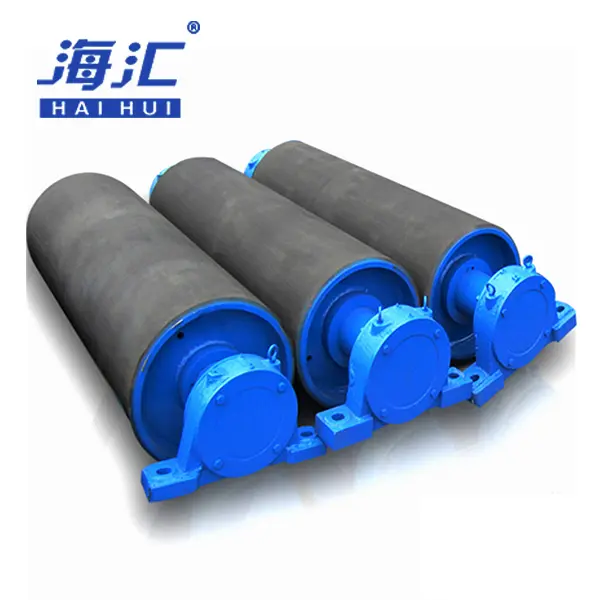
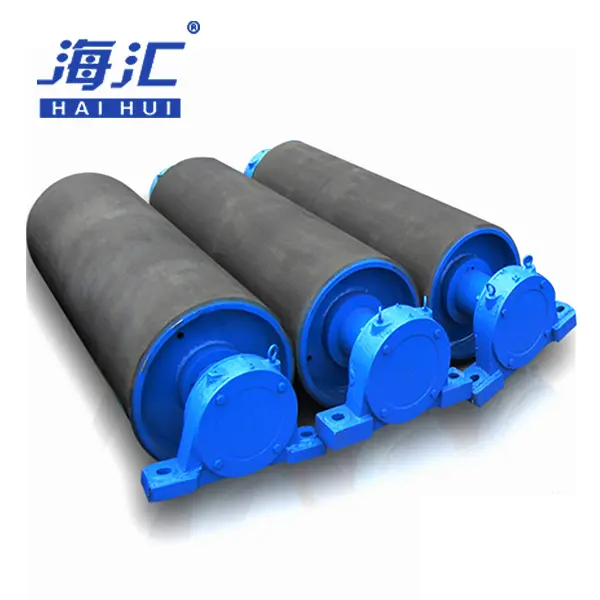
An industrial conveyor drive pulley might look like a heavy chunk of steel, yet it decides if your belt moves smooth or jerks like a bad transmission.
In bulk material handling, flaws snowball into belt damage, unplanned downtime, and annoyed plant managers, so getting this component right saves money, sanity, and your operation’s reputation.
Need reliable conveyor drive components for your next plant upgrade? Explore Haihui’s comprehensive range of heavy‑duty drive pulleys designed for precision and durability.
Key Notes for an Industrial Conveyor Drive Pulley
➔ Materials Matter: Choose forged steel or S355 shell with induction‑hardened shafts and high‑grade lagging for rigidity, wear resistance, and torque transfer.
➔ Sealing & Lagging Mastery: Ensure precision bearing fit and rubber lagging integrity under pressure and temperature variations to avoid slippage and belt tracking issues.
➔ Performance Harmony: Calibrate shaft straightness, concentricity, and lagging durometer for consistent traction, accurate belt centering, and smooth material flow.
➔ Quality Control Rhythm: Implement rigorous weld inspections, automated dynamic balancing, and adherence to CEMA, DIN, and ISO standards to minimize failures and downtime.
What Is an Industrial Conveyor Drive Pulley Made Of?
A solid drive pulley feels simple in your hand – well, maybe not in your hand – but it’s a precise assembly that has to play nice with belt tension, torque, and daily abuse. This quick run‑through breaks down what‘s inside a drive pulley, why the materials matter, and how Haihui keeps the performance consistent from first start to years of service.
The Shaft and Hub Essentials
The shaft is the backbone inside the drive pulley; it transmits torque from the motor to the pulley shell, and tiny geometry changes can flip the vibe from smooth tracking to belt wander. In Haihui builds, the drive pulley design keeps torque transfer stable even under peak loads.
Material – shaft choices balance strength with fatigue resistance so the pulley doesn‘t “sag” under tension.
Length and diameter – shaft length sets bearing spacing; diameter tunes torque capacity with the belt tension pulling behind it.
Torque + bearing pairing – with a belt conveyor, the drive pulley has to match the power curve or tracking gets weird.
Shell Materials: Forged Steel vs. Fabricated S355
The shell is the “drum” you see and wrap the belt around, and it takes the daily pounding. For a drive pulley body, Haihui typically weighs strength, weld integrity, and how the belt behaves over time.
- S355 fabricated steel – good strength, cost‑effective, weldable. Works for standard applications.
- Forged steel shell – higher rigidity and impact resistance, so the pulley stays round under heavy loads. Better for high‑torque or high‑impact zones.
Quick tradeoffs people notice:
- Cost – both can be efficient, but tooling and welding targets change manufacturing math.
- Durability – S355 holds shape with good welds; forged steel shrugs off shock loads.
Role of Lagging and Bearing Housing in Torque Transfer
If a drive pulley “mysteriously” slips, it‘s usually not mystery at all – it‘s lagging or bearing fit. The lagging provides friction between the pulley and belt, while the bearing housing does the quiet work of keeping shaft alignment tight.
- Lagging – rubber or ceramic material bonded to the shell. Maintains traction when moisture or dust messes with grip.
- Bearing housing – holds bearings in alignment so the shaft stays concentric with the shell.
Failure chain (common and annoying):
Weak lagging adhesion → belt slip → accelerated lagging wear → uneven belt tension → conveyor tracking issues.
Shaft and Bearing Fit: Ensuring Optimal Torque Transfer
Inside the drive pulley, the shaft is the torque carrier you never see, and the bearing fit is the part your maintenance team judges instantly. Haihui tunes each assembly so the pulley doesn‘t wobble, and torque transfer stays repeatable.
Key parts that shape performance:
- Shaft material (often 42CrMo4 forged steel) sets fatigue life and yield strength.
- Bearing fit (h7 or h6) affects alignment and housing stress.
How it plays out in use:
- Motor turns the shaft.
- Shaft transfers torque through hub to shell.
- Lagging grips the belt.
- Belt moves material.
Small tweak, big difference – a softer lagging durometer can improve grip in wet conditions, but too soft can cause premature wear and shift belt tracking.
Looking for the perfect match? From standard CEMA pulleys to high‑precision drive systems, Haihui can supply fabricated or forged pulleys complete with compatible bearings, hubs, and lagging.
4 Key Components of a Drive Pulley
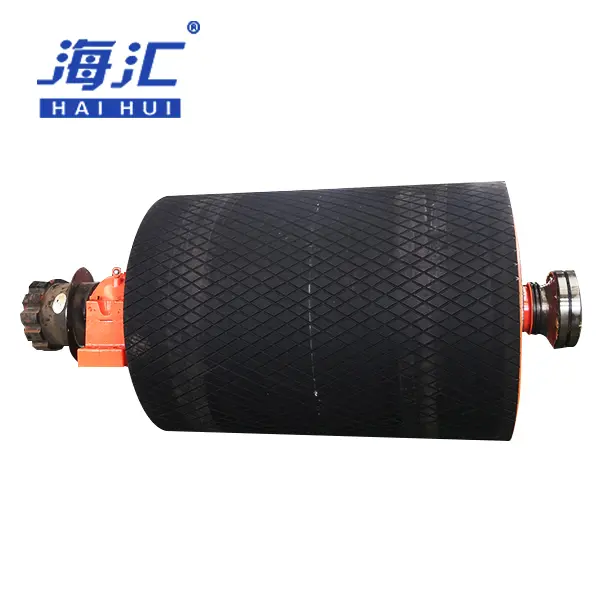
A solid drive pulley feels simple, but it‘s doing a lot behind the scenes. Split “industrial conveyor drive pulley” into everyday chunks – shaft, shell, lagging, bearings – and the whole story clicks. Haihui builds each drive pulley around torque transfer, belt tracking, and wear resistance, so the pulley behaves the same on day one and day one‑thousand.
The Shaft Mechanism
In a drive pulley, the shaft is the backbone that decides how torque flows and how smooth the belt tracks. It‘s not fancy; it just has to be right.
Torque path control
- Diameter sets torsional stiffness
- Keyway or locking element transfers torque to hub
- Bearing journal tolerances (h7/h6) control alignment
Pickup and delivery
- The hub connects shaft to shell, so torque doesn’t “slip”
- A smoother torque path cuts vibration, which matters in long overland conveyors
海辉 pairs shaft tolerances with hub fit so each drive pulley hits repeatable torque transfer without drama.
Bearing Housing Function
The unsung hero of any drive pulley is the bearing housing. If the housing is sloppy, everything else turns into a mess fast.
What the bearing housing must handle:
- Radial and axial loads under start/stop cycles
- Alignment so the shaft stays concentric with the shell
- Heat dissipation from continuous operation
Quick reality check – when the shaft and housing meet, the fit has to feel “snug,” not forced. Haihui keeps bearing housing alignment aligned with CEMA standards, because a misaligned bearing kills trust.
Precision Lagging Attachment
Lagging isn‘t just rubber; in a drive pulley, it‘s the traction referee. Too slick and the belt slips. Too soft and it wears fast.
Force and grip behavior
- Durometer sets friction coefficient
- Bond strength keeps lagging attached under load
- Grooved or plain pattern changes water displacement
Traction consistency
- Stable coefficient of friction supports predictable belt movement
- Reliable lagging adhesion improves belt tracking, not just starting torque
海辉 tunes lagging specs to match the pulley‘s operating environment, so traction stays consistent even in wet or muddy conditions.
Drum Shell Welding and Concentricity
The shell is the part people see – and judge – every time they walk the belt. If it wobbles, or the weld looks bad, the whole drive pulley feels cheap.
- Shape the shell for real loads, not lab loads, so concentricity holds up during long runs.
- Match weld penetration to shell thickness, so the joint doesn‘t crack under torque.
- Confirm shell roundness with dial indicators before lagging.
Check hub fit for shaft concentricity without “almost fits” frustration.
海辉 keeps shell geometry tied to performance, because a good drive pulley should feel natural, not like a vibration machine.
Drive Pulley Functional Layers
A good drive pulley is like a solid pair of work boots: you notice it only when it fails. This breakdown keeps it practical, tying material choices to day‑to‑day use, clean production needs, and belt feel. Haihui tunes each drive pulley layer so every pulley performs predictably.
Outer Shell Layer
Material choices set the vibe: S355 keeps the pulley strong while still weldable in fabrication. Forged steel shrugs off shock loads.
Design doesn’t live on a slide deck; it shows up when the pulley doesn‘t wobble after a year of service.
Concentricity matters because a stiff run-out gets old fast.
Shape decisions
- Shell thickness pushes durability up without making the pulley too heavy.
- Crown profile helps belt tracking but can squeeze belt life if the profile is too aggressive.
Surface and look
- Paint or zinc coating supports corrosion resistance without repaint steps.
- Texture from lagging gives grip and reduces belt slip.
海辉 keeps the pulley shell stable so the belt just tracks and goes.
Lagging Layer
Material composition is the quiet hero; a tired lagging loses traction and the belt starts acting weird.
Lagging design isn‘t only geometry – it‘s barrier function against moisture and material build‑up.
Key checks for a cleaner build:
- Chemical side – compatibility with oils, water, or chemicals in the material stream
- Mechanical side – elasticity that bounces back after years of compression
- Abrasion resistance so traction holds during hot‑truck days and long shifts
For a pulley that doesn‘t slip or squeal, Haihui keeps lagging specs tight, not “close enough.”
Internal Shaft and Hub Mechanism
Core parts that shape torque transfer:
- Shaft fit controls wobble and helps consistent torque transfer.
- Hub fit influences assembly time, so it doesn‘t feel like a workout.
Output control
- Keyway or locking device tunes torque transfer for smooth belt movement.
- A stable hub supports accurate torque transfer across repeated starts.
Belt tension and torque behavior
- Lagging durometer affects friction and the “slip” some plants hate.
Small tolerance wins keep the drive pulley predictable from first start to last shutdown.
海辉 treats the mechanism like the engine room: boring on purpose, reliable every time.
Why Your Drive Pulley Fails Early
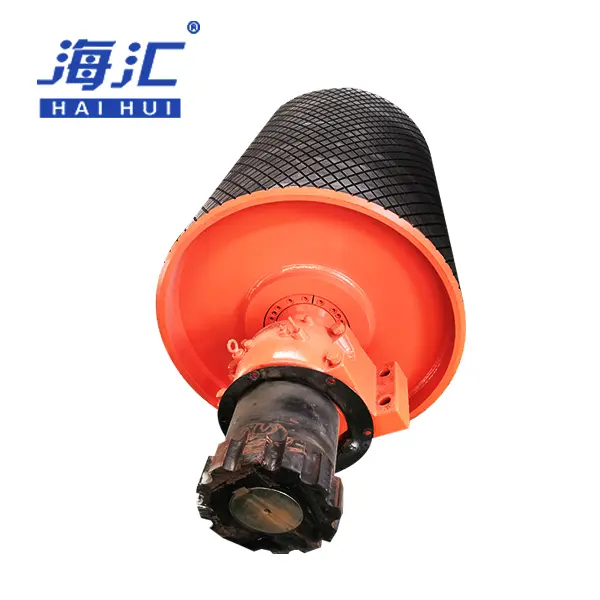
Failure rarely shows up out of nowhere. In a drive pulley, tiny oversights stack up fast, from material choices to welding habits. This breakdown keeps it real, practical, and grounded in what actually happens on busy plant floors.
Poor Lagging Adhesion or Wrong Durometer
- Lagging is applied with inadequate bond strength.
- Rubber separates from shell during operation.
- Belt slips, lagging wears unevenly, pulley loses traction.
Most drive pulley failures trace back to the lagging interface.
Inside the system:
- Failure starts small – bond voids, incorrect durometer.
- Lagging chunking develops.
- Uneven traction, belt wander, total slip.
| Failure Source | Durometer Range | Failure Rate |
|---|---|---|
| Incorrect durometer spec | <55 or >75 Shore A | 35% |
| Poor bond adhesion | N/A | 28% |
| Groove pattern mismatch | N/A | 22% |
| Installation damage | N/A | 15% |
Clean handling keeps the lagging alive. Since 海辉 provides vulcanized lagging services, we advise clients to maintain proper storage and handling, because once lagging is damaged during installation, no belt tension can save that drive pulley.
Inadequate Shaft Strength or Bearing Fit
Shaft strength drops quietly. Bearings wear faster than expected. Failure follows.
Step‑by‑step stress looks like this:
- Shaft sees torque spike.
- Keyway wallows out.
- Shaft bends or bearing seats wear.
- Bearing alignment slips, then shaft wobble.
“Shaft and bearing fit remain top root causes of drive pulley failures,” noted a 2024 CEMA maintenance survey.
Nested reality on the plant floor:
- If shaft hardness is too low, bearing seats wear.
- Maintenance tightens bearings.
- Shaft spins inside inner ring.
- Pulley wobbles, belt tracks off.
This is where 海辉 specs higher‑grade forged steel (42CrMo4) and induction‑hardened bearing seats, keeping the pulley steady across cycles.
Improper Welding and Shell Fabrication Issues
- Rushed welding.
- Loose quality control checks.
- Hidden fabrication defects.
Long story short, bad welds haunt good designs.
Fabrication stage:
- Poor fit‑up, inadequate penetration
- Hidden weld porosity
- Misfit shell components
Production stage:
- Uneven cooling
- Weak weld consistency
- Silent fabrication errors
Small variances change how a drive pulley feels, sounds, and tracks. One line might pass. Another fails. That‘s why drive pulley reliability lives or dies by weld discipline, not luck.
High‑Torque Applications with Drive Pulleys
High‑torque applications can be demanding, but the right pulley keeps it smooth. This cluster looks at how an industrial conveyor drive pulley handles high starting torque, abrasive materials, and fast‑paced bulk handling, all while keeping performance steady and costs in check for everyday plant operations.
High Starting Torque in Overland Conveyors
Handling high starting torque pushes drive pulleys to their limit, especially with long overland conveyors that resist movement. A well‑tuned drive pulley keeps things predictable.
Core torque logic:
- Shaft diameter affects stiffness
- Keyway or locking device influences torque transfer
- Hub fit shapes stress distribution
Real shop‑floor tweaks:
- Adjusting shaft diameter for peak torque
- Matching hub locking method to conveyor length
This is where 海辉 designs its drive pulley line to stay calm under pressure, even when starting torque feels more like a jolt than a ramp.
Induction‑Hardened Shaft for High Fatigue Life
The shaft does quiet work, yet it takes a beating. Using induction‑hardened 42CrMo4 as the shaft material boosts fatigue resistance and keeps drive components stable.
Why it works:
- Strong fatigue strength under cyclic loading
- Long‑term durability without bending or pitting
In daily use:
- Steady torque transfer from each pulley start
- Fewer failures in overland and high‑tonnage plants
Material selection here isn‘t flashy, just smart. 海辉 leans on this approach so the drive pulley, head pulley, and tail pulley all age gracefully.
Automated Balancing and NDT for Bulk Applications
Once production ramps up, speed and reliability matter. Automated balancing pairs neatly with non‑destructive testing (NDT) to support bulk handling goals.
- Pulleys flow through balancing systems without bottlenecks.
- Automation cuts balancing errors.
- NDT integration checks welds and material integrity.
Short pauses disappear. Material handling gets cleaner. Overall production efficiency climbs, and each drive pulley arrives ready for action. 海辉 builds around this rhythm, keeping logistics simple and scalable.
Ready to scale your bulk handling operations? With over 15 years of engineering expertise and a facility equipped for pulleys up to 1,800mm diameter, Haihui provides one‑stop customized drive solutions. Contact us today to receive a proposal within 1 day.
References
- CEMA – Conveyor Equipment Manufacturers Association – Pulley standards
- DIN 22101 – Continuous conveyors – Pulley specifications
- ISO 9001 – Quality management systems
- ASTM A370 – Mechanical testing of steel products
- Haihui – Internal engineering specifications for industrial conveyor drive pulleys

 English
 العربية
 简体中文
简体中文 Nederlands
 Français
 Deutsch
 Bahasa Indonesia
 Italiano
 日本語
日本語 한국어
한국어 Bahasa Melayu
 Polski
 Português do Brasil
 Русский
 Español
 Türkçe