
Head and Tail Pulley:Stop Failure & Improve Conveyor Reliability
If your conveyor system keeps gambling on under-engineered pulleys, properly specified head and tail pulleys are the straight-up fix. Better tracking, more uptime, peace of mind. Period.
Grand View Research reports the global conveyor components market continues steady growth through 2025, driven by mining and aggregate operations demanding durable, high-tension components [1].
That pressure lands on your procurement desk, where one undersized shaft or soft bearing seat can wreck production schedules and maintenance budgets fast. Choose pulleys built to hold firm.
5 Key Features Of Head And Tail Pulleys
Head and tail pulleys are more than simple steel drums. In bulk conveyor systems, every detail affects belt tracking, component life, and maintenance cost. From shell design to shaft metallurgy, smart engineering keeps head and tail pulleys reliable under tension. Below are five features that serious buyers check before locking in large pulley orders.
Seamless Fabricated Shell for Maximum Strength
When sourcing head and tail pulleys, the shell construction matters a lot.
Core design principle: Rolled and welded steel plate (S355)
- Full-penetration welds eliminate weak points
- Strong structural integrity against belt tension
- In large conveyors, shell construction plays out like this:
Structural Integrity
a. Rolled plate forming
i. Eliminates weak seam joints
ii. Reduces stress concentration risk
b. Uniform wall thickness
i. Balanced load distribution
ii. Improved resistance to deformation [3]
Performance Control
a. Concentricity (≤0.5mm TIR) for smooth belt tracking
b. Dynamic balancing (G-16 minimum for >3 m/s)
For head and tail pulleys, proper shell fabrication keeps tracking true, even in long overland conveyors. Haihui focuses on high-precision shell rolling to maintain stable concentricity across bulk pulley orders.
Hardened Shaft and Bearing Integration
In head and tail pulleys, the shaft connects everything.
Shaft Engineering
a. Forged 42CrMo4 steel
i. Ensures high fatigue strength
ii. Improves torque capacity
b. Induction-hardened bearing seats (HRC 50-55)
i. Prevents shaft scoring
ii. Supports bearing life
Bearing and Fitment
a. C3 or C4 clearance based on application
b. h7 or h6 shaft-to-bearing fit [4]
Sealing System
a. Labyrinth or contact seals
b. Grease retention verification
In bulk conveyor systems, poor shaft hardening ruins entire pulleys. High-grade head and tail pulleys maintain tight tolerance between shaft and bearing, helping mines avoid unplanned downtime. That’s a big deal in high-tonnage operations.
Shaft Hardening to Preserve Component Life
Inside every pulley, shaft hardening does quiet but critical work.
Protective System
a. Induction hardening [5]
i. Prevents bearing seat wear
ii. Maintains shaft integrity
b. Case depth 3-5mm
i. Enhances wear resistance
ii. Extends service life
Component Safety
a. Maintains shaft straightness
b. Supports long-term reliability
c. Protects production schedules
Technical comparison for common shaft materials in head and tail pulleys:
| Material Type | Hardness (HRC) | Fatigue Life (cycles) | Typical Use |
|---|---|---|---|
| C45 bar stock | 15-25 (as-rolled) | 500,000 | Light duty tail pulleys |
| 42CrMo4 (standard) | 50-55 (induction) | 1,500,000 | Head drive pulleys |
| 42CrMo4 (premium) | 55-58 (induction) | 2,500,000 | High-tension head pulleys |
In large pulley orders, shaft hardening consistency is key. Even soft spots can affect bearing life. Many manufacturers are transitioning to induction-hardened shafts to meet strict reliability standards [6].
Precision Bearing Fit and Shaft Alignment
Bulk buyers of head and tail pulleys pay close attention to precision bearing fit.
Assembly Control
a. Accurate shaft-to-bearing fit (h7/h6)
i. Uniform load distribution
ii. Reduced fretting risk
b. Housing alignment tolerance [7]
Alignment System
a. Correct shaft straightness (≤0.2mm/m)
b. Stable bearing housing placement
Sealing Stability
a. Double-check seal integrity
b. Final assembly inspection
Even the best pulleys fail if bearings aren’t seated right. In head and tail pulleys for high-tension conveyors, consistent bearing fit protects shaft life during operation. Haihui integrates automated inspection systems to keep every batch stable and predictable.
Optimal Face Width and Diameter Selection
Volume is not just about belt width. In head and tail pulleys, optimal sizing connects to safety and belt tracking.
Size Engineering
a. Calibrated diameter range
i. Based on belt tension requirements
ii. Allowance for lagging thickness [8]
b. Face width matching belt width
Lagging Geometry
a. Herringbone or plain pattern
i. Even traction distribution
ii. Enhanced water shedding
b. Belt-friendly shape
User Experience
a. Balanced belt tracking
b. Reduced edge wear
For head and tail pulleys, proper sizing reduces belt damage during operation. That keeps conveyor systems running clean on arrival. Haihui engineers pulley geometry to improve belt tracking while maintaining safe tension distribution.
When buyers evaluate head and tail pulleys, these five features quietly decide long-term performance. In bulk pulley sourcing, details are everything.
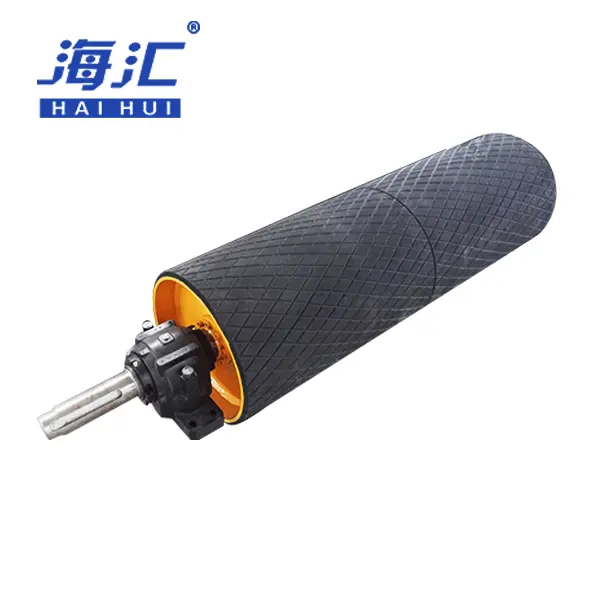
Quality Standards For Head And Tail Pulleys
When sourcing head and tail pulleys, quality is not just a checkbox—it’s peace of mind. From steel plate sourcing to NDT inspections and audits, serious conveyor component suppliers keep standards tight. If you’re buying head and tail pulleys, these checkpoints matter more than ever.
ISO Certification and Regulatory Compliance
In the world of head and tail pulleys, compliance shapes market access and brand trust.
ISO standards and certification
1.1 Implementation of a documented quality management system aligned with global ISO standards [9]
1.2 Routine third-party audit cycles to maintain active certification
1.3 Continuous updates to match revised international regulations
Regulatory compliance across industries
2.1 Alignment with CEMA and mining industry standards
2.2 Conformity with regional safety directives for conveyor components
2.3 Documentation ready for site inspections and authority inspections [10]
For buyers of bulk pulleys, this structure keeps operational risks low and approval processes smooth.
Rigorous NDT Inspection and Tension Testing
No one wants a pulley failure in service. That’s why head and tail pulleys go through layered validation.
- NDT weld inspection (ultrasonic or dye-penetrant) finds hidden defects.
- Tension resistance testing simulates belt load stress [11].
- Dynamic balancing confirms safe operation thresholds.
Testing normally follows this rhythm:
- Inspect shell welds with NDT.
- Verify shaft hardness under defined HRC levels.
- Record dimensional data for quality control logs.
Below is a typical performance reference used in pulley quality evaluation:
| Test Type | Standard Requirement | Minimum Acceptance | Purpose |
|---|---|---|---|
| NDT Weld Inspection | 100% | No defects | Defect detection |
| Hardness Testing | HRC 50-55 | Pass | Structural performance |
| Dynamic Balancing | G-16 (or better) | Pass | Operational stability |
| Concentricity Check | ≤0.5mm TIR | Pass | Seal integrity verification |
For brands like Haihui, strict component safety checks protect both production and reputation.
Batch Traceability for Full Quality Assurance
Strong batch traceability keeps head and tail pulleys accountable from steel plate to shipment.
Lot identification
1.1 Unique codes engraved or stamped [12]
1.2 Digital mapping to manufacturing records
Production data control
2.1 Storage of steel supplier details
2.2 Archived inspection and quality assurance reports
2.3 Clear component tracking pathways
Recall procedures
3.1 Rapid search by lot number
3.2 Isolated shipment tracing across the supply chain visibility system
For buyers ordering pulleys in bulk, this transparency reduces compliance headaches and speeds up audits.
Material Analysis: Steel Grade and Hardness Verification
Durability starts with the right steel grade.
Material analysis fundamentals
1.1 Verification of steel plate grade and mechanical properties [13]
1.2 Measurement of shell thickness under strict material specifications
Hardness validation
2.1 Rockwell C hardness testing
2.2 Case depth verification (3-5mm)
Surface finish evaluation
3.1 Inspection of coating adhesion
3.2 Assessment of machined surface quality
High-grade steel protects head and tail pulleys from aggressive belt tension and fatigue. For growing mining operations seeking reliable components, Haihui aligns steel selection with long-term fatigue resistance and stable surface finish performance.
Head And Tail Pulleys Vs. Standard Alternatives
Choosing between engineered head and tail pulleys and standard options can feel like a real head-scratcher. From cost to fatigue life, every detail counts when scaling conveyor systems.
Engineered Head Pulleys
When mines source engineered head pulleys, they usually focus on performance under high tension and long-term value.
Core Material Strength
1.1 Forged 42CrMo4 shaft
- Induction-hardened bearing seats improve fatigue resistance [14].
- Ideal for high-tension drive applications.
1.2 Fabricated S355 shell - Rolled and welded steel plate.
- Full-penetration welds for structural integrity.
Operational Performance
2.1 Mining Use
- Compatible with high-torque drives.
- Strong fatigue resistance.
2.2 Sustainability - Long service life (8-12 years).
- Lower lifecycle waste than many alternatives [15].
| Feature | Engineered Pulley | Tension Capacity | Service Life (years) |
|---|---|---|---|
| Head Drive Pulley | Yes | High (>50kN) | 8-12 |
| Tail Pulley | Yes | Moderate (20-40kN) | 10-15 |
| Snub Pulley | Yes | Low-Moderate | 12-18 |
Bulk buyers sourcing head and tail pulleys often partner with Haihui for consistent shaft hardness and reliable shell fabrication. In the world of bulk conveyor supply, that reliability matters.
Standard Alternatives
Some operations still compare engineered pulleys with standard options to cut upfront cost.
Material Traits
1.1 Fabricated C45 shaft
- Made from bar stock.
- Lower fatigue resistance.
1.2 Weight Advantage - Cheaper upfront cost.
Performance Limits
2.1 Fatigue Resistance
- Not ideal for high-tension or high-cycle applications.
2.2 Bearing Seat Wear - Soft shafts lead to bearing spin and shaft scoring.
Maintenance Strategy
3.1 Short-Term Savings
- Lower tooling costs.
3.2 Long-Term Trade-Off - Higher replacement frequency vs. engineered pulleys.
For operations needing reliable, high-tension conveyor systems, engineered head and tail pulleys still lead the pack. Haihui supports both custom designs and bulk orders, helping mines move from small upgrades to full-scale production without missing a beat.
How Durable Are Head And Tail Pulleys?
Bulk buyers care about one thing: durability that holds up in real life. When sourcing head and tail pulleys, strength isn’t just talk—it’s about steel science, fabrication precision, and long-term fatigue control. Let’s break down how pulleys perform under tension, storage, and transport.
Material Thickness and Alloy Strength
When evaluating head and tail pulleys, durability starts at the metal core:
Material structure
- Material gauge – Optimized shell thickness balances weight and tension resistance.
- Steel grade – S355 plate provides high yield strength.
- Fabrication – Welding procedures verified by NDT.
Shaft metallurgy
- Forged 42CrMo4 – High-purity alloy improves fatigue strength.
- Induction hardening – Controlled elements increase bearing seat hardness (HRC 50-55).
- Temper designation – Proper heat treatment enhances mechanical properties.
Thicker shells don’t always mean better performance.
- Balanced alloy ratios prevent fatigue cracking.
- Correct hardening avoids brittleness.
For large-volume pulley orders, Haihui selects steel grades engineered for consistent structural integrity across batches. That’s key when you’re moving pallets of head and tail pulleys across regions.
Shell Fabrication and Welding Processes
Durability is also shaped—literally—by shell rolling and welding:
Fabrication process
- Single-roll forming creates concentric shells.
- Precision tooling design controls wall thickness.
Manufacturing techniques
- Annealing reduces internal stress.
- Advanced welding improves joint uniformity.
Quality methods
- NDT inspection enhances dimensional stability.
Step by step:
- Steel plate cutting
- Shell rolling
- Full-penetration welding
- NDT weld inspection
This fabrication process ensures head and tail pulleys resist bending during shipping. As noted in a 2025 global conveyor outlook by Smithers:
“Engineered steel pulleys continue to outperform alternative formats in fatigue resistance and reliability metrics.”
That’s why Haihui keeps tight control over every fabrication parameter for head and tail pulleys and related conveyor lines.
Resistance to Corrosion and Environmental Stress
Long-term operation exposes head and tail pulleys to moisture, chemicals, and temperature swings.
Key protection layers:
- Internal coatings – Epoxy or polyurethane paints enhance chemical stability.
- External surface treatment – Enhanced corrosion resistance against atmospheric exposure. Improved oxidation resistance for coastal operations.
- Structural durability – Reduced stress cracking under tension changes. Long-term environmental durability during storage.
Short and simple: good coating protects steel. Good fabrication protects shape. Together, they protect your head and tail pulleys from fabrication to final installation. Haihui builds that durability into every batch—because bulk buyers can’t afford weak links.
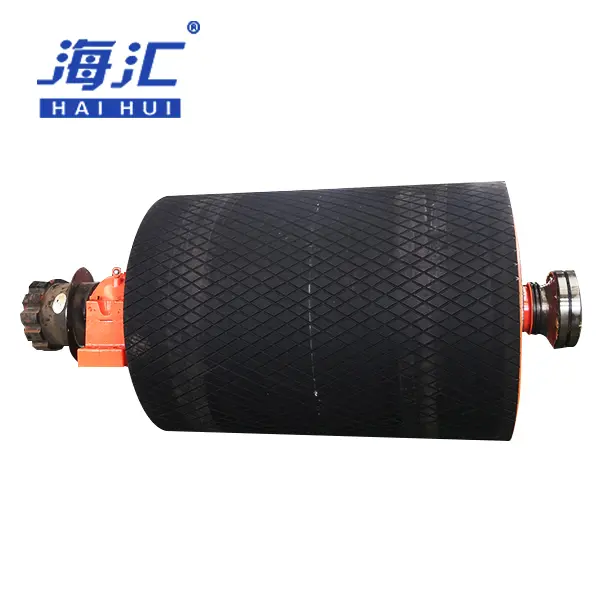
Conveyor Systems: Robust Bulk Components
Conveyor systems demand tough components. From pulley fabrication to shipping, every detail affects safety and output. For mines sourcing head and tail pulleys, smart design keeps belts running and operations smooth.
Lagged vs. Bare Pulley Selection
When selecting head and tail pulleys for conveyors, traction decides performance.
Pulley types
- Drive head pulleys
▸ Lagged (rubber or ceramic) for traction
▸ Herringbone or plain pattern - Tail pulleys
▸ Bare or lightly lagged
▸ Self-cleaning options available
Material compatibility
- Lagging materials
- Rubber (60-75 Shore A) → general traction
- Ceramic → extreme grip in wet/muddy conditions
- Herringbone → water shedding
Sealing mechanisms
- Labyrinth seals reduce contaminant ingress
- Contact seals improve corrosion prevention
Belt tension management
- Check tension requirements for specific application
- Validate against safety standards for torque limits
Haihui aligns pulley selection with application requirements, making bulk conveyors safer for high-demand operations.
Face Width and Diameter Selection
Belt tracking depends on the right pulley sizing.
Face width selection
- Match face width to belt width (+25-50mm each side)
- Verify against belt edge clearance requirements
Diameter selection
- Based on belt speed and tension
- Large diameters reduce belt stress
Performance optimization
- Balance belt tension requirements with component size
- Reduce belt fatigue risks
Result? Steady belt tracking, less edge wear, and happier maintenance teams using head and tail pulleys in daily operations.
Packaging Solutions and Container Shipping
Bulk orders of head and tail pulleys travel far, so protection matters.
| Container Type | Load Capacity (kg) | Shaft Support Required |
| :— | :— | :— | :— |
| 20ft Standard | 28,000 | Yes (cradles) |
| 40ft High Cube | 26,500 | Yes (cradles) |
| Flat Rack | 30,000+ | Yes |
Protective packaging
- Shaft support cradles
- Corner protection
- Palletization strategies
- Cross-stack layout
- Corner board reinforcement
Add compliance with freight regulations, clear handling procedures, and monitored storage conditions. Haihui supports global shipping plans so pulley orders arrive dent-free.
Lead Time and Logistics Management
Keeping supply steady takes tight control.
Supply chain optimization
- Steel plate sourcing
- Fabrication and coating schedules
- Production scheduling
- Batch planning
- NDT inspection windows
- Inventory control
- Safety stock levels
- FIFO rotation
- Transportation modes
- Sea freight for bulk
- Truck for regional runs
Clear customs clearance, realistic delivery schedules, and active risk management stop delays before they start. For mines relying on head and tail pulleys, Haihui keeps timing sharp and commitments real.
FAQs
What makes head and tail pulleys reliable for mining and aggregate applications?
Head and tail pulleys are built for tension, storage, and real-world handling. Their performance depends on three core layers:
Material strength
- High-grade forged 42CrMo4 shafts with controlled hardness
- Strong fatigue resistance for continuous operation
- Stable during container shipping
Structural design
- Fabricated S355 steel shell formed by rolling and welding
- Precision machined bearing seats
- Balanced design to manage belt tension
Functional integration
- Shaft matched with CEMA compliance
- Secure bearing fit and durable sealing
- Lagging tuned for traction requirements
The result is a pulley that holds tension calmly and performs consistently in mining, aggregate, and heavy industrial applications.
How do manufacturers ensure quality and reliability in bulk supply?
Quality is proven in stages, not promises. After shell fabrication and shaft hardening, each unit passes through controlled checks:
- NDT weld inspection under quality standards
- Hardness verification for bearing seats
- Dynamic balancing and concentricity audits
- ISO certification and regulatory compliance reviews
Every batch carries batch traceability records, linking steel plate sourcing to final quality assurance reports. For buyers managing tight lead time and global logistics management, this traceable system protects both safety and reputation.
Why choose engineered pulleys over standard alternatives for large-scale purchases?
The difference becomes clear in high-tension and high-cycle applications.
| Feature | Engineered Pulley | Standard Pulley |
| :— | :— | :— | :— |
| Tension handling | Designed for high belt tension | Limited capacity |
| Fatigue life | Forged 42CrMo4 shaft | C45 bar stock |
| Bearing seat hardness | HRC 50-55 (induction) | As-rolled (15-25) |
| NDT inspection | 100% | Sample only |
| Industry use | Mining, aggregate, cement | Light-duty, intermittent |
For bulk supply programs, engineered pulleys offer better reliability, stronger shipping durability, and dependable capacity control across mining and industrial lines.
References
- Conveyor Component Market Size & Growth Report – grandviewresearch.com
- Understanding Rolled Shell Fabrication – sciencedirect.com
- Deformation Resistance in Steel Structures – researchgate.net
- Bearing Fitment Standards – skf.com
- Induction Hardening for Shafts – heat treating.net
- CEMA Standards for Conveyor Pulleys – cemanet.org
- Shaft Alignment and Tolerance Standards – isa.org
- Headspace Requirements for Conveyor Systems – conveyorengineering.com
- ISO 9001:2015 Quality Management Systems – iso.org
- Global Regulatory Compliance for Industrial Components – compliancegate.com
- NDT Testing Standards for Steel Structures – astm.org
- Batch Traceability in Manufacturing – gs1.org
- Steel Plate Grades and Purity – worldsteel.org
- Fatigue Resistance of Forged Steel – tappi.org
- Recycling Efficiency of Steel – epa.gov
 English
 العربية
 简体中文
简体中文 Nederlands
 Français
 Deutsch
 Bahasa Indonesia
 Italiano
 日本語
日本語 한국어
한국어 Bahasa Melayu
 Polski
 Português do Brasil
 Русский
 Español
 Türkçe