Mining Conveyor Rollers:Stop Bearing Failure & Belt Damage
- 7 Essential Factors For Choosing Mining Conveyor Rollers
- 5 Hidden Risks When Vetting Mining Roller Suppliers
- Price vs. Quality: Finding The Sweet Spot
- Reduce Lead Times With Smart Partnerships
- How To Validate Supplier Sustainability Claims
- Ready to Upgrade Your Mining Conveyor Roller Supply Chain?
- References
Picking mining conveyor rollers isn‘t a price game; it’s a risk bet. One bad tube, wrong bearing seal, or soft shaft turns a smooth production run into belt damage, bearing seizure, and emergency change-outs.
This guide outlines how to match materials, seals, bearings, and compliance so your underground belt hums daily.
Key Points to Navigate Mining Conveyor Rollers
➔ Match materials and seals to your dust/water exposure and load needs to prevent bearing contamination and seizure.
➔ Verify bearing, seal, and shaft compatibility against start-stop cycles to avoid blocking and premature failure.
➔ Audit supplier processes—tube welding, shaft hardening, seal assembly—for dimensional control.
➔ Confirm MSHA, ISO, and CEMA compliance with traceable batch records.
➔ Leverage supplier capabilities—custom lengths, seal upgrades, tech support—to streamline mine-scale operations.
7 Essential Factors For Choosing Mining Conveyor Rollers
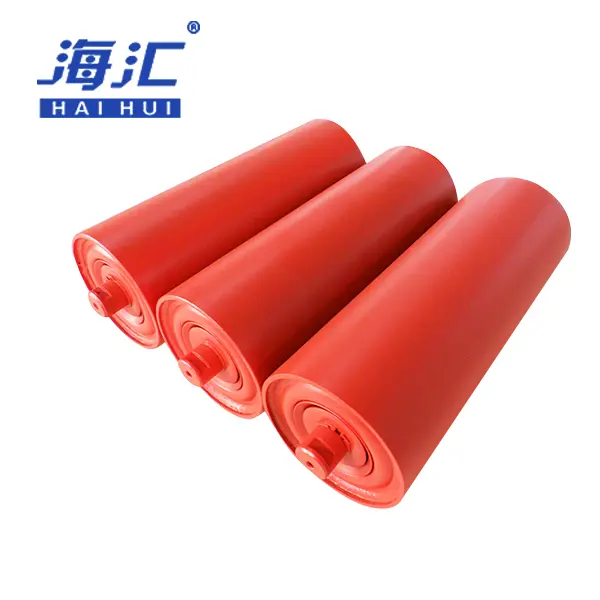
Picking mining conveyor rollers means choosing a system: tube strength, bearing seals, shaft durability, and field support. This guide details practical specs for evaluating any mining roller supplier short list.
Material Choices: Steel Tube to Hardened Shaft
Start with tube material; it dictates impact resistance and corrosion limits.
- Steel tube (S355) – High strength and impact resistance. Best paired with thicker walls (3-5mm) for underground heavy loads.
- Forged shaft (42CrMo4) – Rugged fatigue tolerance ideal for high-start-torque longwall conveyors. Requires induction-hardened bearing seats (HRC 50-55).
- Sealed bearing cartridge – Track seal type (triple labyrinth for dust, contact lip for wet). Demand C4 clearance for high-heat or high-impact applications.
- Recyclability – Request exact PCR percentages for steel tube. Mining rollers often cap PCR at 25-40% to maintain structural integrity under shock load.
Key Components Selection: Bearings, Seals, Shafts Insights
Performance lives in the components. Keep compatibility tight.
- Bearings – Match C3 or C4 clearance to conveyor length and start-stop frequency.
- Seals – Tune seal type to environment: triple labyrinth for fine coal dust, contact lip for potash or wet conditions.
- Shafts – Specify induction-hardened bearing seats; soft shafts wear, causing inner ring spin and shaft scoring.
- Grease – Validate compatibility with mine water or chemical dust. Swelling exceeding 5% volume change equals seal failure.
- Labyrinth gaps – Check tolerance (≤0.3mm for fine dust) to ensure transit survival.
Manufacturing Techniques: Tube Forming, Welding, and Shaft Hardening
Process choices directly impact defect rates and roller life underground.
| Manufacturing process | Key control | Risk if ignored |
|---|---|---|
| Tube welding | Full penetration, ≤0.2mm straightness | Shell distortion, belt wander |
| Shaft induction hardening | HRC 50-55, case depth 3-5mm | Bearing seat wear, shaft scoring |
| Seal assembly | Labyrinth gap tolerance, grease fill | Contamination ingress, seizure |
| Balancing | ISO 1940 G-16 minimum | Vibration, bearing noise |
- Production efficiency – Top-tier roller suppliers run at 85%+ OEE. Ask for changeover times to gauge true lead-time agility.
- Tooling – Clarify ownership and exact maintenance intervals.
Supplier Capabilities: Customization and Design Services
Vendors who co-design save weeks of feasibility iterations.
- Customization – Verify tube length, shaft ends, and seal type won‘t fail at your specific belt speed and tonnage.
- Design services – DFM feedback prevents locking into un-manufacturable shapes or seal cavities that don’t fit your idler frames.
- Prototyping – Insist on production-tooled pilot runs, not hand-built samples.
- Technical support – Require compatibility mapping for dust, water, grease, and seal pairings.
Looking for a partner with deep mining roller expertise? With over 15 years of underground experience, ハイフイ offers a 1-day solution proposal (design + materials + quote) and rapid physical samples in just ~10 days. Explore our Customization Services.
Industry Standards: MSHA, CEMA, and ISO Certification
Compliance must be backed by a crisp paper trail.
- MSHA regulations – Ensure seals and grease are flame-resistant for underground coal applications.
- CEMA standards – “We follow CEMA” fails. Demand specific roller classifications (B, C, D, E) for your belt width and tonnage.
- Quality control – Mandate incoming tube checks, weld inspection, and final running torque testing.
- Safety standards and regulatory adherence – Lot coding must tie tube batch, bearing lot, seal supplier, and assembly date together.
- Testing – Enforce mandatory random spin testing and salt spray verification.
| Checkpoint (QC) | Typical target | Test frequency (example) | Record to request |
|---|---|---|---|
| Running torque (Nm) | ≤1.5 (114mm roller) | 1 / shift | Raw results by batch |
| Seal ingress (IP rating) | IP65 minimum | 1 / 1000 | Lab reports |
| Shaft hardness (HRC) | 50-55 | 1 / lot | Hardness test logs |
| Concentricity (mm) | ≤0.3 | 1 / 100 | SPC charts |
Application Fit: Longwall Gate Roads, Mainlines, Belt Feeders
Application dictates tube wall, seal type, and bearing clearance.
- Longwall gate roads – High dust, high start-stop → triple labyrinth seals, C4 bearings, forged shafts.
- Mainline haulage – Continuous running, moderate dust → double labyrinth, C3 bearings, standard shaft.
- Crusher feed / transfer points – Heavy impact, lump material → heavy wall tube (5-6mm), impact-rated design.
- Belt feeder breakers – Tight spaces, moderate load → smaller diameter (89-114mm), sealed-for-life bearings.
- Underground coal – Non-negotiable MSHA flame-resistance and documented batch traceability.
Packaging Features: Corrosion Protection and FIFO Storage
Roller failures cost downtime, not just replacement parts.
- Corrosion protection – Salt spray rating ≥240 hours for wet mines.
- FIFO storage – Require batch dating and first-in-first-out inventory practices.
- Palletizing – Stacking supports to prevent shaft bowing during storage.
5 Hidden Risks When Vetting Mining Roller Suppliers
The boring paperwork matters more than shiny machinery. Watch these five traps when evaluating mining roller suppliers.
Gaps in Batch Traceability and Material Inspection
Sloppy traceability systems magnify recall headaches.
Batch identification
- Raw inputs – Tube mill certs, bearing lot codes, seal batch IDs explicitly tied to coil certs.
- In-process – Roller assembly mapped to exact shifts; explicit rework codes.
- Outbound – Pallet tags linked to the parent batch tree.
Inspection protocols
- Thickness/hardness validation on incoming steel tube.
- Documented seal assembly cure windows (if molded-on rubber).
- Component checks against engineering prints.
Ask for the latest supplier audits – healthy mining roller suppliers like ハイフイ share this documentation seamlessly.
Undisclosed Shaft Hardness or Seal Quality Issues
Uncontrolled shaft hardness drift causes bearing seat wear and premature seizure.
- Material – Confirm material specifications lock down shaft hardness (HRC 50-55) and case depth (3-5mm).
- Seal – Request seal material certs, labyrinth gap tolerance records, and IP rating test results.
Reality check
- Require running torque testing at your actual belt speed.
- Confirm CEMA or MSHA compliance matches your mine’s regulations.
- Run a pilot on the exact high-volume longwall line you‘ll utilize.
Welding or Tube Straightness Defects
Roller integrity relies entirely on tube weld quality and straightness.
- Weld controls – Demand hard setpoint limits, not “operator feel.” Check wire and roller wear logs.
- Tube straightness – ≤0.2mm per meter maximum; bowed tubes ruin bearing alignment.
- Inspection proof – Request a structural defects catalog and weld penetration data.
- Component assembly – Verify end cap fit tolerances tie back to concentricity requirements.
Skipped Running Torque or Seal Testing Oversights
Treating running torque or seal testing as optional risks massive downtime.
- Testing protocols – Demand a rigid sampling plan and strict retest rules following bearing change or line maintenance.
- Quality assurance – Verify calibration logs tie back to batch identification.
- Defect detection – Review top defects and corrective action closures.
| Control metric (example) | Target | Typical evidence |
|---|---|---|
| Running torque tester sensitivity (Nm) | ≤0.1 | Calibration cert + daily check sheet |
| Running torque pass rate (%) | ≥99.5 | Lot report tied to traceability systems |
| Retest rate after line change (%) | ≤0.5 | Changeover log + quality control summary |
ハイフイ maps these metrics to your exact SKU risk level.
Limited Technical Support for Underground Scale-Up
You are buying engineering support at scale.
- Require explicit technical assistance contacts (names, SLA response times for mine sites).
- Demand scale-up support focused on production scalability across longwall panels, not remote guessing.
- Expect a problem resolution playbook: isolate variables (dust, water, load), execute trials, lock settings.
- If operational challenges hit, you need an expert on the mine site instantly.
Need reliable OEM/ODM support for mine scale-up? ハイフイ integrates advanced tube welding, induction hardening, and automated seal assembly, performing 100% running torque tests to guarantee quality. With ISO 9001 certification and a capacity of ~1 million rollers annually, we back your production up seamlessly. Contact our team today for a quote.
Price vs. Quality: Finding The Sweet Spot
Chasing the lowest unit cost destroys cost-effectiveness when scrap rates double in the field. ハイフイ helps map true landed cost.
Price
Keep budget alignment focused on total financial outlay:
- Roller + bearings + seals + shaft
- Custom tooling (special lengths or shaft ends)
- Freight, tariffs, and hidden field scrap
- Poor value assessment flips economic viability fast. Long lead times trap cash, while customization workarounds hurt affordability metrics.
| Cost driver (per 10k units) | Low-quote scenario | Typical scenario (Haihui) |
|---|---|---|
| Scrap rate (field failure) | 8-12% | <2% |
| Freight (USD) | 2,500 | 1,800 |
| Emergency change-out labor (USD) | 15,000 | 3,000 |
Quality
Performance metrics guarantee supplier reliability. Push manufacturing excellence into the SLA.
- Lock material specifications (tube grade, shaft hardness, seal type).
- Define fail tests tied to mine safety protocols (running torque, IP rating, salt spray).
- Enforce consistency standards (concentricity, straightness, seal gap).
- Demand a strict corrective action workflow.
ハイフイ provides transparent KPI reporting to anchor “mining conveyor rollers” comparisons in product durability and regulatory compliance.
Reduce Lead Times With Smart Partnerships
Shrinking lead times requires proximity, locked schedules, and rapid tech resolution. ハイフイ removes the guesswork.
Leveraging Regional Warehousing
International reach means holding inventory near mines.
- Supply chain network – Regional warehousing solutions hold common roller diameters close to mining districts. Dual plant setups act as backup distribution channels.
- Pre-approved freight – ensures predictable delivery routes to remote mine sites.
ハイフイ strategically stages high-volume sizes to eliminate panic freight, successfully supplying mines across North America.
Aligning on High-Volume Production Schedules
Spikes destroy production capacity without strict alignment.
- Lock demand forecasting windows (quarterly for longwall moves).
- Set firm manufacturing schedules; late changes incur fees.
- Keep volume planning tied to MOQ changeover realities.
- Maintain operational synchronization for steady output consistency.
Streamlining Communication via Dedicated Technical Support
Dedicated support prevents mine-site downtime.
- Clean communication channels – One point of information exchange for seal or bearing changes. Rapid escalation for issue resolution.
- Stick-built technical assistance – Expert guidance utilizing collaborative tools to prevent stall-outs on tube straightness or seal fitment issues.
ハイフイ treats tech support as a primary production asset.
How To Validate Supplier Sustainability Claims
Strip away generic environmental claims. Stress-test sustainability reports down to the material batch.
Reviewing Recycled Content Certifications
- Documentation – Demand third-party certification standards and mass-balance files proving compliance.
- Material traceability – Trace steel tube lots back to the supply chain melt, not an aggregated facility average.
- Variability controls – Verify how PCR percentage shifts are managed to maintain impact resistance.
- Environmental claims – Ensure claims explicitly match the SKU, keeping documentation audit-ready.
Verifying MSHA, CEMA, and ISO Compliance
Regulatory compliance requires hard data.
- Demand MSHA flame-resistance statements covering seal and grease materials.
- Require CEMA roller classification letters and dimensional verification reports.
- Audit material safety SDS dates and legal requirements for change-notifications.
Conducting Onsite Audits for Dimensional Control
Onsite audits verify dimensional control at line speed.
- Onsite audit – Review measurement tools, Gage R&R calibration, and adjustment authority.
- Quality control evidence – Require inspection logs explicitly tied to batch histories.
- Manufacturing process traceability – Follow the defect trail (wall drift, seal gap, bearing noise) to confirm the production facility solved root causes rather than widening specifications.
Ready to Upgrade Your Mining Conveyor Roller Supply Chain?
Stop gambling with quality and lead times. ハイフイ is a global mining roller manufacturer with over 15 years of experience, supplying mines across North America. Whether you need standard CEMA rollers or specialized sealed designs for longwall gate roads, our ISO 9001 and MSHA-compliant facility is ready to deliver with flexible MOQs.
👉 Contact Haihui today for a free sample and a customized solution proposal within 24 hours.
References
- MSHA – Mine Safety and Health Administration (30 CFR)
- CEMA – Conveyor Equipment Manufacturers Association – Roller standards
- ISO 9001 – Quality management systems
- ASTM A370 – Mechanical testing of steel products
- ISO 1940 – Mechanical vibration – Balance quality requirements
- Haihui – Internal test specifications for mining conveyor rollers
 English
 العربية
 简体中文
简体中文 Nederlands
 Français
 Deutsch
 Bahasa Indonesia
 Italiano
 日本語
日本語 한국어
한국어 Bahasa Melayu
 Polski
 Português do Brasil
 Русский
 Español
 Türkçe