
Ultimate Guide to Head Pulleys for Belt Conveyor Drives
- Quick Insights for Head Pulley Mastery
- Why Head Pulleys Matter for Belt Conveyors
- How Head Pulleys Work
- Key Components and Their Roles
- Benefits of Properly Designed Head Pulleys
- Critical Design Parameters
- 4 Key Head Pulley Configurations
- Application Selection Guide
- Installation and Commissioning
- Maintenance and Service Life
- Common Problems and Solutions
- Quality and Testing
- What Makes a Head Pulley Suitable for Conveyors?
- Why Choose Haihui Head Pulleys?
- 🚀 Upgrade Your Conveyor Drive with Haihui
- FAQs about Head Pulleys
- References
Head Pulleys: The Driving Force of Belt Conveyor Systems
A head pulley looks straightforward—just a cylinder that turns the belt. But its design dictates conveyor reliability. One undersized shaft, wrong lagging, or poor alignment stops your entire line, costing hours of lost production. Haihui engineers in 2025 emphasize shaft sizing, lagging selection, and bearing protection as the backbone of consistent conveyor uptime.
Quick Insights for Head Pulley Mastery
- Shaft sizing: Proper shaft diameter prevents deflection and fatigue failure under peak belt tension.
- Lagging selection: Rubber, ceramic, or diamond pattern lagging determines grip and wear life.
- Bearing arrangement: Spherical roller bearings handle radial and axial loads in dusty environments.
- Shell construction: Heavy-duty steel shells withstand belt tension and impact forces.
- Maintenance essentials: Regular bearing temperature monitoring and lagging inspection prevent unexpected failures.
Why Head Pulleys Matter for Belt Conveyors
The head pulley is the drive pulley at the discharge end of a belt conveyor. It transfers motor torque to the belt through friction, moving material from loading to discharge. A properly designed head pulley ensures smooth belt tracking, consistent material flow, and long service life.
How Head Pulleys Work
Motor power is transmitted through a gearbox or direct drive to the head pulley shaft. The pulley rotates, and the lagging on the pulley surface grips the belt. Friction between the lagging and belt pulls the belt forward. Belt tension must be sufficient to prevent slipping.
Key Components and Their Roles
Shaft: The shaft transmits torque from the drive to the pulley shell. It must be sized to handle starting torque and peak belt tension without excessive deflection.
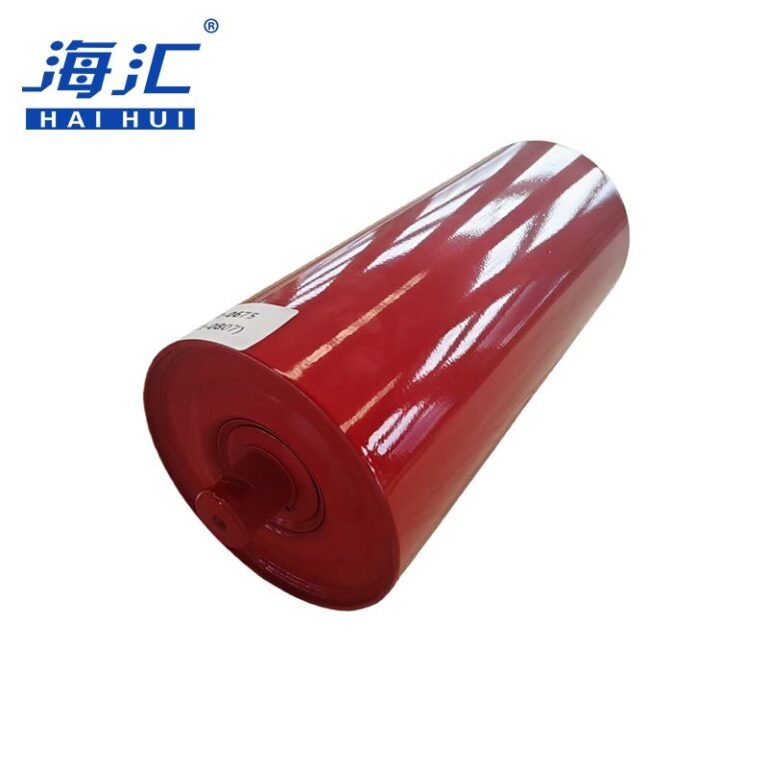
Shell: The shell is the cylindrical body that contacts the belt. It is fabricated from steel plate and must be concentric to prevent belt tracking issues.
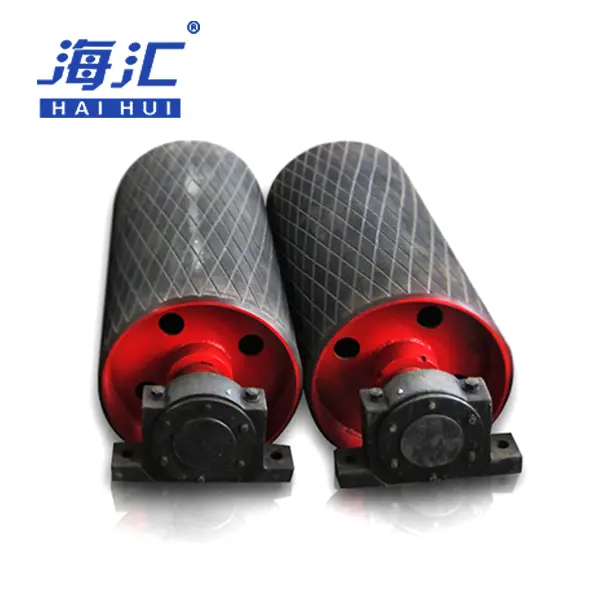
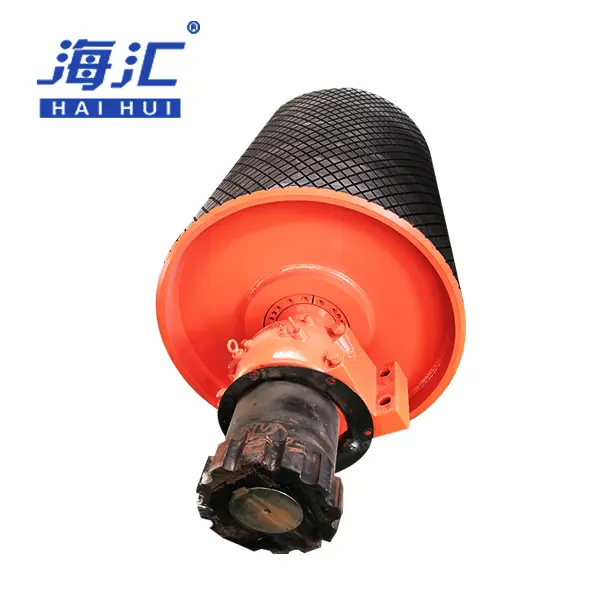
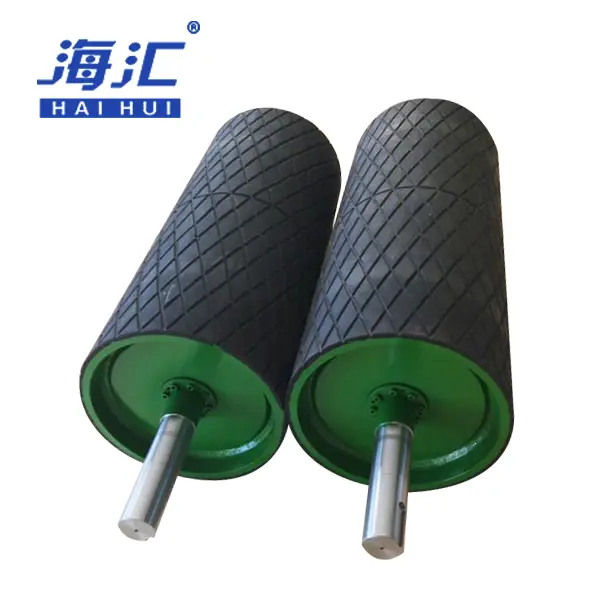
Lagging: Lagging is the cover material bonded to the shell surface. It increases friction between the pulley and belt, preventing slip.
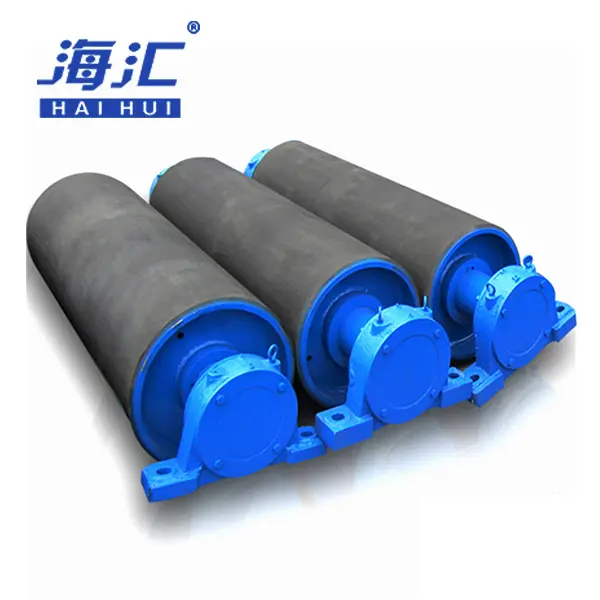
Bearings: Bearings support the shaft and handle radial and axial loads. Sealed bearings protect against dust and moisture.
Locking elements: Keyless locking assemblies or shrink discs secure the shaft to the hub, eliminating keyway stress risers.
Benefits of Properly Designed Head Pulleys
- Reliable belt grip: Proper lagging prevents belt slip, especially in wet or oily conditions.
- Long service life: Heavy-duty construction and sealed bearings extend maintenance intervals.
- Smooth tracking: Concentric shells and proper alignment keep the belt centered.
- Easy maintenance: Accessible bearing housings and lagging inspection points simplify servicing.
Critical Design Parameters
| Parameter | Typical Range | Impact |
|---|---|---|
| Shell diameter | 250 mm to 1600 mm | Matches belt speed and tension |
| Face width | 500 mm to 2400 mm | Aligns with belt width |
| Shaft diameter | 80 mm to 300 mm | Determines torque capacity |
| Lagging thickness | 6 mm to 25 mm | Affects grip and wear life |
| Bearing life (L10) | 30,000 to 100,000 hours | Defines replacement interval |
| Shell concentricity | ≤ 0.5 mm TIR | Ensures smooth belt tracking |
4 Key Head Pulley Configurations
Standard Head Pulley
The standard head pulley is the most common configuration. It is a straight cylindrical shell with lagging and bearings mounted on a shaft. This design suits most conveyor applications where belt speed and tension are moderate.
Wing Pulley
Wing pulleys feature a series of metal wings instead of a solid shell. Material buildup falls through the gaps, reducing carryback. This design is ideal for sticky materials like clay, coal, or fertilizers.
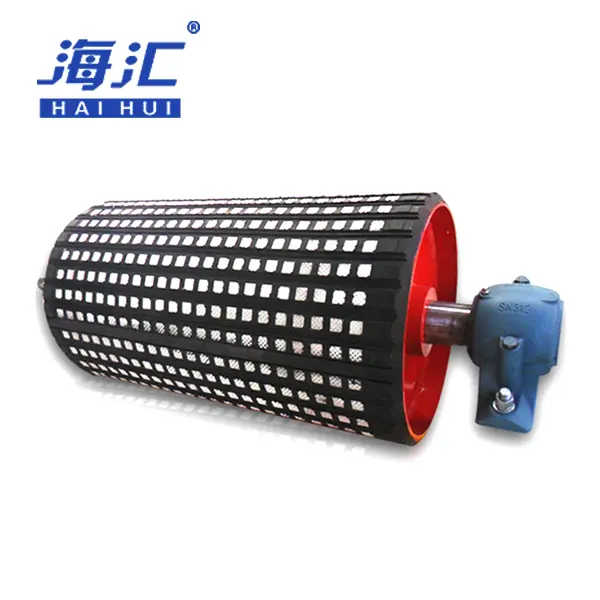
Ceramic Lagged Pulley
Ceramic lagging consists of ceramic tiles bonded to the shell. It provides maximum grip and wear resistance for high-tension or abrasive applications. Ceramic lagging is widely used in mining and heavy industry.
Self-Cleaning Pulley
Self-cleaning pulleys incorporate spiral or chevron bars on the shell. These bars help break up material buildup and prevent belt misalignment. This design is commonly used in recycling and waste handling applications.
Application Selection Guide
| Industry | Typical Application | Recommended Pulley Type |
|---|---|---|
| Mining | High-tension ore conveyors | Ceramic lagged with heavy-duty bearings |
| Cement | Raw material and clinker conveyors | Standard head pulley with diamond lagging |
| Ports | Ship loading and unloading | Wing pulley to reduce carryback |
| Aggregate | Gravel and sand conveyors | Standard head pulley with rubber lagging |
| Recycling | Waste and refuse conveyors | Self-cleaning or wing pulley |
| Power plants | Coal conveyors | Standard head pulley with flame-resistant lagging |
Installation and Commissioning
Head pulley alignment is critical. Misalignment causes belt tracking issues, uneven wear, and premature bearing failure. The pulley must be perpendicular to the belt centerline and level across its width. Common mistakes include over-tightening bearing housings, ignoring shaft deflection, and using incorrect lagging for the application.
Maintenance and Service Life
Head pulleys are designed for long service life, but regular maintenance is essential.
| Maintenance Item | Frequency | Action |
|---|---|---|
| Bearing temperature | Weekly | Monitor with thermal imaging |
| Lagging inspection | Monthly | Check for wear, damage, or separation |
| Shaft alignment | Annual | Verify with dial indicator |
| Bearing lubrication | Quarterly | Re-grease per schedule |
| Locking element torque | Semi-annual | Re-torque to specification |
Common Problems and Solutions
Belt slipping:
- Causes: Worn lagging, insufficient belt tension, oil contamination.
- Solutions: Replace lagging, adjust tension, clean pulley surface.
Bearing overheating:
- Causes: Over-greasing, misalignment, excessive load.
- Solutions: Follow grease schedule, realign shaft, reduce load.
Lagging delamination:
- Causes: Poor bonding, chemical attack, heat damage.
- Solutions: Replace lagging with appropriate material.
Shell wear:
- Causes: Abrasive material, misalignment, worn lagging.
- Solutions: Replace shell or pulley, improve alignment.
Quality and Testing
Haihui head pulleys undergo rigorous testing before shipment. Each unit is tested for:
- Shell concentricity and roundness
- Shaft straightness and keyway fit
- Weld integrity (100% NDT on shell seams)
- Bearing temperature under load
- Lagging adhesion strength
- Dynamic balancing to G-16 standard
What Makes a Head Pulley Suitable for Conveyors?
- Properly sized shaft for peak torque and belt tension
- Shell concentricity within 0.5 mm TIR
- Lagging selected for specific material and environment
- Sealed bearings with adequate L10 life
- Easy access for inspection and maintenance
Why Choose Haihui Head Pulleys?
- Experience: Haihui has been manufacturing head pulleys for over 20 years.
- Quality: All pulleys are designed and manufactured to CEMA and ISO standards.
- Customization: Haihui offers custom shaft sizes, lagging options, and mounting configurations.
- Service: Haihui provides technical support, on-site commissioning, and after-sales service.
🚀 Upgrade Your Conveyor Drive with Haihui
Stop dealing with belt slip, bearing failures, and misalignment. Haihui head pulleys offer reliable grip, rugged construction, and long service life. Contact us today for a customized quotation and fast delivery.
FAQs about Head Pulleys
1. What is a head pulley?
A head pulley is the drive pulley at the discharge end of a belt conveyor. It transfers motor torque to the belt, moving material along the conveyor.
2. What is the purpose of lagging on a head pulley?
Lagging increases friction between the pulley and belt, preventing slip. It also protects the shell from wear.
3. What type of lagging is best for wet conditions?
Diamond or herringbone rubber lagging provides good grip in wet or oily conditions by channeling moisture away from the belt surface.
4. How do I know if my head pulley needs replacement?
Signs include:
- Belt slippage despite proper tension
- Visible shell wear or grooving
- Vibration or noise from bearings
- Lagging separation or cracking
5. How do I select the right head pulley?
Consider these factors:
- Belt width and tension
- Belt speed and torque requirements
- Material type and environmental conditions
- Lagging type and thickness
- Bearing size and sealing
References
- CEMA – Belt conveyor design standards
- ISO 5048 – Continuous mechanical handling equipment
- DIN 22101 – Belt conveyors – Calculation of operating power and tensile forces
- AGMA 2001 – Gear rating standards
- Haihui internal test reports and field data (2020-2025)
 English
 العربية
 简体中文
简体中文 Nederlands
 Français
 Deutsch
 Bahasa Indonesia
 Italiano
 日本語
日本語 한국어
한국어 Bahasa Melayu
 Polski
 Português do Brasil
 Русский
 Español
 Türkçe