Ultimate Belt Conveyor Guarding Selection Guide
According to recent research from Grand View Research and Smithers, industrial conveyor safety system demand continues rising through 2026, driven by stricter workplace safety mandates and standardized mechanical protection regulations. Buyers need guarding partners built for full compliance, long-term durability, and scalable site protection, not just basic protective covers.
Belt conveyor guarding forms the primary safety barrier between operating personnel and high-risk moving components. From fixed heavy-duty enclosures to modular removable safety guards, every category serves a unique protective purpose in mining, logistics, manufacturing, and bulk material handling ecosystems.
Types of Belt Conveyor Guarding
Belt Conveyor Guarding
Not all belt conveyor guarding delivers equal protection. Generic protective panels often fail site-specific safety standards, resulting in hidden hazards, frequent inspections failures, and unplanned shutdowns. Professional conveyor safety systems are categorized by structural design, installation position, protection logic, and maintenance adaptability. Below are the four mainstream types widely adopted in modern industrial sites.
Fixed Enclosed Belt Conveyor Guarding
Fixed enclosed guarding is the most fundamental and widely certified safety solution for standard belt conveyor lines. It is designed for permanent installation on high-risk rotating and meshing components.
Structural & Material Design
- Welded steel frame with rigid integrated structure
- Heavy-duty metal mesh or solid steel plate panels
- Anti-rust electrostatic spraying or hot-dip galvanized surface
Core Protection Coverage
- Fully encloses drive drums, tail drums, and coupling parts
- Covers belt roller meshing areas and tensioning devices
- Eliminates exposure of all continuous moving components
On-Site Advantages
Fixed enclosed belt conveyor guarding delivers stable, long-term isolation protection with zero accidental displacement risks. It fully complies with ISO 14120 and EN 620 mechanical safety standards for permanent mechanical hazard isolation [1]. For conventional factory conveying lines and stable operating workshops, this type remains the baseline safety configuration. Haihui optimizes frame rigidity and mesh density to avoid deformation under long-term environmental vibration, ensuring consistent safety performance throughout equipment service life.
Modular Removable Conveyor Guarding
Modular removable guarding is engineered for sites requiring frequent inspection, maintenance, and belt overhaul operations, balancing safety protection and operational convenience.
Structural & Material Design
- Assembled modular splicing structure, no integral welding required
- Quick-release bolt and buckle locking system
- Lightweight high-strength steel and aluminum alloy composite materials
Core Protection Coverage
- Covers intermediate roller groups and open belt sections
- Protects low-risk moving areas that need regular manual inspection
- Supports partial disassembly for targeted maintenance
On-Site Advantages
Traditional integrated guarding requires overall disassembly during maintenance, wasting labor and time costs. Haihui modular belt conveyor guarding supports rapid single-module disassembly, avoiding full-line shutdown caused by minor maintenance. The standardized splicing design realizes universal matching of different conveyor specifications, greatly improving equipment maintenance efficiency while maintaining complete safety isolation.
Elevated Walkway & Handrail Guarding
Elevated walkway guarding is customized for high-altitude overhead conveyor lines, focusing on personnel walking safety and anti-fall protection.
Structural & Material Design
- High-strength steel handrail frame + anti-slip pedal structure
- Full-height enclosure design to prevent crossing and falling risks
- Reinforced connection nodes for wind resistance and load resistance
Core Protection Coverage
- Encloses overhead conveyor operation and maintenance channels
- Blocks personnel from approaching high-altitude moving belt areas
- Provides stable walking and inspection platforms
On-Site Advantages
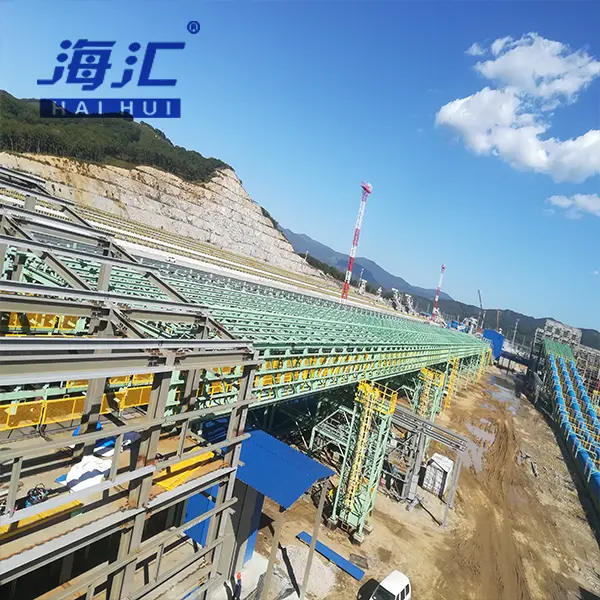
Overhead long-distance conveyors in ports, mines, and chemical plants face prominent high-altitude operation risks. Professional walkway belt conveyor guarding isolates operating personnel from moving equipment while ensuring unobstructed inspection passages. Haihui strictly controls handrail height, mesh spacing, and pedal load-bearing standards to fully meet EN 617 conveyor safety access specifications [2].
Custom Anti-Collision & Dust-Proof Guarding
Custom anti-collision and dust-proof integrated guarding is a multi-functional upgraded solution for harsh working conditions such as high dust, severe corrosion, and frequent vehicle crossing.
Structural & Material Design
- Thickened plate anti-collision structure + fully enclosed dust-proof cover
- Corrosion-resistant coatings and weather-resistant sealing strips
- Custom curved and inclined structures adapting to special conveyor tracks
Core Protection Coverage
- Prevents external vehicle and object collision damage to conveyor components
- Blocks internal material dust overflow to improve workshop environment
- Isolates corrosive humid air to extend equipment service life
On-Site Advantages
Harsh industrial scenarios have diversified protection demands beyond single safety isolation. Haihui customized multi-functional belt conveyor guarding integrates anti-collision, dust-proof, anti-corrosion, and safety isolation functions in one, solving the pain points of single-functional guards being unable to adapt to complex working conditions. It is the preferred upgraded solution for mine, cement, and chemical conveyor systems.
4 Core Criteria for Selecting Belt Conveyor Guarding
Belt Conveyor Guarding
Choosing qualified belt conveyor guarding is never a simple procurement task. Excellent safety guarding can reduce site accident rates, pass standardized safety audits, and lower long-term maintenance costs. Unqualified products will leave persistent safety hazards and cause repeated rectification delays. The following four core criteria help industrial buyers complete scientific and compliant selection.
Full International & Industrial Compliance
Safety compliance is the primary threshold for belt conveyor guarding procurement, determining site audit pass rate and production legality.
Core Compliance Standards
- Conform to ISO 12100 mechanical safety general design principles [3]
- Meet EN 620 bulk material conveyor safety protection specifications
- Comply with local workplace safety and mechanical isolation regulations
- Pass third-party safety performance testing and certification
Practical Value
Standardized compliant guarding avoids safety rectification shutdowns and ensures smooth project acceptance and daily safety inspections. As a professional manufacturer, Haihui provides complete qualification documents, test reports, and compliance certificates for all belt conveyor guarding products, supporting global customer audit and filing needs.
Scenario-Matched Structural Durability
Different working conditions put forward completely different durability requirements for guarding structures. Blind universal matching leads to rapid deformation, rust, and failure of protective equipment.
Key Durability Indicators
- Material thickness and frame structural stability
- Surface anti-rust, anti-corrosion and weather resistance performance
- Anti-vibration and anti-deformation capability under long-term equipment operation
- Impact resistance against external object collision
Practical Value
General thin-walled guarding is prone to loose welding joints and mesh deformation after long-term vibration, losing protective effect. Haihui designs targeted structural reinforcement and surface treatment schemes according to light, medium, and heavy-duty working conditions, ensuring that belt conveyor guarding maintains stable protective performance for years without frequent replacement.
Balanced Safety & Maintainability Design
Excellent belt conveyor guarding must achieve perfect balance between absolute safety isolation and convenient daily maintenance.
Optimized Design Logic
- Completely covers all dangerous exposure points without safety dead angles
- Modular disassembly structure for rapid inspection and component replacement
- Reserved maintenance observation windows and operation gaps
- Locking device to prevent random opening by non-operators
Practical Value
Overly enclosed integrated guarding increases maintenance difficulty, while overly simple hollow guarding has insufficient safety performance. Haihui insists on scenario-based customized design, ensuring zero safety hazards while minimizing maintenance time costs and improving overall operational efficiency.
Standardized Batch Consistency & Traceability
For large-scale industrial conveyor parks, batch consistency of guarding products determines the overall safety uniformity and later maintenance convenience.
Quality Control System
- Unified mold production to ensure consistent specification and size
- Full-process inspection of welding, spraying, and assembly processes
- Independent batch coding and production record archiving
- Standardized after-sales replacement and matching system
Practical Value
Irregular products from small manufacturers lead to messy on-site styles and difficult later replacement and matching. Haihui realizes standardized mass production of belt conveyor guarding, with stable batch quality and strong versatility, bringing long-term stable safety protection and convenient after-sales service for enterprise production lines.
How Professional Belt Conveyor Guarding Eliminates Industrial Risks
Belt Conveyor Guarding
Most conveyor safety accidents are not caused by equipment failure, but by incomplete safety isolation and unstandardized guarding configuration. Professional belt conveyor guarding forms a three-dimensional risk prevention and control system from physical isolation, environmental protection, and standardized operation.
Physical Isolation of Mechanical Injury Hazards
The biggest hidden danger of running belt conveyors is rolling, meshing, and extrusion hazards. Unprotected rotating drums and belt operation areas easily cause personnel entanglement and extrusion injuries.
Qualified belt conveyor guarding completely isolates personnel from all moving parts through rigid structural barriers. Standard mesh spacing and height specifications prevent accidental contact of limbs with dangerous areas, effectively eliminating mechanical injury risks [4]. Haihui strictly implements safety distance standards in structural design, leaving no blind spots for danger exposure.
Dust Control & Environmental Safety Optimization
Bulk material conveying such as coal, ore, and chemical raw materials easily produces flying dust, which not only pollutes the workshop environment but also triggers hidden dangers such as dust explosion and equipment wear.
Fully enclosed belt conveyor guarding locks dust inside the conveying area, reduces dust overflow, improves workshop air quality, and reduces equipment wear caused by dust deposition. For environmentally restricted industrial parks, dust-proof guarding is an essential safety and environmental protection configuration.
Standardized Site Management & Anti-Misoperation
Unstandardized open conveyor lines easily lead to misoperation and accidental entry of foreign objects. Complete guarding systems standardize site management boundaries and restrict non-staff access to operating areas.
Equipped with standardized warning signs and locking structures, Haihui belt conveyor guarding reminds personnel of risk boundaries at all times, avoiding safety accidents caused by human misoperation and foreign object entry, and realizing standardized and refined safety management of conveyor lines.
Common Wrong Selection & Matching Cases
Belt Conveyor Guarding
Many enterprises have installed conveyor guarding but still fail safety inspections, mostly due to mismatched model selection and irregular installation. The following typical wrong cases help enterprises avoid safety loopholes.
Wrong Selection 1: Light-duty mesh guarding for heavy-duty mine conveyor lines
Light-duty thin mesh guarding has insufficient impact resistance and rigidity, which is easily deformed and damaged by material impact and equipment vibration in mine heavy-load working conditions, losing protective effect. Solution: Adopt thickened steel plate fixed enclosed guarding customized for heavy-duty scenarios.
Wrong Selection 2: Integrated fully enclosed guarding for frequent maintenance lines
Integrated fully enclosed structure requires overall disassembly for daily inspection and roller replacement, seriously affecting production efficiency. Solution: Match modular removable belt conveyor guarding to balance safety and maintenance efficiency.
Wrong Selection 3: Ordinary non-corrosive guarding for chemical humid workshops
Ordinary sprayed guarding is prone to rust and peeling in humid and corrosive chemical environments, resulting in structural damage and shortened service life. Solution: Upgrade to hot-dip galvanized or stainless steel anti-corrosion customized guarding.
Wrong Selection 4: No elevated guarding for high-altitude overhead conveyors
Lack of professional walkway handrail guarding for overhead conveyor lines leads to high-altitude fall risks for inspection personnel and fails to meet national safety standards. Solution: Install dedicated elevated walkway and handrail integrated guarding.
Step-by-Step Scientific Selection Guide
Belt Conveyor Guarding
Scientific selection of belt conveyor guarding does not rely on experience, but needs to comprehensively match equipment parameters, working condition characteristics, safety standards, and maintenance demands. The following five-step selection method helps buyers achieve zero-error compliant matching.
Step 1: Confirm conveyor basic parameters and risk points
Clarify conveyor installation position (ground/overhead), belt speed, load grade, and key dangerous areas (drive drum, tensioning device, roller group) to confirm core protection demands.
Step 2: Judge on-site working condition attributes
Distinguish conventional workshop, mine heavy-duty, chemical corrosion, high-altitude operation, and dust-intensive scenarios to select corresponding anti-vibration, anti-corrosion, dust-proof, and anti-collision functional guarding.
Step 3: Match maintenance frequency demands
Adopt fixed enclosed guarding for long-term stable operation lines; choose modular removable guarding for lines requiring frequent inspection and component replacement.
Step 4: Verify local safety compliance standards
Confirm local mechanical safety specifications and audit requirements to ensure guarding size, height, mesh spacing, and structure fully meet certification standards.
Step 5: Confirm manufacturer customization and after-sales capability
Prioritize manufacturers with mature scenario customization experience, which can adjust structure, function, and size according to special on-site conditions to achieve perfect fitting installation.
FAQs
1. What is the core function of belt conveyor guarding?
Belt conveyor guarding is the core safety barrier of conveyor systems. Its core functions include physical isolation of mechanical moving hazards, prevention of personnel injury and foreign object entry, dust and environmental protection, and standardized on-site safety management, ensuring compliant and stable operation of conveyor lines.
2. What standards must industrial conveyor guarding comply with?
Formal industrial belt conveyor guarding needs to comply with ISO 12100 mechanical safety standards, EN 620 bulk conveyor specifications, and local workplace safety regulations. It must pass third-party performance testing to meet anti-collision, isolation, and structural stability requirements.
3. How to choose guarding for mine heavy-duty conveyor lines?
Mine heavy-duty scenarios require thickened fully enclosed fixed guarding with high structural rigidity, anti-vibration, anti-impact, dust-proof, and anti-corrosion functions. It needs to adapt to long-term high-load operation and harsh environmental conditions to avoid frequent damage and safety hazards.
4. Is modular removable guarding safe enough for industrial use?
Yes. Qualified modular belt conveyor guarding adopts standardized locking and splicing structure, with safety isolation performance completely consistent with fixed guarding. Its quick-disassembly design only optimizes maintenance efficiency without reducing safety protection level, which is widely recognized in modern industrial safety management.
5. How often does conveyor guarding need maintenance and replacement?
Under normal working conditions, high-quality Haihui belt conveyor guarding can be used stably for more than 5 years. Daily inspection only needs to check firmness of connection, surface anti-rust status, and locking flexibility. Timely replacement is required only for individual deformed and damaged components.
Haihui Customization & Technical Service
Belt Conveyor Guarding
Standard single-specification belt conveyor guarding cannot fully adapt to complex and changeable industrial working conditions and safety audit standards. Unreasonable matching will lead to unqualified safety inspections and potential operational risks. As a professional conveyor safety system manufacturer, Haihui focuses on scenario-based accurate matching and personalized customization of belt conveyor guarding.
Haihui has rich practical experience in mine bulk conveying, port logistics, chemical industry, food processing, and automated manufacturing fields. Our technical team can formulate targeted safety guarding schemes according to customers’ on-site equipment parameters, working condition characteristics, maintenance habits, and compliance requirements.
All Haihui belt conveyor guarding products are manufactured in strict accordance with international industrial safety standards, with stable structural performance, strong environmental adaptability, and full compliance certification. We provide one-stop services including pre-sales safety scheme evaluation, personalized structural customization, in-production precision manufacturing, on-site installation guidance, and after-sales technical support.
If you have guarding selection confusion, safety compliance matching demands, or special scenario customization needs, contact Haihui’s professional technical team to obtain exclusive belt conveyor safety guarding solutions!
References
Industrial Conveyor Safety Market Outlook 2026 – Grand View Research
Mechanical Safety General Design Principles ISO 12100 – International Organization for Standardization
Bulk Material Conveyor Safety Standard EN 620 – European Committee for Standardization
Conveyor Equipment Safety Protection Specification EN 617 – European Safety Certification Standard
Mining Conveyor Mechanical Hazard Prevention Research – Industry Safety Research Institute
 English
 العربية
 简体中文
简体中文 Nederlands
 Français
 Deutsch
 Bahasa Indonesia
 Italiano
 日本語
日本語 한국어
한국어 Bahasa Melayu
 Polski
 Português do Brasil
 Русский
 Español
 Türkçe