Reliable Idle Rollers Selection & Cost Guide
- Why Idle Roller Selection Matters For Conveyor Systems
- 4 Common Idle Roller Types Every Conveyor Engineer Should Master
- Standard vs Rubber-Coated Idle Rollers: Which Is Better?
- Prevent Idle Roller Failures—3 Practical Optimization Methods
- Scenario-Based Idle Roller Selection Guide
- How to Judge High-Quality Idle Rollers?
- FAQs about Idle Rollers
- Partner with Haihui for Reliable Idle Roller Solutions
- References
On industrial conveyor lines, idle rollers operate like silent foundational components: one defective roller results in belt sagging, material deviation, abnormal vibration, or premature belt wear that turns smooth conveying into costly downtime and frequent maintenance. That simple unpowered roller is the make-or-break component for conveyor stability, belt service life, and consistent material transportation efficiency.
For factory-scale conveyor deployment and batch procurement, success requires sticking to standardized roller mechanics—structural material, bearing configuration, surface finish, and load-bearing tolerance acting as an integrated operational unit. The priority isn’t just basic rotation; it is selecting idle rollers that maintain stable passive rotation, resist dust and corrosion, support uniform load distribution, and reduce belt friction without abnormal jitter or stagnation.
Why Idle Roller Selection Matters For Conveyor Systems
If conveyor belts suffer from unstable operation, uneven load stress, or frequent wear, idle roller quality and matching specifications are usually the core culprit. Understanding the synergy between idle roller structure, material performance, and on-site working conditions is vital for stable, low-cost, and long-lasting conveyor operation.
Matching Roller Structure to Conveyor Operational Stability
On standard conveyor lines, idle rollers undertake passive rotation, supporting the full weight of materials and belts while maintaining flat and stable belt operation. Improper structural matching will cause uneven stress concentration, resulting in local belt fatigue and cumulative operational failures.
Hardware configuration inside industrial idle rollers:
Tube body selection:
Seamless steel tube and high-precision welded tube determine overall rigidity and load capacity.
Thin-walled tubes deform easily under heavy loads, causing belt jitter and deviation.
Bearing and seal pairing:
High-precision deep groove ball bearings dictate rotation flexibility and low-resistance operation.
Single-layer sealing fails in dusty and humid environments, leading to bearing clogging and stuck rotation.
Material & working condition matching in idle rollers:
Surface anti-corrosion treatment must align with on-site humidity, dust, and chemical erosion risks to prevent rust and surface peeling.
Haihui engineers tailor idle roller tube thickness, bearing models, and sealing structures to maintain consistent low-friction rotation across variable load and environmental conditions.
How Structural Precision and Surface Quality Influence Conveyor Performance
Idle roller precision determines the flatness of the entire conveyor belt. Roller runout error, surface roughness, and coaxiality directly affect belt operating stability. Excessive dimensional deviation will cause periodic belt jitter, material bouncing, and accelerated local wear. When surface anti-wear treatment is insufficient, long-term friction will generate fine debris, pollute materials, and aggravate equipment loss.
| Parameter (Idle Roller) | Lower value effect | Higher value effect |
|---|---|---|
| Tube runout tolerance (mm) | Smoother operation, higher processing cost | Severe belt jitter, material bouncing risk |
| Surface roughness (μm) | Lower belt friction, extended belt life | Accelerated belt wear, scratch damage risk |
| Bearing resistance (N) | Energy-saving operation, low startup load | Increased motor load, belt creep phenomenon |
Impact on Operational Cost and Equipment Lifespan
Idle roller quality directly dictates conveyor operating cost and maintenance frequency, forming the foundation of long-term stable production.
Stability and wear control on conveyor lines:
Belt protection:
Precision idle rollers provide uniform support, avoiding local overstress and belt fatigue damage.
Unstable roller operation causes irregular friction, shortening belt service life by 20%–30%.
Operational loss control:
Stable passive rotation reduces motor load and lowers long-term power consumption.
Low-quality rollers require frequent shutdown replacement, disrupting continuous production schedules.
Practical outcomes for industrial conveyor systems:
High-precision Haihui idle rollers maintain consistent flat support, maximizing belt utilization and reducing replacement frequency.
Excellent sealing and anti-corrosion performance minimize failure rate, cutting daily maintenance labor and spare parts costs.
Haihui prioritizes overall conveyor operational stability, ensuring equipment durability is systematically guaranteed, not reliant on later maintenance remedies.
4 Common Idle Roller Types Every Conveyor Engineer Should Master
Selecting the correct idle roller type determines whether the conveyor system delivers stable low-loss operation or frequent hidden failures. Different structural designs target distinct load conditions, environmental scenarios, and conveying requirements.
Standard Flat Idle Rollers: Optimizing Light-Load Stable Conveying
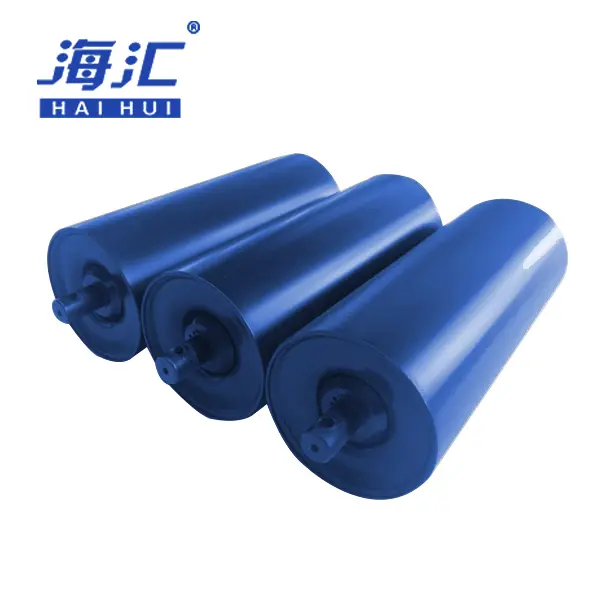
Standard flat idle rollers adopt straight cylindrical structure, delivering uniform flat support for horizontal conveyor lines, with low rotation resistance and stable operation—ideal for light-load, low-dust, and stable material conveying scenarios.
Selection checklist for working condition matching:
Load adaptation:
Match tube wall thickness according to single-point material load to avoid bending deformation.
Overload operation will cause roller bending and irreversible belt deviation.
Environmental adaptation and stability:
Standard sealing structure adapts to indoor and low-dust workshops.
Ordinary surface treatment is suitable for non-corrosive material conveying scenarios.
Quick reference parameters for standard idle rollers (typical targets):
| Application Scenario | Load Range (kg/m) | Linear Speed (m/s) | Recommended Wall Thickness (mm) |
|---|---|---|---|
| Light packaging conveying | ≤50 | ≤1.2 | 2.0 |
| General bulk material | 50–120 | 1.2–2.0 | 2.5 |
| Medium-load workshop line | 120–200 | 2.0–2.5 | 3.0 |
For general flat conveying lines, Haihui standard idle rollers maintain low-resistance passive rotation, matching load parameters to avoid unnecessary structural redundancy and cost waste.
Troughing Idle Rollers for Bulk Material Conveying
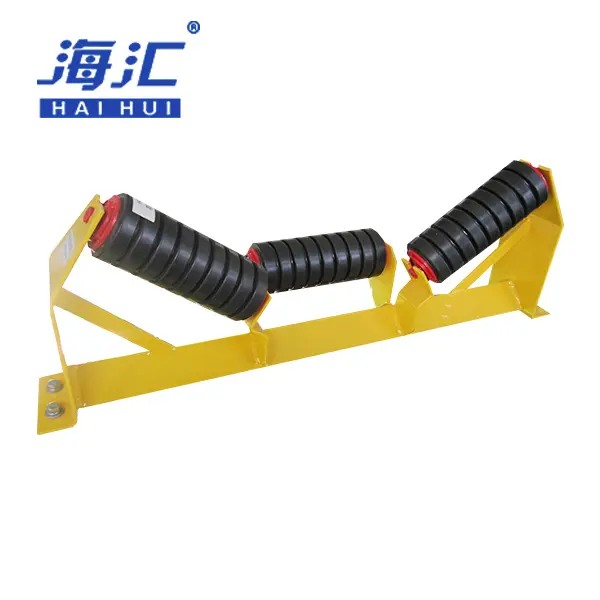
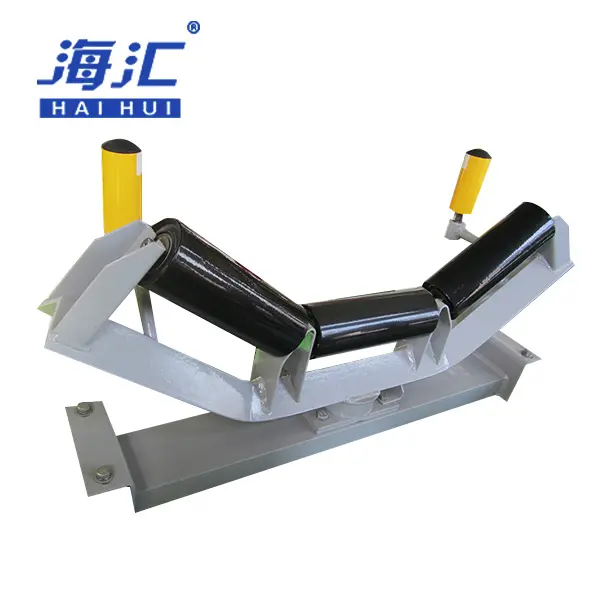
Troughing idle roller groups adopt three-roller or five-roller combined structure, forming a concave trough shape to gather bulk materials, prevent material scattering, and improve single-line conveying capacity. They are core configurations for mining, cement, grain, and port bulk conveying lines.
Target bulk conveying optimization:
Maintain stable trough angle to ensure material gathering without belt edge extrusion.
Match roller group spacing according to material particle size to avoid local belt sagging.
Strengthen bearing load capacity to adapt to impact load of bulk material feeding.
Haihui troughing idle rollers are pre-adjusted for standard trough angles, ensuring uniform force on each roller and stable material gathering without spillage.
Rubber-Coated Idle Rollers Ensuring Belt Protection
Rubber-coated idle rollers wrap high-elastic rubber layer on the steel tube surface, which increases friction coefficient, prevents belt slipping, buffers feeding impact, and effectively protects the belt surface from scratch damage. They are widely used for fragile materials, high-speed conveying, and impact frequent scenarios.
Build stable belt operation on purpose, not rely on luck:
Anti-slip and buffer performance:
High-friction rubber surface eliminates belt slipping under variable speed and load.
Elastic buffer absorbs feeding impact force to reduce belt fatigue loss.
Wear and aging resistance:
High-quality rubber formula resists ultraviolet aging and daily friction wear.
Integrated vulcanization process avoids rubber layer peeling and delamination.
Haihui rubber-coated idle rollers balance friction coefficient and wear resistance, protecting the belt while avoiding excessive resistance that increases operational load.
Anti-Dust Sealed Idle Rollers for Harsh Environments
Anti-dust sealed idle rollers adopt multi-layer labyrinth sealing structure, specially engineered for high-dust, humid, and corrosive working conditions such as mining, metallurgy, and chemical plants, ensuring flexible long-term rotation with zero clogging failure.
Where harsh environment optimization pays off:
Dust and moisture isolation:
Multi-layer sealing completely isolates external dust, humid air, and fine particles.
Prevent bearing rust, grease deterioration, and stuck rotation failure.
Long-term stability:
Special high-temperature and anti-aging grease adapts to variable ambient temperatures.
Integrated sealed structure avoids frequent maintenance and disassembly cleaning.
Haihui anti-dust sealed idle rollers deliver stable passive operation in harsh scenarios, greatly reducing equipment failure rate and downtime loss.
💡 Upgrade Your Conveyor Roller System Today > Looking for stable and low-consumption idle roller solutions? With mature industrial manufacturing experience, Haihui offers a full range of customized idle rollers for different working conditions. We provide 1-day technical solution proposals and flexible MOQs. Contact Us to match exclusive roller configurations for your conveyor line!
Standard vs Rubber-Coated Idle Rollers: Which Is Better?
Selecting between standard and rubber-coated idle rollers for industrial conveyors depends entirely on balancing operational stability, belt protection, environmental adaptability, and long-term maintenance costs.
Standard Flat Idle Rollers
Standard flat idle rollers adopt all-steel structure with low rotation resistance and high rigidity, focusing on basic support and energy-saving operation.
Operational advantages and cost control:
Cost performance: Simple structure, low manufacturing cost, suitable for large-scale batch deployment.
Energy saving: Smooth steel surface minimizes friction resistance and conveyor power consumption.
Stability limits you can’t ignore:
Hard steel surface provides no buffer, easily causing belt scratch under hard material impact.
Low friction coefficient leads to belt slipping under wet surface or heavy load conditions.
Where Haihui optimizes performance:
Haihui controls tube runout and surface finish precisely, ensuring ultra-stable rotation and making up for the structural limitations of ordinary standard rollers.
Rubber-Coated Idle Rollers
Rubber-coated idle rollers prioritize belt protection and anti-slip performance, sacrificing partial low-resistance performance in exchange for higher operational safety and longer belt life.
Core application advantages:
Excellent anti-slip performance ensures synchronous operation of belt and roller to avoid slipping deviation.
Elastic buffer performance effectively protects belts and fragile materials from impact damage.
Scenario limitations:
Higher surface friction slightly increases long-term power consumption.
Rubber layer ages faster under high-temperature and strong ultraviolet environment.
Application matching suggestions:
For high-speed, anti-slip, and belt-protection required scenarios, rubber-coated idle rollers are the priority.
For stable indoor light-load energy-saving conveying, standard idle rollers achieve higher cost performance.
Prevent Idle Roller Failures—3 Practical Optimization Methods
Most idle roller failures are caused by improper selection, poor sealing, and irregular installation, not natural aging. Standardized configuration and maintenance can eliminate over 90% of daily failures.
Adopt Multi-Layer Sealing Structure to Isolate Environmental Interference
Ordinary single-layer sealed idle rollers easily inhale dust and moisture, leading to bearing clogging, rust, and rotation stagnation. Upgrading to multi-layer labyrinth sealing can fundamentally solve environmental failure problems.
Sealing optimization key points:
Multi-stage isolation structure prevents external particles from entering the bearing cavity.
High-density grease locking design avoids grease loss and dry friction.
Anti-corrosion shaft head design prevents shaft rust and rotation jamming.
Haihui equips all harsh-environment idle rollers with upgraded sealing systems to guarantee long-term flexible rotation.
Match Specs Scientifically to Avoid Overload and Deformation Failure
Blindly selecting thin-walled or low-rigidity rollers for heavy-load scenarios is the main cause of roller bending and belt deviation. Scientific load matching is the core of long-term stability.
Load matching standards:
Calculate single-point load according to material density, conveying volume, and belt spacing.
Reserve 20%–30% load margin to cope with instantaneous impact load.
Adopt thickened tube body and reinforced shaft body for bulk material impact scenarios.
Daily test benchmark for roller operation:
| Daily Inspection Item | Qualified Target | Optimization Action |
|---|---|---|
| Manual rotation resistance | Uniform and smooth, no stuck point | Replace clogged bearing roller |
| Roller surface runout | ≤0.5mm no obvious jitter | Calibrate installation level or replace deformed roller |
| Surface corrosion & wear | No rust, no peeling, uniform wear | Renew anti-corrosion coating or replace rubber layer |
Standardize Installation Spacing to Balance Belt Stress
Unreasonable roller installation spacing leads to uneven belt support, local sagging, and stress concentration, accelerating fatigue damage. Standardized spacing layout ensures uniform stress on the entire belt.
Spacing layout principles:
Reduce spacing for heavy-load bulk materials to enhance support rigidity.
Appropriately increase spacing for light packaging materials to save costs.
Strictly level the installation base to avoid height difference and single-point stress overload.
Stabilize Operation With Standardized Configuration > Haihui provides one-stop working condition matching, specification customization, and installation guidance services. Strict factory precision control eliminates batch differences, ensuring every idle roller maintains consistent low-friction and high-stability operation.
Scenario-Based Idle Roller Selection Guide
Different industrial scenarios have completely different requirements for idle roller load capacity, wear resistance, sealing performance, and anti-slip ability. Targeted selection can maximize operational efficiency and reduce comprehensive costs.
Light Packaging & Logistics Conveying
Logistics sorting, carton conveying, and light workshop production lines feature light load, stable operation, and low environmental interference.
Recommended configuration: Standard flat idle rollers with ordinary sealing and medium wall thickness.
Core advantages: Low rotation resistance, energy-saving operation, high cost performance, meeting long-term stable conveying demands.
Mining & Bulk Material Conveying
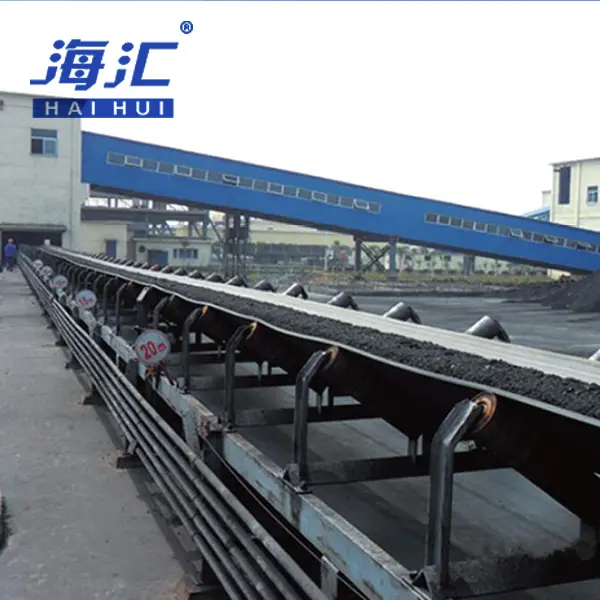
Mining, cement, coal, and port scenarios feature heavy load, frequent impact, high dust, and severe corrosion.
Recommended configuration: Thickened troughing idle rollers + multi-layer dustproof sealing structure.
Core advantages: Strong load resistance, anti-impact, anti-clogging, adapting to harsh continuous working conditions.
High-Speed & Fragile Material Conveying
High-speed sorting, food packaging, and fragile material conveying require anti-slip, buffer, and scratch-free protection.
Recommended configuration: High-elastic rubber-coated idle rollers.
Core advantages: Anti-slip synchronization, impact buffering, effective protection of belt and material integrity.
How to Judge High-Quality Idle Rollers?
Excellent idle roller performance is a comprehensive result of precision processing, high-quality accessories, and standardized assembly, which can be verified through multiple dimensional indicators.
Verifying Rotation Smoothness and Low Resistance
Qualified idle rollers have uniform and stable rotation without jitter, stagnation, or abnormal noise. Excessive resistance will increase belt load and cause creeping deviation.
Haihui products adopt precision bearing matching and strict assembly process to ensure ultra-low stable rotation resistance.
Checking Sealing Integrity and Environmental Adaptability
Sealing performance determines the service life of idle rollers in harsh environments. Poor sealing leads to early failure and frequent replacement.
Haihui multi-layer labyrinth sealing structure passes strict dust-proof and waterproof tests, adapting to long-term harsh working condition operation.
Confirming Structural Rigidity and Dimensional Precision
Tube wall thickness, coaxiality, and runout tolerance determine load capacity and operational stability. Low-precision rollers cause persistent belt jitter and wear.
| Curing & Working Condition | Continuous Operation Life | Failure Rate | Comprehensive Maintenance Cost |
|---|---|---|---|
| Ordinary low-precision idle rollers | 6–12 months | High, frequent clogging & deformation | High replacement & labor cost |
| Haihui high-precision idle rollers | 3–5 years | Ultra-low, stable operation | Long-term cost saving |
FAQs about Idle Rollers
1) Why do idle roller specifications affect overall conveyor operational stability?
Idle rollers bear all belt and material loads and determine the flat support of the entire conveyor line. Unmatched wall thickness, poor sealing, or low dimensional precision will cause uneven stress, belt jitter, deviation, and accelerated wear. Scientific specification matching ensures uniform passive rotation and stable belt operation, reducing downtime and loss.
2) What core indicators should be prioritized when purchasing industrial idle rollers?
Priority should be given to dimensional runout tolerance, bearing precision, sealing structure grade, tube wall thickness uniformity, and surface anti-corrosion process. These indicators directly determine rotation stability, load capacity, environmental adaptability, and service life, avoiding batch failure risks in later operation.
3) What scenarios require rubber-coated idle rollers instead of standard steel rollers?
High-speed conveying, wet working conditions, easy slipping lines, fragile material transportation, and frequent impact feeding scenarios all require rubber-coated idle rollers. The rubber layer increases friction to prevent slipping, buffers impact to protect belts, and effectively reduces material and equipment loss.
4) How to extend the service life of idle rollers in dusty and humid environments?
Adopt multi-layer dustproof and waterproof sealed idle rollers, regularly clean surface dust and debris, check rotation flexibility, replenish special lubricating grease regularly, and eliminate deformed and stuck rollers in time. Haihui’s optimized sealed structure can greatly reduce daily maintenance frequency and extend service life.
5) What causes idle roller jitter and belt deviation?
Common causes include excessive roller runout, uneven wall thickness, deformed tube body, inconsistent installation height, stuck bearing rotation, and unbalanced load. Standardizing selection precision and installation process can completely solve most jitter and deviation problems.
Partner with Haihui for Reliable Idle Roller Solutions
As a professional manufacturer of conveyor accessory equipment, Haihui focuses on R&D, precision processing, and customized production of high-performance idle rollers. Relying on mature production technology and strict ISO 9001 quality control system, we provide stable, low-loss, and long-life idle roller products for global industrial conveyor systems.
We support full-size customization, special working condition structural optimization, fast sample testing, and bulk batch supply. Our professional engineering team provides free working condition matching and installation technical guidance to help customers eliminate hidden conveyor failures, reduce operational costs, and improve production efficiency.
Fast Service: 1-day professional technical solution proposal, customized drawing support, and efficient after-sales response.
Strict Quality Control: Full-dimensional precision testing, sealed performance testing, and load durability testing before delivery.
Flexible Order Support: Support small-batch trial orders and large-scale mass customized production to meet different procurement demands.
👉 Contact Haihui Today to customize exclusive idle roller solutions and optimize your conveyor system operation!
References
Conveyor Idler Roller Structural Design Specification – Industrial Mechanical Standard
Belt Conveyor Operation Stability Optimization Guide – Mechanical Industry Research Institute
Sealed Bearing Dustproof and Waterproof Technology Standard
Rubber Coating Anti-Aging and Wear Resistance Technical Specification
Industrial Conveyor Load Matching Design Manual
ISO 9001 Industrial Mechanical Parts Quality Management System
Belt Conveyor Deviation Control and Maintenance Technology Research
Harsh Environment Conveyor Accessories Selection Guide
 English
 العربية
 简体中文
简体中文 Nederlands
 Français
 Deutsch
 Bahasa Indonesia
 Italiano
 日本語
日本語 한국어
한국어 Bahasa Melayu
 Polski
 Português do Brasil
 Русский
 Español
 Türkçe