Premium Trough Roller | Haihui Industrial Guide
- Key Points to Navigate Trough Roller Performance
- 7 Essential Factors For Choosing Trough Roller
- Structured Group Types: Single, Three and Five Roller Trough Sets
- Material Choices: Carbon Steel, Galvanized and Rubber-Coated Shell
- Bearing & Sealing Systems: Core of Long-Term Stability
- Manufacturing Precision: Roundness and Welding Quality
- Installation Spacing and Layout Standards
- On-Site Scenario Adaptation
- Haihui Customization and Technical Support
- Industrial Quality Standards and QC Inspection Benchmarks
- 5 Hidden Risks When Selecting Trough Roller
- Price Vs. Quality: Finding The Trough Roller Cost-Effective Sweet Spot
- Optimize Lead Time and Supply Stability With Haihui
- Validate Product Reliability and Sustainability
- Partner With Haihui for Premium Trough Roller Solutions
- References
Picking trough roller configurations isn’t a trivial spare-part swap; it’s a foundational conveyor system decision. One mismatched trough angle, substandard shell thickness, or poorly sealed bearing turns steady bulk conveying into material spillage, belt abrasion, and recurring unplanned downtime.
This guide breaks down how to match trough roller structures, material specs, sealing performance, and installation standards to your working conditions, so your belt conveyor runs stably with minimal maintenance and maximum throughput efficiency.
Key Points to Navigate Trough Roller Performance
➔ Match trough angle and roller grouping to bulk material density to eliminate spillage and center load distribution.
➔ Verify shell material, wall thickness, and surface treatment for targeted wear and corrosion resistance.
➔ Audit bearing and sealing configurations to block dust, moisture, and slurry intrusion in harsh environments.
➔ Follow industrial installation spacing and horizontal calibration standards to prevent belt deviation and sagging.
➔ Leverage customized trough roller designs from Haihui to adapt to heavy-load, high-speed, and corrosive conveying scenarios.
7 Essential Factors For Choosing Trough Roller
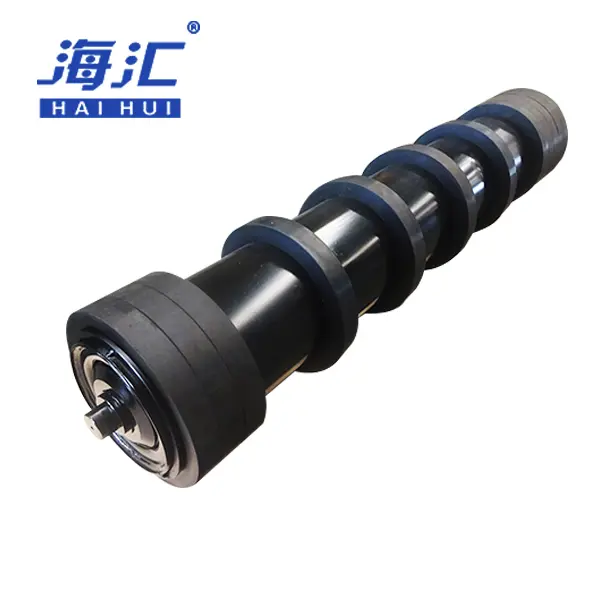
Selecting qualified trough rollers means building a reliable load-support system: structural stability, anti-wear performance, sealing durability, and on-site adaptability. This guide delivers practical, shop-tested specs for evaluating and configuring industrial trough roller sets.
Structured Group Types: Single, Three and Five Roller Trough Sets
Trough roller grouping directly determines the belt holding shape, material carrying capacity, and anti-spillage effect, serving as the core of bulk conveying stability.
Single trough roller
Integral curved structure forms a natural trough shape, featuring simple installation and low cost. Ideal for light-load, low-speed conveying of fine materials and small-particle bulk goods. Limited load-bearing capacity makes it unsuitable for heavy ore and large-scale material transportation.
Three-roller trough set
The most widely used industrial configuration, combining one horizontal middle roller and two inclined side rollers. It balances load uniformity and material holding effect, adapting to most mine, port, and factory bulk conveying lines. Standard trough angles include 20°, 30°, and 35° for flexible scenario matching.
Five-roller trough set
Multi-section segmented combination achieves a larger trough depth and ultra-stable load support. Perfect for heavy-load, high-capacity conveying and large-particle sharp materials, effectively preventing material sliding and belt local stress concentration.
Angle matching logic
Shallow 20°–30° trough angles suit fine powder materials to avoid material accumulation; deep 35°–45° angles adapt to large, heavy bulk materials to maximize loading volume and anti-spillage performance.
Material Choices: Carbon Steel, Galvanized and Rubber-Coated Shell
Trough roller shell material dictates wear resistance, anti-corrosion capability, and overall service life, which must be matched with on-site environmental conditions.
Carbon steel shell
High structural strength and impact resistance, suitable for heavy-load mine and quarry conveying. Requires regular anti-rust maintenance in humid environments; prone to surface oxidation without protective treatment.
Hot-dip galvanized shell
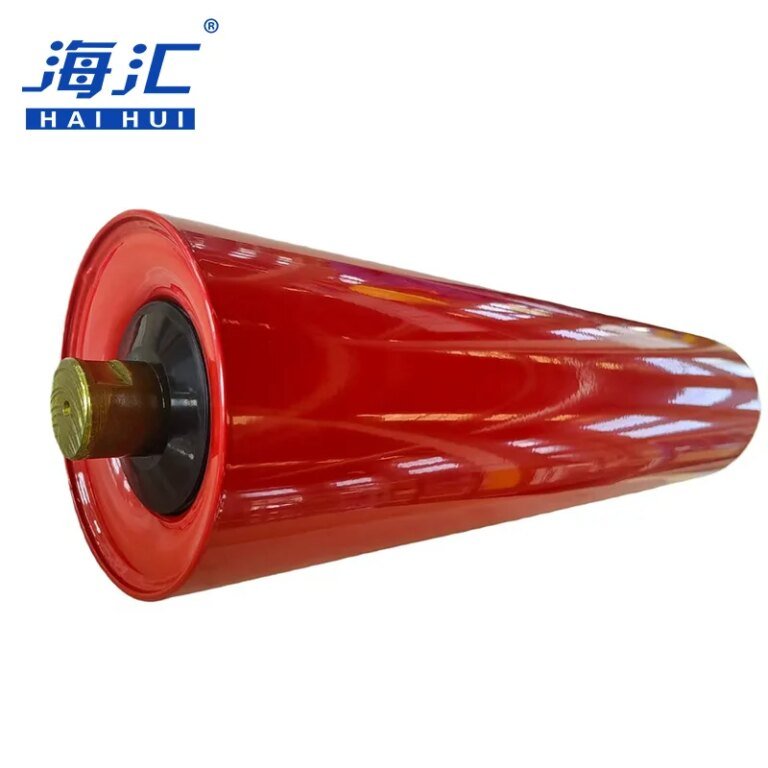
Integrates anti-corrosion and anti-rust performance, adapting to humid ports, outdoor open-air lines, and slightly corrosive workshops. No frequent painting maintenance needed, reducing long-term upkeep costs.
Rubber-coated trough roller
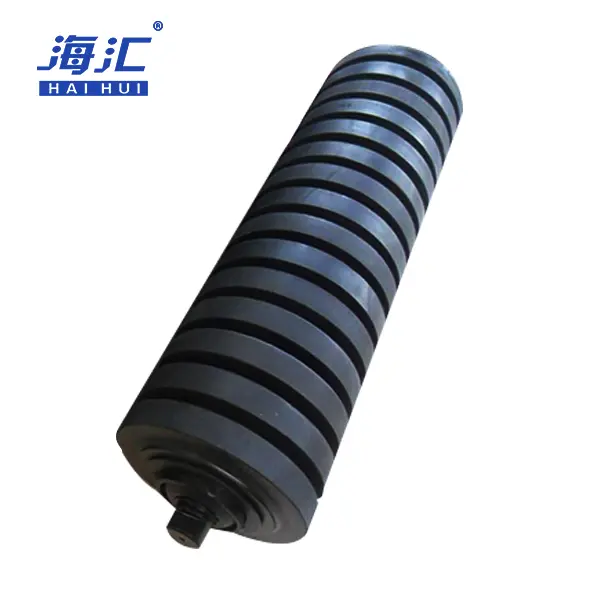
Surface rubber layer buffers material impact, reduces belt friction and wear, and effectively prevents belt slipping and deviation. Ideal for fragile materials, high-speed conveying lines, and scenarios requiring noise reduction.
Wall thickness standard
Light-load lines adopt 2.5mm–3mm wall thickness; heavy industrial lines require 3.5mm–4.5mm thickened shells to avoid deformation under long-term impact load.
Bearing & Sealing Systems: Core of Long-Term Stability
Most trough roller failures do not stem from shell wear, but from bearing jamming and sealing failure. High-quality sealing and low-resistance bearings ensure flexible long-term operation.
High-precision sealed bearings
Low-friction bearing configurations reduce conveyor motor load and energy consumption. High-temperature and wear-resistant grease maintains stable lubrication under continuous high-speed operation, avoiding dry friction and bearing burnout.
Multi-layer composite sealing
Labyrinth + rubber double-layer sealing structure blocks external dust, slurry, and moisture. It effectively solves the common problem of internal contamination and bearing rust in mine dust and humid environments, greatly extending roller service life.
End cover protection
Reinforced end cover design prevents collision deformation during installation and operation, ensuring long-term sealing integrity without gap leakage.
Manufacturing Precision: Roundness and Welding Quality
Dimensional precision determines belt running stability. Slight roundness errors or uneven welding will trigger continuous belt jitter and deviation.
Roundness control
Haihui controls roller roundness error within 0.8mm, ensuring uniform contact with the belt and balanced friction. Out-of-tolerance roundness causes local belt pressure concentration and accelerated unilateral wear.
Welding process standard
Full circumferential seamless welding eliminates weld protrusions and gaps. Smooth weld polishing prevents belt scratching and residue accumulation, avoiding hidden dirt buildup points.
Dynamic balance calibration
High-speed conveying rollers undergo dynamic balance testing to eliminate operational jitter, ensuring stable high-speed operation without abnormal vibration and noise.
Installation Spacing and Layout Standards
Reasonable spacing layout balances support stability and cost control, avoiding belt sagging caused by excessive spacing or energy waste from dense layout.
Heavy-load material zone
Adopt 600mm–80mm dense spacing to enhance load-bearing support and prevent belt sagging and material scattering.
Conventional conveying zone
Adopt 800mm–1000mm standard spacing to meet daily stable operation and control overall equipment cost.
Empty return zone
Adopt 1000mm–1200mm sparse spacing to reduce unnecessary component usage and friction resistance.
On-Site Scenario Adaptation
Trough roller configurations must be customized according to material characteristics and environmental conditions to achieve optimal cost performance.
Mine and quarry scenarios
Thickened carbon steel shell + enhanced sealing + 35° large trough angle, resisting heavy impact and dust erosion.
Port humid environment
Hot-dip galvanized anti-corrosion configuration + multi-layer waterproof sealing, adapting to high humidity and salt fog weather.
Chemical plant corrosive scenarios
Special anti-corrosion coating + chemical-resistant sealing materials, avoiding corrosion damage from chemical volatiles.
High-speed logistics conveying
Rubber-coated silent trough rollers + high-precision dynamic balance calibration, reducing noise and belt wear.
Haihui Customization and Technical Support
Standard trough rollers cannot fully match all complex working conditions. Haihui supports personalized customization to solve on-site pain points for different industries.
Customizable items
Trough angle adjustment, shell thickness enhancement, special anti-corrosion coating, rubber coating thickness customization, and non-standard size processing.
Technical services
Provide on-site layout guidance, spacing optimization schemes, and targeted product matching suggestions. Rapid prototyping and sample delivery shorten project iteration cycles.
Looking for stable and durable trough roller solutions? With mature industrial manufacturing experience, Haihui provides 1-day professional solution proposals and fast customized sample services to help enterprises optimize conveyor system stability.
Industrial Quality Standards and QC Inspection Benchmarks
Qualified trough rollers must comply with strict manufacturing and testing standards. All Haihui products follow standardized quality control processes to eliminate defective products.
| QC Checkpoint | Standard Target | Test Frequency | Verification Record |
|---|---|---|---|
| Roller roundness error | ≤0.8mm | 1 per batch | Dimensional inspection report |
| Wall thickness tolerance | ±0.1mm | 1 per coil material | Raw material certification |
| Rotational resistance | ≤1.5N | 1 per 50 units | Resistance test log |
| Sealing tightness | No leakage after 24h dust test | 1 per batch | Sealing performance report |
| Dynamic balance deviation | ≤2.0g·cm | High-speed model full inspection | Dynamic balance test data |
Haihui strictly implements ISO 9001 quality management system, conducting full-process monitoring from raw material incoming inspection, precision processing, assembly debugging to finished product testing, ensuring every trough roller meets industrial heavy-duty standards.
5 Hidden Risks When Selecting Trough Roller
Many conveyor operation failures stem from neglected trivial selection and installation risks. Master these five hidden traps to avoid long-term losses caused by improper trough roller matching.
Mismatched Trough Angle and Material Characteristics
Using a single fixed trough angle for all materials is the most common on-site mistake. Too shallow angles cause bulk material spillage; excessively deep angles lead to material accumulation and belt local extrusion wear.
Practical avoidance method
Match small-particle powder with 20°–30° shallow trough angles and large heavy materials with 35°–45° deep trough angles. Adjust flexibly according to actual material stacking angle and conveying volume.
Ignoring Sealing Grade for Harsh Environments
Ordinary single-layer sealed trough rollers cannot adapt to high-dust and humid working conditions. Dust and moisture intrusion cause bearing rust, jamming, and roller stall, triggering belt deviation and abnormal wear.
Practical avoidance method
Upgrade to multi-layer composite sealed trough rollers for mine, port, and chemical scenarios. Verify dust-proof and waterproof grade certificates before procurement to ensure environmental adaptability.
Blind Pursuit of Low Price with Insufficient Wall Thickness
Low-cost thin-walled trough rollers are prone to shell deformation and bending under long-term heavy impact load. Deformed rollers damage belt flatness, causing persistent deviation and shortened equipment service life.
Practical avoidance method
Prioritize wall thickness standards according to load weight. Never sacrifice structural thickness for low cost; thin-walled products lead to higher replacement and maintenance costs in the long run.
Non-Standard Installation Spacing and Calibration
Random installation spacing and uneven horizontal height cause unbalanced belt stress. Long-term operation leads to belt fatigue deformation, material scattering, and frequent manual correction, seriously affecting production efficiency.
Practical avoidance method
Implement standardized spacing layout based on load conditions. Use levels and measuring tools for horizontal calibration during installation to ensure consistent height of all trough rollers.
Neglecting Dynamic Balance for High-Speed Lines
Ordinary uncalibrated trough rollers produce severe vibration and jitter under high-speed operation, causing unstable material conveying, belt slip, and excessive equipment noise.
Practical avoidance method
All trough rollers used in high-speed conveying lines must pass dynamic balance testing to eliminate operational vibration risks and ensure stable long-term high-speed operation.
Price Vs. Quality: Finding The Trough Roller Cost-Effective Sweet Spot
Simply pursuing the lowest unit price will increase comprehensive operational costs. Inferior trough rollers bring high scrap rates, frequent shutdown maintenance, and accelerated belt aging, far exceeding the procurement cost savings.
True Cost Composition of Trough Roller
Visible costs: Product procurement fee, installation labor cost, and regular maintenance cost.
Hidden high costs: Belt replacement loss, production shutdown loss, energy consumption waste, and frequent after-sales debugging labor cost.
| Cost Dimension (per 100 sets) | Low-Cost Inferior Roller | Haihui Standard Roller |
|---|---|---|
| Monthly replacement rate | 8%–12% | ≤1.5% |
| Belt wear loss | High frequency of local abrasion | Uniform wear, long service life |
| Monthly maintenance downtime | 8–12 hours | ≤2 hours |
| Comprehensive annual cost | High overall expenditure | Low long-term comprehensive cost |
Haihui focuses on long-term cost performance. Although the initial procurement cost is slightly higher than inferior products, the ultra-low failure rate and maintenance frequency greatly reduce hidden operational losses, creating stable value for enterprise production.
Optimize Lead Time and Supply Stability With Haihui
Stable supply chain and rapid technical response are crucial for continuous production. Haihui optimizes production scheduling and service processes to shorten delivery cycles and solve urgent order demands.
Scale production guarantee
Equipped with automated production lines and sufficient raw material inventory, supporting large-volume batch orders and ensuring stable delivery cycles.
Fast customized response
Professional technical team provides rapid DFM optimization and scheme design for non-standard trough roller customization, avoiding repeated modification delays.
After-sales technical support
Dedicated engineering team provides 24-hour on-site problem guidance and fault resolution, eliminating production shutdown risks caused by component failure.
Validate Product Reliability and Sustainability
Excellent trough rollers require not only stable performance but also compliant and sustainable production standards.
Quality certification verification
All Haihui products pass ISO 9001 quality system certification, with complete batch inspection records and traceable production processes.
Green manufacturing standards
Adopt environmentally friendly coating and processing technologies to reduce VOC emissions. High-durability products reduce frequent replacement waste, conforming to industrial energy-saving and emission-reduction requirements.
On-site audit support
Support customer factory inspections, production process verification, and quality data docking to ensure transparent and controllable product quality.
Partner With Haihui for Premium Trough Roller Solutions
With years of professional conveyor component manufacturing experience, Haihui focuses on the R&D, production, and customization of high-performance trough rollers, flat rollers, return rollers, and supporting conveyor accessories. Adhering to strict industrial manufacturing standards, our products are widely used in mines, ports, chemical plants, logistics, and heavy industry manufacturing fields.
We support standard product supply and personalized non-standard customization, with flexible MOQ and fast sample delivery. All products undergo 100% performance testing before delivery to ensure stable quality and reliable operation.
Ready to optimize your conveyor system performance and reduce long-term maintenance costs? Contact Haihui today to obtain a professional customized solution and exclusive quotation within 24 hours.
References
Conveyor Trough Roller Structure Design and Angle Matching Standard – Industrial Mechanical Specification 2025
Belt Conveyor Anti-Deviation Technology and Roller Layout Standard – Mechanical Engineering Industry Manual
Conveyor Roller Sealing Performance and Anti-Corrosion Technology Research – Equipment Maintenance Journal
ISO 9001 Industrial Component Manufacturing Quality Control Guidelines
Heavy-Duty Conveyor Roller Wall Thickness and Load-Bearing Design Standard
High-Speed Conveyor Roller Dynamic Balance Calibration Specification
Harsh Environment Conveyor Component Adaptation Technology Report
 English
 العربية
 简体中文
简体中文 Nederlands
 Français
 Deutsch
 Bahasa Indonesia
 Italiano
 日本語
日本語 한국어
한국어 Bahasa Melayu
 Polski
 Português do Brasil
 Русский
 Español
 Türkçe