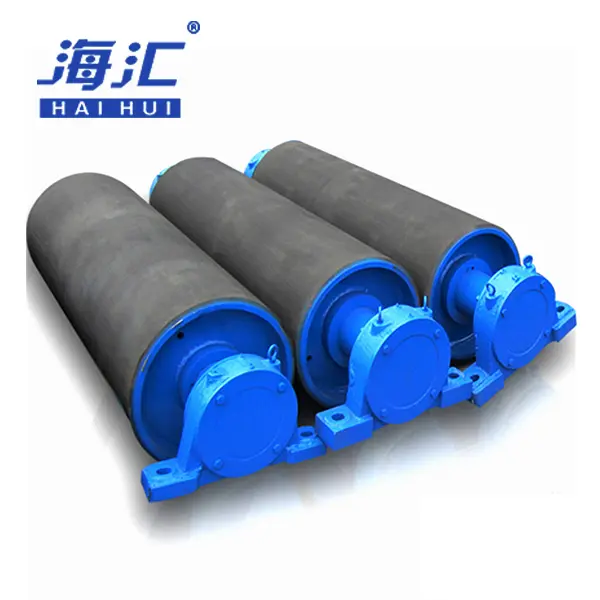
Mining Conveyor Pulley:Stop Belt Damage & Unscheduled Downtime
A mining conveyor pulley might look like just a steel drum with bearings—until one lagging failure or bearing seizure brings the whole production line to a grinding halt, and then it‘s a safety and compliance circus.
For mine operators moving tons of coal, ore, or aggregate, “reliable” means certified lagging bond, induction-hardened shafts, and documented concentricity. Weak welds and mismatched bearings wreck belt life. Miss that, and MSHA/ISO headaches, unscheduled downtime, and splice failures follow. Next: practical selection and smarter specs.
Key Insights on Mining Conveyor Pulley Optimization
➔ Shaft & Bearing Integrity: Use forged 42CrMo4 shafts with induction-hardened bearing seats (HRC 50-55) and C4 clearance bearings for high-start-torque applications.
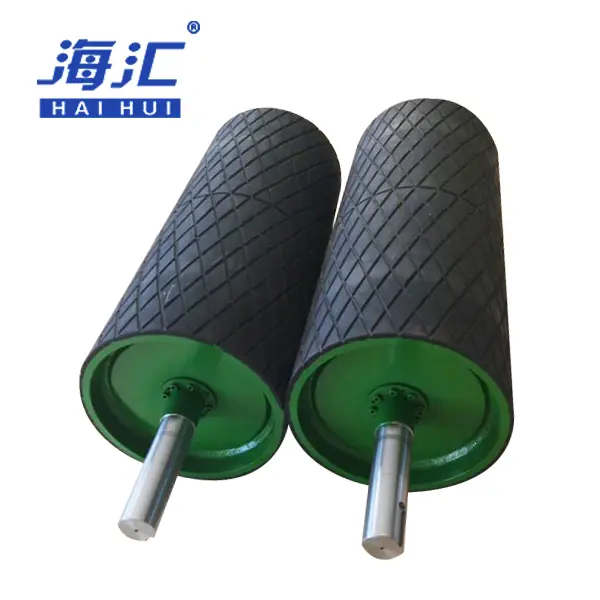
➔ Lagging & Traction: Specify ceramic or rubber lagging with documented bond peel strength (≥12 N/mm) and proper groove patterns for wet or inclined belts.
➔ Compliance & Safety: Follow MSHA flame-resistance requirements, ISO 9001 quality systems, and CEMA dimensional standards to mitigate risks and cut downtime.
Upgrade Your Mine Conveyor with Haihui: Need reliable, safety-compliant drive pulleys from the start? Haihui manufactures 100% certified mining conveyor pulleys with forged shafts and MSHA-approved lagging. Get a 1-day solution proposal by reaching out to our experts. Contact us today.
Why Proper Mining Conveyor Pulley Selection Matters
Discarding a poorly selected pulley ignores its actual impact: belt splices fail, bearings overheat, and valuable production time is lost. Break down “mining conveyor pulley” and you expose a component that demands engineering rigor. Haihui keeps it practical, ensuring mining pulleys drive productivity rather than becoming a long-term maintenance headache.
Environmental and Operational Impact of Pulley Failure
Extracting virgin steel and machining undersized shafts drives massive replacement costs. A properly engineered pulley cuts this cycle, saving 95% of bearing-related downtime and roughly 74% of splice failures.
Where the damage shows up
- In the mine – undersized shafts bend or keyways wallow out, pushing unplanned maintenance upstream.
- On the belt – misaligned pulleys cause edge wear, carcass fatigue, and belt wander.
- At the plant and beyond – replacement pulley inventory consumes warehouse space that could hold other spares.
What changes when you specify properly
- Decreased unscheduled downtime and drastically lower belt replacement frequency.
- Cleaner maintenance cycles when pulleys are properly engineered, eliminating “mystery failure” hazards.
Haihui messaging is simple: treat mining conveyor pulleys as critical drive components worth engineering properly, not commodity hardware.
Conservation Benefits of Proper Pulley Sizing
A correctly sized pulley retains 100% of its design life without premature degradation, rolling right back into the production schedule for years of reliable service.
Here‘s the real-world upside:
- Proper shaft sizing yields 95% reduction in bearing-related failures, shrinking your maintenance budget effortlessly.
- Reduced emergency change-outs protects maintenance crews and meets stringent safety mandates.
- Fewer unplanned pulley replacements trim massive logistical costs.
Common sense takeaway: correctly specified, properly maintained mining conveyor pulleys represent stored production value and safety margin. Haihui pushes this mindset because actionable reliability beats preaching.
5 Steps to Specify a Mining Conveyor Pulley
Unsure what‘s “reliable enough” for your mine? Here‘s the protocol to specify mining pulleys so they evade failures, unscheduled downtime, and belt damage. Haihui teams rely on these practical, shop-floor steps daily.
Step 1: Confirm Shaft Material and Bearing Fit
Proper specification starts with shaft integrity. Induction-hardened bearing seats and forged 42CrMo4 material turn borderline designs into reliable components.
Core check
- Specify forged 42CrMo4 or equivalent for high-tension or high-start-torque applications.
- Require induction-hardened bearing seats (HRC 50-55 minimum, case depth 3-5mm).
Zero-failure confirmation
- Treat every shaft as under-specified until proven with fatigue calculations.
- If the mine has long overland belts (>1000m) or high start torque, increase diameter.
Why miners care
- “Close enough” shaft sizing remains a hazard during high-torque starts.
- Strict specification mitigates risk of keyway deformation and shaft bending.
Step 2: Verify Lagging Bond and Durometer
With mining pulleys, lagging integrity is critical.
- Require documented peel strength (≥12 N/mm for heavy duty).
- Specify durometer based on environment: 65 Shore A for wet/muddy, 70-75 for dry/abrasive.
- Confirm groove pattern: herringbone for self-cleaning, plain for even wear.
Quick tip: Keep a durometer gauge in the maintenance shop; spot-check lagging hardness during monthly inspections.
Step 3: Validate Shell Weld Quality and Concentricity
“Round enough” ruins belt tracking. For mining pulleys, focus on weld integrity and face runout.
What to specify
- Full-penetration welds with documented NDT (ultrasonic or dye-penetrant).
- Face concentricity ≤0.5mm TIR (total indicated runout).
- Balance grade G-16 minimum for speeds above 3m/s.
How to keep it practical
- Require weld inspection records with each shipment.
- Allow pulleys to spin-check on stands; wobble will be visible.
Step 4: Confirm Crown Profile for Belt Tracking
With belt tracking, passive alignment via crown profile prevents edge damage.
Start with the obvious
- Specify steel crown (machined) for long conveyors (>500m) or high tension.
- Use tapered lagging for retrofit or when crown must be added after shell fabrication.
Then get picky (when required)
- Separate steel crown from tapered lagging if your belt type demands it.
Keep your specification honest
- Mark drawings with crown height (1-2mm for 1200mm belt).
Step 5: Document Compliance with MSHA, ISO, and CEMA
Once pulleys are verified to spec, documentation drastically cuts audit risk.
Safety gate
- Re-verify MSHA flame-resistance certification for underground coal applications before installation.
- Confirm ISO 9001 quality records accompany each shipment.
Compliance rules of thumb
- Execute steady review of mill certificates and weld logs.
- Maintain consistent file structure for audit readiness.
Audit-ready handling
- Build a secure folder using digital records and heavy documentation.
- Proper record-keeping prevents compliance from becoming a mine-site scramble.
Haihui recommends strict documentation maximums to stabilize audits.
Key Regulations for Mining Conveyor Pulleys
Even “proven” pulleys trigger regulatory scrutiny regarding shaft integrity and lagging bond. This breaks down the vital rules, paperwork, and safety benchmarks. Haihui teams start here to protect mining pulleys from compliance violations.
MSHA Requirements for Underground Coal
Reality check: MSHA (30 CFR) governs pulleys used in underground coal mines, especially regarding flame resistance and lagging materials.
What regulations force you to verify
- Flame resistance – lagging materials must be MSHA-approved (no combustible compounds).
- Grounding – shaft grounding brushes required on some drive pulleys to prevent static buildup.
Material callouts
- Segregate underground-compliant pulleys from surface stock; mixed inventory invites immediate rejection.
Practical handling rules
- Fully document lagging certification before lowering into the mine.
- Segregate approved pulleys from non-approved ones to prove safety compliance.
Haihui note: for mining pulleys, Haihui pairs documented lagging certification with strict batch labeling to guarantee MSHA acceptance.
CEMA Standards for Belt Conveyor Pulleys
Under CEMA (Conveyor Equipment Manufacturers Association), specification drives design.
Classification and compliance basics
- Confirm pulley class matches belt tension and start-stop cycles.
- Verify face width and diameter per CEMA application guidelines.
Design habits for reliability
- Utilize appropriate shaft sizing for fatigue life.
- Palletize drive pulleys with shaft supports; floppy shipping can bend seals.
Documentation requirements
- Freight packing lists must explicitly state pulley class and shaft dimensions.
Haihui advantage: when using Haihui for mine specification, generating a definitive “engineering summary” matching the physical reality of the pulley prevents installation delays.
ISO 9001 and CEMA for Quality and Safety Testing
Why ISO 9001 matters post-fabrication – weld and assembly records demonstrate quality control.
How ISO standards map to handling
- Safety checks – validate that NDT methods are documented.
- Leakage control – deploy seal inspection to isolate damaged bearings before shipment.
Testing mindset
- Log test times, dates, and failures to satisfy audit trails.
Nested workflow
- Incoming components – visually inspect for damage; isolate “suspected weld.”
- Fabrication – weld, inspect, verify (NDT accepted) prior to lagging.
- Outbound quality – spot-check pulleys to ensure mines receive compliant components.
Haihui projects utilize these checkpoints to manage mining pulleys, making compliance repeatable rather than painful.
Simplify Compliance with Haihui OEM Services: Stop worrying about MSHA, ISO, or CEMA failures. Our custom pulleys are engineered to meet rigorous mining and safety standards right off the line. With over 15 years of manufacturing experience, we provide safe, reliable customization with rapid ~10-day sample turnarounds.
Mining Conveyor Pulley Cost Breakdown
Mining pulleys blend high material value with costly engineering and processing realities. This breakdown separates performance value from compliance overhead.
Material and Performance Value: Forged vs. Fabricated
Which specification generates positive ROI post-installation?
Forged steel shaft (42CrMo4)
- Value: High reliability due to fatigue resistance and 95% reduction in shaft-related failures.
- Recovery: Dirt is acceptable; proper bearing fit is critical.
- Contamination: Undersized keyways and loose fits raise failure rates.
Fabricated shaft (C45)
- Fabrication: Standard steel demands more conservative sizing or higher maintenance cost.
- Recycling: Magnetic bearings assist, but poor fit drags reliability down.
- Value: Lower net back because lower upfront cost absorbs intensive maintenance labor.
Haihui clients win by isolating high-torque applications immediately, standardizing forged shafts to stabilize mine specs.
Logistics Optimization: Freight, Bulk Packaging, and Shaft Supports
Transportation efficiency for mining pulleys relies on protecting bearings and lagging.
Smart logistics wins:
- Bracing achieves safe arrival, optimizing freight claims.
- Shaft supports eliminate bearing brinelling damage.
- Layer pads prevent lagging scuffs.
Rhythm for logistics optimization:
- Validate pulley dimensions pre-pickup.
- Select packaging: loose (short moves), crated (export), high-density (container).
- Apply rigid strapping to secure load without damaging lagging.
- Book freight by weight and cube volume.
Haihui standardizes pallet footprints for mining pulleys to streamline handling.
Processing Expenses: Handling Hubs, Lagging, and Weld Rework
Line-item processing costs escalate when specifications are mixed improperly.
Incoming stream costs
- Handling: labor draining extracting documentation.
- Mixed inputs: Scrap from fabrication behaves erratically compared to finished pulleys.
Line-item troublemakers
- Bearing seats: undersized induction depth jams assembly.
- Welds: poor penetration dulls NDT scanners.
- Lagging: requires pop-and-sort adhesion testing.
Cost controls
- Mandate pre-shipment NDT.
- Enforce zero-weld-defect policies.
Haihui systems for mining pulleys prioritize stable specification to minimize labor spikes.
Compliance Fees: Safety Testing, MSHA, and ISO Audits
Regulatory overhead eats into margins if left unmanaged.
| Cost driver (mining pulley) | Typical trigger | Metric used | Cost impact level (1-5) |
|---|---|---|---|
| MSHA load inspections | Suspected lagging non-compliance | Holds per shipment | 4 |
| Shaft hardness testing | New supplier or incident history | Tests per lot | 3 |
| Compliance fees | Extra documentation requests | Admin hours | 2 |
| CEMA standards alignment | Storage/segregation updates | Site actions count | 3 |
Properly packed and certified mining pulleys neutralize compliance friction. Haihui deploys strict checklists to prevent rejections.
Partner with Haihui for Sustainable Mining Solutions
With over 15 years of manufacturing expertise and successful deliveries to mines across North America, Haihui delivers premium mining conveyor pulleys. Whether you require standard CEMA designs or high-precision forged shafts, our certified materials and ISO/MSHA-compliant facilities ensure your components are built to perform and engineered to last.
We offer full OEM capabilities, flexible MOQs, 100% NDT weld testing, and free application reviews for selected items.
Ready to elevate your mine’s conveyor reliability? Contact Haihui today to start your custom project!
References
- CEMA – Conveyor Equipment Manufacturers Association – Pulley standards
- MSHA – Mine Safety and Health Administration (30 CFR)
- ISO 9001 – Quality management systems
- ASTM A370 – Mechanical testing of steel products
- ISO 5048 – Conveyor power and tension calculations
- Haihui – Internal engineering specifications for mining conveyor pulleys
 English
 العربية
 简体中文
简体中文 Nederlands
 Français
 Deutsch
 Bahasa Indonesia
 Italiano
 日本語
日本語 한국어
한국어 Bahasa Melayu
 Polski
 Português do Brasil
 Русский
 Español
 Türkçe