
Head Pulley Tail Pulley Conveyor:Stop Belt Misalignment & Downtime
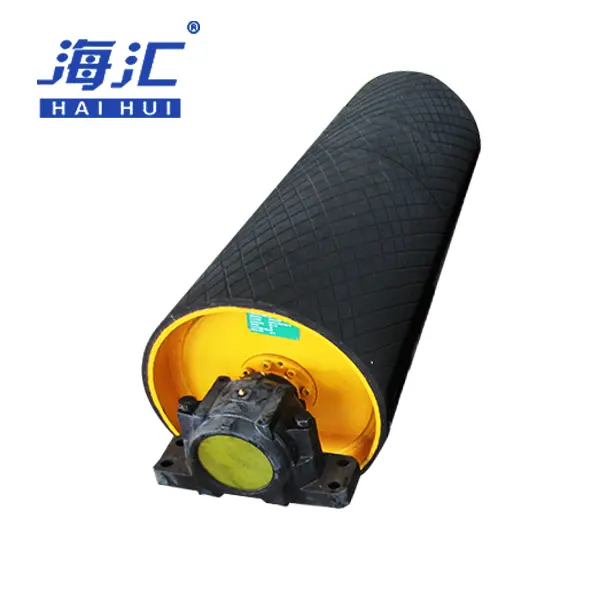
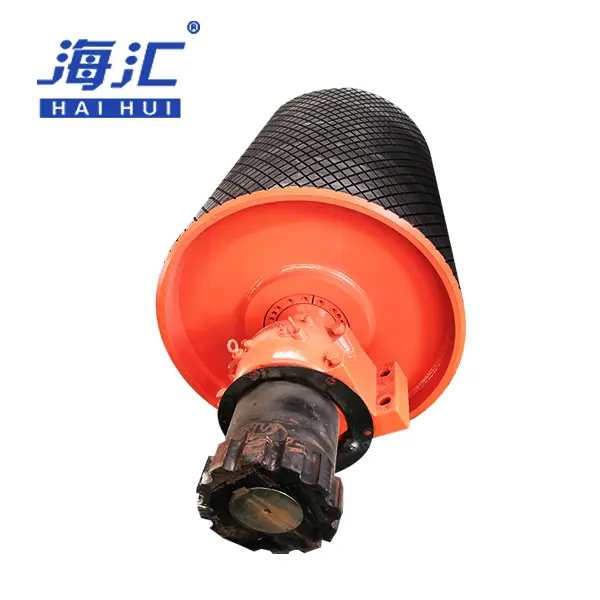
A failing head pulley or tail pulley on a conveyor can shut a plant down, draining cash and patience in one ugly swoop.
Haihui engineers note in 2025 service briefs that precise alignment and regular inspection keep torque steady and prevent cascading failures across the conveyor system.
Ignore it, and downtime, belt tracking issues, and energy waste pile up quickly.
Key Points for Head Pulley Tail Pulley Conveyor Care
➔ Inspect Housing & Shaft Alignment: Check bearing housing, end discs, and run-out tolerance via NDT to prevent imbalance and vibration.
➔ Verify Bushing Torque & Keyway Fit: Ensure taper lock bushing torque meets specs and keyway alignment is true to avoid slippage.
➔ Maintain Proper Lubrication & Tension: Choose the right grease or oil for bearing materials and adjust take-up tension to minimize downtime and energy waste.
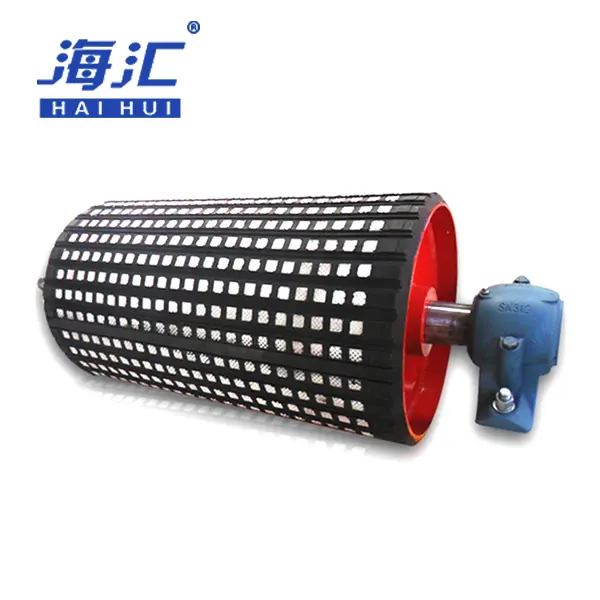
3 Key Checks For Head Pulley Tail Pulley Conveyor
A head pulley and tail pulley conveyor handles heavy loads, constant friction, and daily shock. When the conveyor system runs nonstop, small defects in the head pulley or tail pulley can snowball fast. Below are three practical checks to keep your conveyor pulleys steady, aligned, and ready for long shifts.
Inspect Bearing Housing and End Disc Wear on the Shell
A working head pulley and tail pulley conveyor depends on solid support from the bearing housing and structural integrity of the end disc and shell. Poor inspection routines often lead to uneven wear, vibration, and costly maintenance.
Key inspection focus:
- Surface cracks on bearing housing
- Oil seepage around seals
- Weld fatigue between end disc and shell
External condition check:
1.1 Clean dust buildup around the pulley hub
1.2 Check lubrication points for leakage
1.3 Inspect bolt tightness
Structural assessment:
2.1 Tap-test welded end disc joints
2.2 Look for shell deformation
2.3 Measure radial play near the housing seat
Wear evaluation:
- Compare measured wall thickness with baseline data
- Record abnormal vibration levels
- Flag uneven contact marks
| Inspection Item | Acceptable Limit (mm) | Action Level |
|---|---|---|
| Shell ovality | ≤ 1.0 | Monitor |
| End disc crack | 0 | Repair |
| Housing clearance | ≤ 0.5 | Adjust |
In heavy-duty mining and aggregate applications, brands like Haihui emphasize routine inspection logs to extend service life and stabilize torque transmission across the head pulley and tail pulley conveyor system.
Measure Shaft Run-out Tolerance via Non-Destructive Testing
The shaft of a head pulley and tail pulley conveyor carries torque directly from the motor. Excess run-out reduces balance and increases bearing load. Tight tolerance control is critical for any conveyor pulley in bulk handling.
Here’s a practical approach:
Tools used:
- Dial indicator
- Laser alignment kit
- Ultrasonic non-destructive testing
Measurement routine:
- Mount dial gauge at midpoint of the shaft.
- Rotate the pulley slowly.
- Record peak deviation values.
- Compare with allowable measurement standards.
Typical shaft run-out reference:
- ≤0.05 mm: Ideal
- 0.05–0.10 mm: Acceptable
- 0.10 mm: Requires correction
In 2025, a Materials Performance industry outlook noted:
“Precision alignment and predictive non-destructive testing continue to reduce conveyor downtime by double-digit percentages across bulk material sectors.”
Routine testing keeps the head pulley and tail pulley conveyor aligned and reduces stress on bearings. The engineering team at Haihui integrates shaft balancing checks before factory dispatch to ensure smoother start-up.
Verify Taper Lock Bushing Torque and Keyway Alignment
In any head pulley and tail pulley conveyor, the taper lock bushing connects the shaft to the hub. If torque is off or keyway alignment slips, power transmission suffers and micro-movement causes fretting.
Inspection should follow a logical hierarchy:
Fastener and torque control:
1.1 Confirm bolt grade matches spec
1.2 Use calibrated wrench for torque verification
1.3 Re-check after 24-hour operation
Keyway inspection:
2.1 Examine keyway surface finish
2.2 Ensure no burrs or deformation
2.3 Confirm axial positioning
Alignment validation:
- Check concentricity between hub and pulley rim
- Measure angular deviation
- Confirm even load transfer
Warning signs include: metallic dust near the hub, uneven belt tracking, and sudden vibration spikes.
A correctly installed taper lock system allows the head pulley and tail pulley conveyor to transmit torque smoothly across the drive assembly. In real-world bulk plants, Haihui pulley units are engineered with controlled fit tolerances to reduce slippage and simplify long-term maintenance.
Keep these three checks tight, and your head pulley and tail pulley conveyor will stay steady, balanced, and dependable shift after shift.
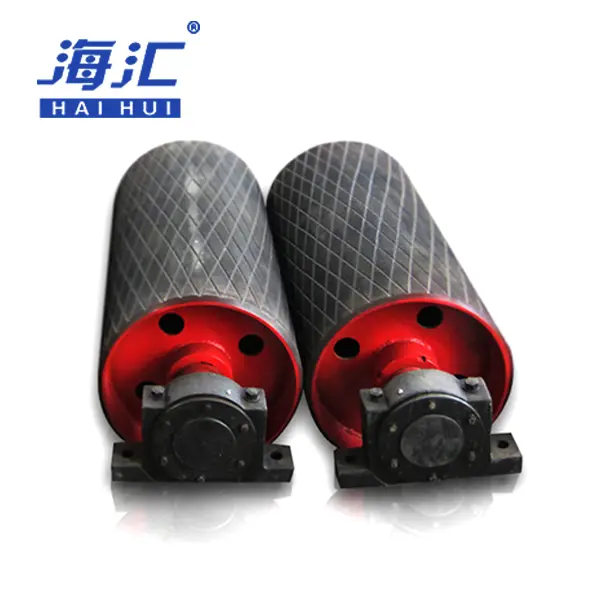
What’s The Best Lubricant For Head Pulley and Tail Pulley Systems?
A head pulley and tail pulley conveyor works hard every single day, moving bulk material across ports, mines, and plants. Choosing the right lubricant keeps the conveyor pulleys stable, reduces downtime, and protects every pulley in the system.
Choosing Synthetic Oil for Alloy Steel Bearing Housings
For a head pulley and tail pulley conveyor, the bearing zone handles radial load, torque transfer, and thermal expansion all at once. That’s where synthetic oil earns its keep.
Key benefits:
- Better temperature stability
- Stronger wear protection
- Cleaner long-term lubrication
- Oxidation resistance lasts longer than mineral blends
- Film strength supports high-performance rotation
- Cold-start flow protects alloy steel surfaces
When applied to bearing housings, selection normally follows a nested logic:
Operating Conditions:
- Load profile: constant bulk flow, shock loading from lump ore
- Ambient range: -20°C winter ports to 60°C enclosed transfer towers
Oil Properties:
- Viscosity grade
- Additive chemistry: anti-wear package, anti-foam agents
Housing Design:
- Sealing method
- Shaft alignment tolerance
Long run cycles demand stable film thickness. A properly selected synthetic oil prevents metal-to-metal contact inside alloy steel bearing housings, extending pulley service intervals and keeping the conveyor smooth under pressure.
Mineral Grease vs. Polyurethane Grease for Rubber Lagging
Rubber-coated pulleys depend on controlled friction. Too dry? Slippage. Too greasy? Belt drift. Here’s the straight talk.
- Mineral grease: budget-friendly, simple lubrication
- Polyurethane grease: higher adhesion, better water resistance
- Material check: confirm compatibility with rubber lagging
Decision flow for a head pulley and tail pulley conveyor with rubber surface:
Environment:
- Wet bulk cargo
- Salt spray near docks
Performance Target:
- Stable friction
- Reduced corrosion
Grease Traits:
- Base oil type
- Thickener structure
- Washout resistance
In port handling systems, polyurethane grease usually sticks better to rotating conveyor pulleys exposed to rain and splash. For lighter-duty conveyor pulley assemblies indoors, mineral grease still gets the job done without blowing the budget.
High-Temperature Molybdenum Disulfide on Ceramic Lagging
Ceramic-coated pulleys operate in brutal zones—cement kilns, clinker transfer, iron ore crushing lines. Standard grease burns off fast. That’s when molybdenum disulfide steps in.
Heavy-load defense:
- Handles extreme pressure
- Maintains friction reduction
- Supports thermal stability
Performance comparison for ceramic lagging interfaces:
| Parameter | Standard Lithium Grease | MoS₂ Lubricant | High-Temp Synthetic |
|---|---|---|---|
| Max Temp (°C) | 130 | 400 | 260 |
| Load Capacity (kN) | 45 | 85 | 60 |
| Film Strength Rating | Medium | High | High |
| Wear Rate Index | 1.0 | 0.4 | 0.6 |
| Reapplication Cycle (hrs) | 500 | 1200 | 900 |
Selection logic for ceramic lagging on a head pulley and tail pulley conveyor:
Surface Condition:
- Tile bonding integrity
- Micro-crack inspection
Duty Profile:
- Continuous load
- Impact spikes
Lubricant Chemistry:
- Solid film additives
- High-temperature carrier oil
In mining operations, this combo protects ceramic lagging while keeping the conveyor pulleys running cool under heavy-duty stress.
Food-Grade Grease Selection for Port Terminal Applications
Food cargo terminals demand clean handling. Stainless components and sealed bearing assemblies must meet regulatory rules without sacrificing efficiency.
“Global bulk food logistics is tightening contamination thresholds across port terminals, driving higher adoption of certified lubricants,” notes the 2025 UNCTAD maritime trade review.
Key checklist for food-grade grease:
Certification:
- NSF H1 compliance
- Audit documentation
Performance:
- Strong corrosion resistance
- Low water washout
Safety:
- Clear labeling
- Storage control
For stainless shafts and bearing units in a head pulley and tail pulley conveyor, grease must prevent rust yet avoid product contamination. Brands like Haihui align pulley design with certified lubrication systems, helping operators meet inspection standards. In high-humidity docks, proper sealing plus compliant grease keeps the conveyor efficient and audit-ready.
Operators working with Haihui equipment often pair corrosion-resistant components with approved lubricants, ensuring smooth conveyor pulley performance without risking cargo safety.
Slipping Belts? Tension Adjustment Tips
A slipping conveyor belt can quietly wreck output and stress every head pulley and tail pulley conveyor in the line. When the belt, drive, and pulleys stop working in sync, friction drops and costs rise. Let’s tighten things up the smart way.
Setting Conveyor Belt Tension with the Take-up System
Proper tension keeps the head pulley and tail pulley conveyor gripping instead of skating. Focus on the take-up system and treat the adjustment like fine tuning, not brute force.
Inspect the current state:
- Check visible sag in the conveyor belt.
- Listen for chatter at the drive pulley.
- Note any belt slippage during peak load.
Calibrate the take-up assembly:
- Mechanical take-up: Adjust screw travel evenly on both sides. Measure displacement in millimeters.
- Gravity take-up: Confirm counterweight moves freely. Remove debris blocking travel.
Validate tension balance:
- Run the head pulley and tail pulley conveyor at low speed.
- Gradually increase load.
- Recheck tracking and heat buildup.
Routine maintenance from Haihui keeps the conveyor pulleys stable, extending the life of both belt and pulley lagging.
Fine-Tuning Torque Capacity through Gear Reducer Coupling
When torque feels weak, look beyond the belt. The gear reducer, coupling, and motor alignment define real torque capacity in a drive system.
- Misalignment steals power transmission efficiency.
- Excessive backlash reduces torque at the pulley shaft.
- Poor lubrication raises heat and cuts capacity.
For tight optimization, try this mix of checks:
- Measure shaft runout.
- Verify coupling concentricity.
- Compare actual torque with rated output.
A slipping head pulley and tail pulley conveyor often traces back to reducer alignment. The conveyor system works best when motor, gearbox, and pulleys share the same centerline. Even a slight offset changes load distribution across the pulley face.
Haihui engineers recommend recording torque before and after coupling correction to confirm gains in real numbers, not guesswork.
Preloading V-Belt Drives Using Precision Machining Marks
Accurate preloading on V-belt drives prevents uneven wear across the drive system.
Step 1: Clean pulley grooves and confirm alignment using straightedge checks.
Step 2: Match belt set lengths; never mix old and new.
Step 3: Use factory machining marks to set initial belt tension.
Step 4: Rotate the head pulley and tail pulley conveyor manually to seat belts.
Step 5: Recheck tension after 30 minutes of operation.
A properly installed belt keeps the conveyor pulleys spinning steady, with RPM staying consistent under load.
Confirming Load Capacity and Speed (RPM) After Adjustment
After every adjustment, confirm load capacity and speed (RPM) on the full conveyor system. Guessing here leads to overload and belt damage.
Measure baseline:
- No-load RPM at the head pulley
- Motor current draw
Apply rated load:
- Track RPM drop
- Observe vibration
Verify against design spec:
- Compare to service factor
- Confirm safe margin
| Test Condition | Load (kN) | Measured RPM | Motor Current (A) |
|---|---|---|---|
| No-load | 0 | 1480 | 22 |
| 50% Load | 12 | 1465 | 35 |
| 75% Load | 18 | 1452 | 44 |
| 100% Load | 24 | 1438 | 56 |
If RPM drop exceeds 5%, revisit tension or gearbox calibration. A healthy head pulley and tail pulley conveyor holds speed without dramatic sag. With Haihui equipment, consistent measurement and verification keep the belt, pulleys, and full conveyor line running smooth day after day.
References
- UNCTAD Maritime Trade Review 2025 – unctad.org
- Materials Performance Industry Outlook 2025 – materialsperformance.com
- CEMA Conveyor Equipment Standards – cemanet.org
- ASTM E18 Hardness Testing – astm.org
- ASTM E709 Magnetic Particle Inspection – astm.org
- NDT Weld Inspection Standards – asnt.org
- NSF H1 Lubricant Certification – nsf.org
- Haihui – Technical specifications for head pulley tail pulley conveyor
 English
 العربية
 简体中文
简体中文 Nederlands
 Français
 Deutsch
 Bahasa Indonesia
 Italiano
 日本語
日本語 한국어
한국어 Bahasa Melayu
 Polski
 Português do Brasil
 Русский
 Español
 Türkçe