Dicas essenciais para a seleção de roletes de retorno para transportadores de correia
- Harmonious Highlights for Return Rollers
- Roll Diameter and Belt Width Matching
- Roll Surface: Plain Steel vs. Spiral vs. Rubber Disc
- Projeto de rolamentos e vedações: o fator determinante da vida útil
- Shaft Material and Shell Thickness
- Frame Compatibility and Mounting Dimensions
- Plain Steel Return Rollers
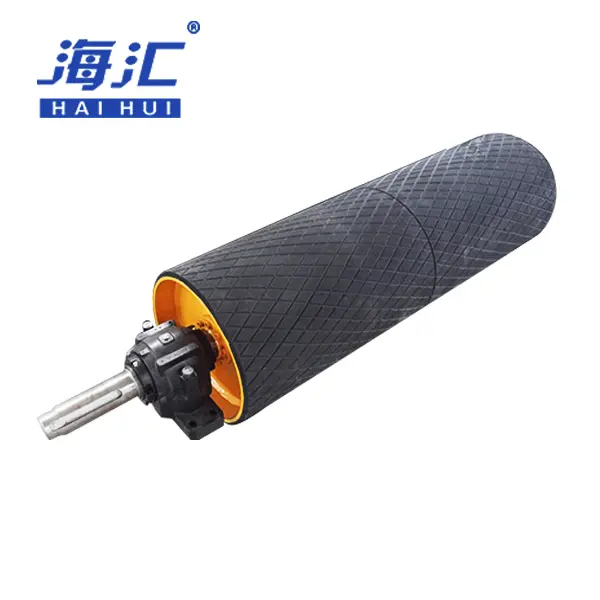
- Spiral Return Rollers for Sticky Materials
Return rollers look simple—a steel tube, a shaft, and some bearings sitting under the empty side of the belt. But one wrong specification turns your conveyor into a maintenance headache: the belt sags, tracks crooked, and eventually damages itself against the structure.
Buyers chasing the lowest price on return rollers often overlook the details that actually matter: roll diameter, bearing seal type, shell thickness, and frame compatibility. Get these wrong, and you’re paying for belt edge damage, spillage, and repeated roller replacements—costs that dwarf the roller’s purchase price.
Haihui engineers emphasize roll concentricity, seal integrity, and bearing life as the baseline for dependable return roller performance. Drawing on our experience manufacturing conveyor idlers for bulk material handling across cement, power, mining, port, and steel industries, we build return rollers that keep belts running straight and smooth.

Harmonious Highlights for Return Rollers
➔ Roll Surface Selection: Plain steel for dry, abrasive materials; spiral or rubber disc for sticky, wet loads that build up on the return side.
➔ Lógica dos rolamentos e vedações: As vedações tipo labirinto com rolamentos reenlubrificáveis ou vedados de fábrica determinam a vida útil dos rolos em ambientes com poeira, umidade e condições corrosivas.
➔ Disciplina de classificação de carga: CEMA Class B through F rollers match load capacity to belt width and belt weight — undersizing guarantees premature failure.
➔ Frame Compatibility: Interchangeable mounting dimensions per CEMA 502 ensure drop-in replacement without structural modification.
5 Factors To Check Before Ordering Return Rollers
When sourcing return rollers, small details make or break your conveyor’s reliability. Buyers chasing better pricing often overlook specs that affect belt training, roller life, and maintenance frequency. Here’s a practical breakdown to help you specify a return roller with confidence.
Roll Diameter and Belt Width Matching
The return roller diameter directly affects belt support and roller rotational speed. A roller that’s too small for the belt width causes excessive belt sag between rollers and accelerates bearing wear.
Recommended return roller diameter by belt width:
| Largura da correia (mm) | Recommended Return Roller Diameter (mm) | Diâmetro típico do eixo (mm) | Load Class |
|---|---|---|---|
| 400–650 | 89 | 20 | CEMA B |
| 800–1000 | 108 | 25 | CEMA C |
| 1200–1400 | 133 | 30 | CEMA D |
| 1600–1800 | 159 | 40 | CEMA D/E |
| 2000–2400 | 194 | 50 | CEMA E/F |
Reference: CEMA Standard 502 and Haihui return roller product specifications
Normal spacing for return rollers is 10 feet (approximately 3 meters). For belts wider than 800 mm, a V-return roller configuration may be preferred to help center the belt on the return side.
Roll Surface: Plain Steel vs. Spiral vs. Rubber Disc
The return roller surface determines how well the empty belt is supported and whether material buildup becomes a problem.
Roll surface options:
| Tipo de superfície | Ideal para | Característica principal | Limitação |
|---|---|---|---|
| Aço comum | Materiais secos, limpos e abrasivos | Simples, durável e de baixo custo | Acúmulo de material em cargas úmidas ou pegajosas |
| Rolo em espiral | Materiais pegajosos, úmidos e corrosivos | Autolimpante; minimiza o acúmulo de resíduos | Deslocamento da correia apenas em uma direção |
| Disco de borracha | Materiais pegajosos que aderem à correia | Reduz o acúmulo de resíduos e os problemas relacionados ao treinamento com correias | Custo mais elevado do que o do aço comum |
| Uretano / cerâmica | Materiais altamente abrasivos ou com pH alto/baixo | Maior vida útil | Aplicação especializada |
Spiral return rollers are unique in that the spiral construction minimizes belt fleet and damage to the return belt due to material build-up on the roller surface. They can be used for belt travel in one direction only.
For belts carrying wet or sticky materials like cement, clay, or fertilizer, a spiral or rubber disc return roller significantly reduces maintenance frequency compared to plain steel.
Projeto de rolamentos e vedações: o fator determinante da vida útil
Bearing failure is the most common reason a return roller is pulled from service. The seal design determines how long the bearing lasts.
Bearing and seal comparison:
| Destaque | Vedação de contato básica | Vedação labiríntica de múltiplas passagens | Design selado de fábrica |
|---|---|---|---|
| Resistência à contaminação | Moderado | Alto | Alto |
| Reutilizável | Não | Sim | Não |
| Aplicação típica | Ambientes limpos e secos | Empoeirado, úmido, ao ar livre | Locais remotos ou de difícil acesso |
| Tendência de vida útil do rolamento | Padrão | Ampliado | Ampliado |
| Requisitos de manutenção | Substituir em caso de falha | Lubrificação periódica | Instale e não se preocupe mais |
As roldanas com lubrificação reabastecível utilizam um projeto com labirinto e proteção externa, permitindo a relubrificação periódica para eliminar contaminantes. As roldanas seladas de fábrica utilizam o mesmo projeto de vedação com eixo maciço e constituem uma alternativa econômica viável nos casos em que não é possível realizar a relubrificação periódica.
Para aplicações em mineração e na indústria de cimento com alta concentração de poeira, uma vedação labiríntica de múltiplas passagens é a especificação mínima. Para ambientes sujeitos a lavagem ou corrosivos, considere vedações de contato ou vedações combinadas do tipo labiríntico-de contato.
Shaft Material and Shell Thickness
The shaft carries the belt load and transmits it to the frame. The shell protects the bearing and provides the rolling surface. Both must be sized for the actual load, not the catalog load.
Shaft and shell material options:
| Componente | Opções de materiais | Aplicação típica | Notas |
|---|---|---|---|
| Eixo | Aço 20#, aço 40#, aço inoxidável | Padrão industrial | 20#/40# para uso geral; aço inoxidável para ambientes corrosivos |
| Concha | Aço carbono Q235B, tubo sem costura | Padrão industrial | Parede mais espessa para zonas de alto impacto |
| Revestimento | Pintura, pintura a pó, galvanização | Proteção contra a corrosão | Galvanizado para uso ao ar livre ou em ambientes úmidos |
Haihui return rollers use 20#/40# steel or stainless steel shafts depending on the application. Tube material is typically Q235B carbon steel, with custom options available.
Frame Compatibility and Mounting Dimensions
A return roller that doesn’t fit the frame is useless, no matter how well it’s made. CEMA Standard 502 defines dimensional guidelines for troughing and return idlers to ensure interchangeability.
Mounting dimension checklist:
- Shaft diameter: Must match the frame bracket bore
- Shaft length: Must fit between bracket centers
- Flat position: Must align with the frame locking mechanism
- Drop-in replacement: CEMA-compliant dimensions ensure no structural modification
For operations with mixed conveyor brands, specifying CEMA-compliant return rollers simplifies spare parts inventory and reduces change-out time.
Steel Vs. Spiral Return Rollers: Which To Choose?
Choosing between a plain steel return roller and a spiral return roller isn’t just shop talk. If you’re sourcing return rollers, planning a conveyor upgrade, or comparing replacement options, the surface type shifts cost, maintenance frequency, and belt life.
Plain Steel Return Rollers
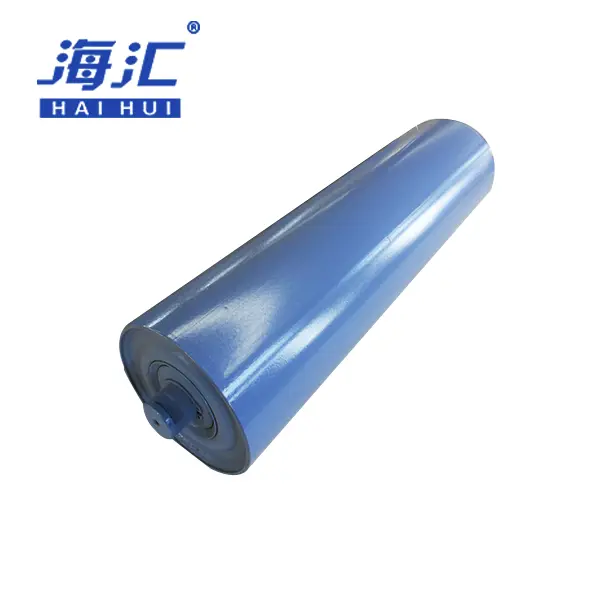
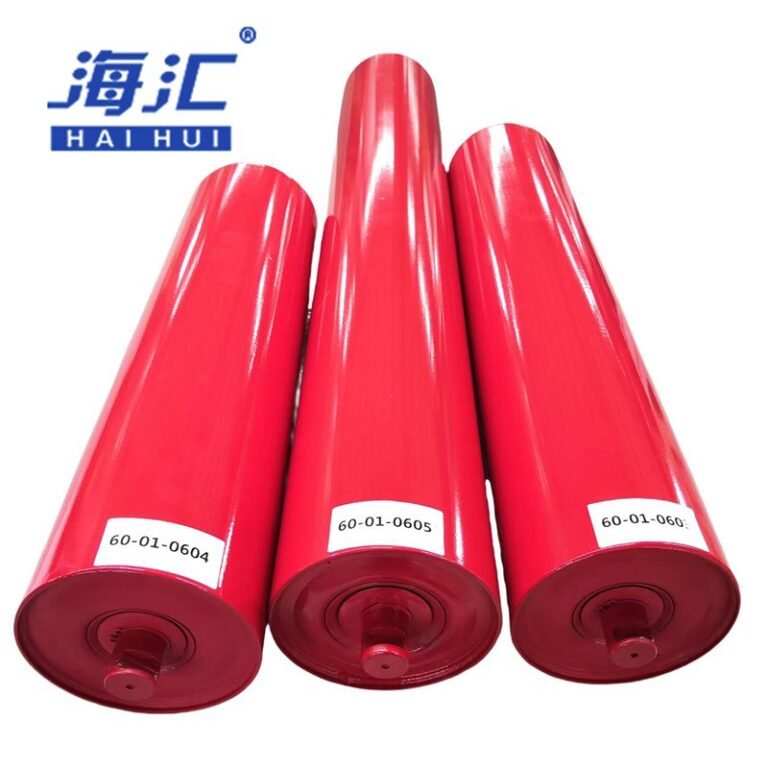
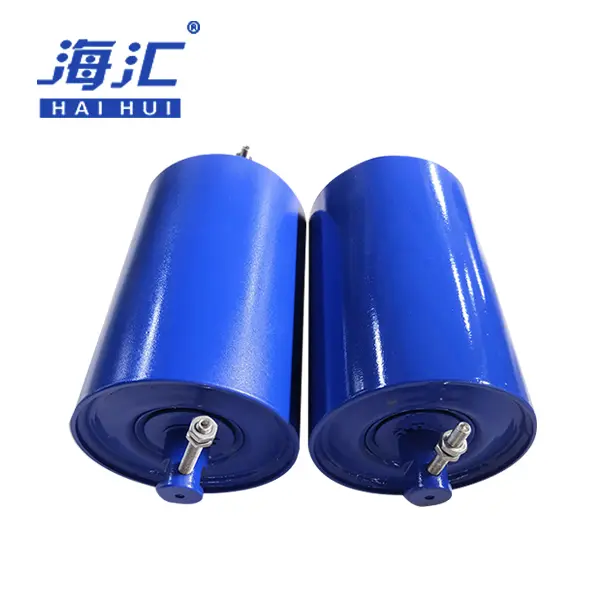
Plain steel return rollers are the standard choice for dry, clean conveyor applications. They provide a smooth, flat surface for the empty belt to ride on.
Principais vantagens:
- Smooth belt path; no bounce or oscillation
- Compatible with belt cleaning systems
- Simple to align and maintain
- Lowest cost option
Selection logic:
- Confirm material is dry and non-sticky.
- Select CEMA class based on belt width and load.
- Choose seal type for the environment.
- Verify shaft dimensions match the frame.
Plain steel return rollers are common in aggregate, coal, and dry ore applications where material buildup is not a concern.
Spiral Return Rollers for Sticky Materials
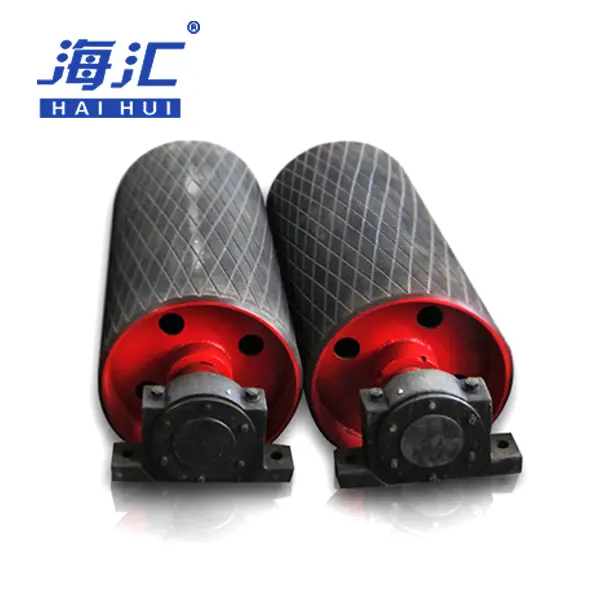
Spiral return rollers have a helical steel strip wrapped around the roller surface. Material that would otherwise build up passes through the spiral gaps. The design is self-cleaning: the roller’s rotation throws material off its surface.
Principais vantagens:
- Self-cleaning action reduces buildup
- Material passes through gaps instead of getting trapped
- Eficaz em ambientes úmidos, pegajosos ou corrosivos
- Reduces belt training problems caused by buildup
Limitações:
- Deslocamento da correia apenas em uma direção
- Not suitable for reversing conveyors
Spiral return rollers perform best on belts carrying cement, clay, fertilizer, or other sticky materials. They are also used in corrosive environments where material buildup would otherwise accelerate roller failure.
Return Roller Specifications at Haihui
A Haihui Environmental Protection Equipment Co., Ltd. é uma fabricante de roletes, polias e componentes estruturais para transportadores de correia, com sede em Rizhao, Shandong, China. A empresa opera 12 oficinas de produção inteligentes com capacidade de produção anual de 15.000 conjuntos de equipamentos e detém 168 patentes registradas, incluindo 15 patentes de invenção.
Escopo do produto: carrying idlers, return idlers, impact idlers, spiral idlers, rubber disc idlers, and complete idler assemblies for belt conveyors. Belt widths from 400 mm to 2,400 mm; roller diameters from 54 mm to 219 mm. Materials include Q235B carbon steel and custom alloy steels for high-tension applications.
Sistemas de qualidade: Certificada pelas normas ISO 9001, ISO 14001, ISO 45001 e ISO 50001. Os produtos são fabricados de acordo com as normas CEMA, AS, DIN, ISO e GB.
Mercados de exportação: Products are exported to the United States, Russia, Canada, Australia, Egypt, South America, the Middle East, and Southeast Asia. Haihui has established long-term partnerships with major steel and paper producers including Shandong Iron and Steel Group, Yongfeng Iron and Steel, Nine Dragons Paper, and Sun Paper.
Capacidade de atendimento: Equipe profissional de vendas com atendimento 24 horas, entrega de amostras em 1 a 2 dias, personalização OEM para produtos, logotipos e embalagens, além de aceitação de pedidos em pequenas quantidades para necessidades urgentes.
FAQ about Return Rollers
Q: What is a return roller on a belt conveyor?
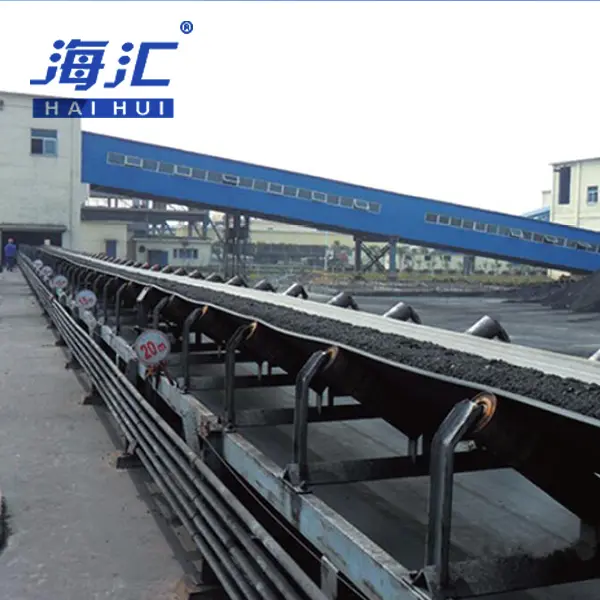
A: A return roller is an idler that supports the empty belt on the return side of the conveyor. It prevents the belt from sagging between support points and helps maintain proper belt training.
Q: What is the difference between a carrying idler and a return roller?
A: Carrying idlers support the loaded belt on the top side. Return rollers support the empty belt on the bottom side. CEMA Standard 502 defines dimensional and selection guidelines for both types.
Q: What is the normal spacing for return rollers?
A: Normal spacing for return rollers is 10 feet (approximately 3 meters). Impact idlers should be at least 6-inch diameter and spaced at 1-foot intervals to maximize belt protection.
Q: What are the main return roller surface options?
A: Plain steel rollers are standard for dry, clean materials. Spiral rollers are self-cleaning for sticky or wet materials. Rubber disc rollers reduce buildup for materials that adhere to the belt.
Q: How do I choose the right CEMA class for return rollers?
A: CEMA classes run from B (light-duty) through F (super heavy-duty). Selection depends on calculated idler load, belt width, material weight, and operating conditions. Undersizing the class leads to premature bearing failure.
Q: What is the difference between regreasable and factory-sealed return rollers?
A: Regreasable rollers use a labyrinth and outer shield design, allowing periodic regreasing to flush contaminants. Factory-sealed rollers use the same seal design with a solid shaft and are a viable economic alternative where periodic regreasing will not be provided.
Q: What shaft materials are used for return rollers?
R: Os materiais mais comuns para eixos incluem o aço 20#, o aço 40# e o aço inoxidável. A escolha do material depende da carga, da exposição à corrosão e dos requisitos de manutenção.
Q: Can return rollers be used on reversing conveyors?
A: Plain steel and rubber disc return rollers can be used on reversing conveyors. Spiral return rollers are one-directional only and should not be used on reversing conveyors.
Q: What is the typical service life of a return roller?
A: With proper specification and maintenance, a return roller can last 20,000 to 50,000 hours. Sealed labyrinth bearings extend life in dusty or wet conditions.
Q: Does Haihui manufacture return rollers for all conveyor applications?
A: Haihui manufactures return rollers for heavy-duty industrial conveyors in mining, cement, steel, power, port, chemical, and paper industries. We do not supply portable or light-duty conveyors used in warehouses or retail settings.
Referências
- Norma CEMA 502-2004 – Calhas e roletes de retorno para transportadores de correia de materiais a granel: seleção e dimensões. Associação dos Fabricantes de Equipamentos de Transporte.
- Regal Rexnord – Rex Belt Conveyor Idlers and Components: return idler types, spiral idlers, and load ratings. Rexnord technical library.
- Haihui Environmental Protection Equipment Co., Ltd. – Especificações do produto “Rolo-guia para calha de transporte em aço”: largura da correia 400–2.400 mm, diâmetro do rolo 54–219 mm, aço carbono Q235B.
- Haihui Environmental Protection Equipment Co., Ltd. – High Precision Industrial Conveyor Roller with Sealed Bearing: ISO 9001 certified, belt width 400-2400 mm, roller diameter 54-219 mm.
- Haihui Group – Company profile: ISO9001, ISO14001, ISO45001, ISO50001 certified, annual output of 16,000+ sets of conveying machinery and environmental equipment.
- MT/T 821-2006 – Transportador de correia para minas de carvão — Rolos — Especificação técnica. Administração Nacional de Segurança Mineira.
- Jornal Rizhao – A Haihui Environmental registra aumento nas encomendas do exterior; a taxa de utilização da capacidade produtiva ultrapassa 95%.
 English
 العربية
 Português do Brasil
 Русский
 Español