Top Guide Roller for Belt Conveyor Types & Uses
- 5 Core Functions of Guide Roller for Belt Conveyor
- Main Types of Guide Roller for Belt Conveyor
- Guide Roller Parameter & Scenario Comparison Table
- Quality Compliance & Testing Standards for Guide Rollers
- Common Wrong Selection & On-Site Matching Cases
- Step-by-Step Scientific Selection Guide
- FAQs
- Haihui Customization & Technical Service
- References
If your conveyor line keeps gambling on low-precision accessories, generic guide roller for belt conveyor units are the hidden bottleneck. More belt stability, less unplanned downtime. Period.
Global conveyor component market research confirms that industrial belt conveyor demand grows steadily through 2026, driven by mining, port logistics, and automated manufacturing requiring stable anti-deviation systems [1].
That pressure lands on your equipment maintenance and sourcing teams, where one mismatched roller batch can trigger continuous belt wear, frequent shutdowns, and rising operational costs. Always choose guide rollers engineered for scenario-specific stability.
5 Core Functions of Guide Roller for Belt Conveyor
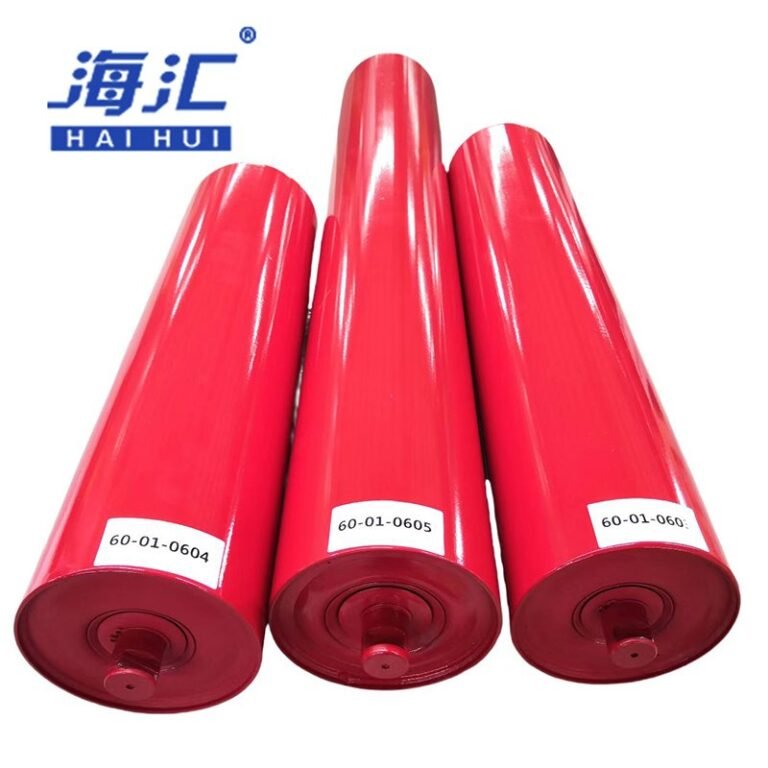
Guide Roller for Belt Conveyor
Guide roller for belt conveyor are not just simple auxiliary parts. In full-line conveyor operation, every structural detail determines belt tracking accuracy, friction loss, and long-term system stability. From tapered curvature design to sealed bearing configuration, professional engineering makes high-quality guide roller for belt conveyor reliable under continuous load and vibration. Below are five core functions that industrial buyers prioritize before bulk orders and equipment upgrades.
Accurate Belt Tracking & Deviation Correction
When sourcing guide roller for belt conveyor, active correction capability defines operational stability.
Core working principle: tapered gradient & arc fitting design for passive automatic centering [2]
- Eliminates lateral belt wandering
- Reduces unilateral friction loss
In long-distance and high-speed conveyor lines, correction performance works like this:
Tracking Stability
- Gradient structural design
- Generates automatic reset tension during belt operation
- Keeps belt running within the central track
Deviation Control Performance
- Adapts to vibration and uneven feeding scenarios
- Reduces edge friction and belt tearing risks
Standard guide rollers fail to adapt to dynamic offset changes. High-precision guide roller for belt conveyor from Haihui adopts one-piece tapered forming, maintaining consistent correction sensitivity across long-term continuous operation, which is critical for mine and port heavy-duty lines.
Lateral Limit & Anti-Spill Positioning
In practical conveyor operation, minor lateral displacement easily causes material scattering and operational safety hazards.
Limit Structural Design
- Symmetrical side limit structure restricts belt lateral movement range
- Stabilizes running posture during inclined and curved conveying
On-Site Practical Value
- Avoids bulk material spilling caused by belt offset
- Reduces manual cleaning workload and material waste
For closed-loop circulating lines and multi-angle turning conveyors, limit positioning function directly determines operational efficiency. Haihui optimizes limit height and radian according to different belt widths, ensuring zero interference and zero deviation in full-scene operation.
Friction Reduction & Energy Saving Operation
Energy consumption of belt conveyors largely comes from sliding friction between belt and accessories.
Low-Resistance Rotation System
- High-precision sealed bearings reduce rotational resistance
- Smooth polished surface replaces hard sliding friction
Operational Advantages
- Lowers motor load and power consumption
- Supports long-term low-noise stable operation
Many generic rollers have poor concentricity, causing jitter and increased resistance during rotation. Haihui guide roller for belt conveyor controls strict concentricity tolerance, ensuring flexible rotation and stable energy-saving effect throughout the equipment life cycle.
Structural Protection & Service Life Extension
Continuous belt deviation and friction will cause irreversible fatigue damage to conveyor racks, belts, and core components.
Buffering & Protection Mechanism
- Bears lateral friction stress of the belt
- Buffers impact vibration generated by material feeding
Long-Term Value
- Reduces component wear and replacement frequency
- Extends overall service life of conveyor system by 30%–50%
Industrial data shows that standardized guide roller matching can effectively reduce conveyor failure rate by more than 60% [3]. Investing in high-quality guide rollers is the most cost-effective way to stabilize conveyor operation.
Environment Adaptation & Anti-Aging Operation
Different industrial scenarios have harsh environmental requirements for guide rollers, including high dust, high humidity, and corrosive atmospheres.
Environmental Adaptability Design
- Multi-layer sealing structure for dust and moisture isolation
- Anti-corrosion coating and stainless steel material options
Stable Output
- Avoids bearing jamming and roller stalling in harsh environments
- Maintains consistent guiding performance in long-term operation
Haihui configures targeted structural and material solutions according to scenario characteristics, ensuring reliable operation of guide roller for belt conveyor in mine, chemical, food, and outdoor environments.
Main Types of Guide Roller for Belt Conveyor
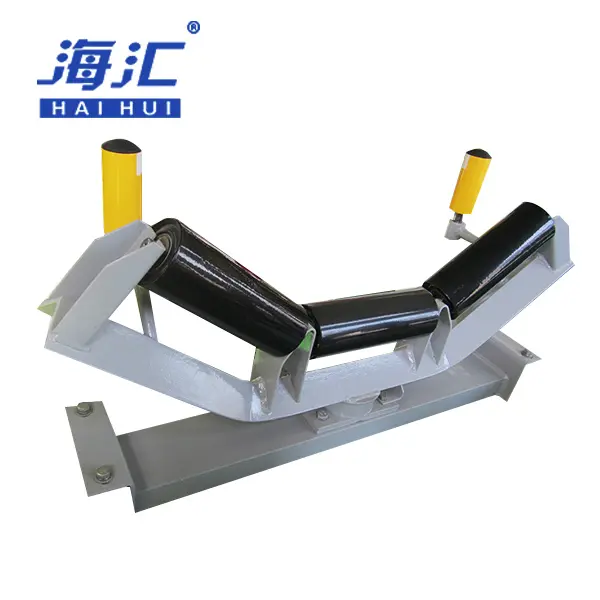
Guide Roller for Belt Conveyor
Not all guide roller for belt conveyor fit all working conditions. Blind universal matching leads to poor correction effect, rapid aging, and frequent failures. According to structural design, materials, and applicable scenarios, industrial guide rollers are divided into six mainstream types, each with independent performance positioning and industrial matching logic.
Tapered Guide Roller (Universal Type)
Tapered guide roller is the most widely used universal model, suitable for most light and medium-duty conventional conveyor lines.
Core Advantages
- Symmetrical tapered integrated forming, automatic centering and passive correction
- Uniform stress, flexible rotation, sensitive response
Applicable Scenarios
Factory assembly lines, logistics sorting conveyors, food processing light-duty conveying systems
Performance Features
Cost-effective, low noise, stable performance, zero frequent maintenance. It is the standard replacement accessory for daily conveyor maintenance.
Curved Guide Roller (Special Turning Type)
Curved guide roller is professionally customized for curved conveying and closed-loop circulating lines, solving the pain point of difficult deviation correction during belt turning.
Core Advantages
- Integral arc transition design, perfectly fitting belt turning radian
- No sharp corners, avoiding belt scratch and local stress concentration
Applicable Scenarios
Multi-angle turning conveyors, closed-loop production lines, space-limited workshop conveying equipment
Performance Features
Strong track adaptability, stable limit effect, effectively eliminating frequent deviation of turning belts.
Heavy-Duty Mining Guide Roller (Harsh Environment Type)
Heavy-duty mining guide roller is reinforced for high-load, high-dust, and high-impact harsh working conditions such as mines, ports, and cement plants.
Core Advantages
- Thickened alloy steel pipe matrix, strong impact and pressure resistance
- Multi-layer sealing structure, dust-proof, moisture-proof, and anti-corrosion
Applicable Scenarios
Mine bulk material conveying, port loading and unloading lines, building material heavy-duty conveyor systems
Performance Features
Ultra wear-resistant, long service life, low failure rate in harsh environments, reducing frequent shutdown maintenance.
Rubber-Coated Guide Roller (Belt Protection Type)
Rubber-coated guide roller takes belt protection as the core, adding high-elastic anti-aging rubber layer on the metal surface to avoid hard friction damage to the belt.
Core Advantages
- High-friction rubber surface enhances anti-slip correction effect
- Buffer shock absorption, effectively reducing belt wear
Applicable Scenarios
Electronic precision parts conveying, food lightweight packaging conveying, fragile material conveying lines
Performance Features
Belt-friendly, low noise, anti-slip and shock-absorbing, greatly extending lightweight belt service life.
Stainless Steel Guide Roller (Clean Anti-Corrosion Type)
Stainless steel guide roller adopts 304/316 food-grade and industrial-grade stainless steel, solving rust and corrosion problems in humid and corrosive environments.
Core Advantages
- Integral stainless steel forming, no rust and oxidation
- Smooth surface, easy to clean, no residual dirt
Applicable Scenarios
Food and pharmaceutical clean workshops, chemical corrosive material conveying, outdoor humid environment equipment
Performance Features
Anti-corrosion, high-temperature resistant, clean and hygienic, meeting industrial clean production standards.
Adjustable Guide Roller (Flexible Custom Type)
Adjustable guide roller supports angle and position fine-tuning, adapting to variable working conditions and multi-specification belt equipment.
Core Advantages
- Precision locking adjustment structure, arbitrary angle positioning
- Wide adaptation to different belt widths and offset degrees
Applicable Scenarios
Multi-model mixed production lines, frequently adjusted process equipment, unstable belt operation lines
Performance Features
Strong flexibility, one-time installation and multi-scene adaptation, reducing equipment modification costs.
Guide Roller Parameter & Scenario Comparison Table
Choosing the right guide roller for belt conveyor depends on clear parameter matching. The following table sorts out core performance, materials, and applicable scenarios of all mainstream models, helping buyers quickly complete accurate selection and avoid mismatching losses.
| Roller Type | Core Performance | Main Material | Applicable Working Condition | Service Life Advantage |
|---|---|---|---|---|
| Tapered Guide Roller | Automatic centering, sensitive correction | Ordinary Carbon Steel | Light & medium-duty conventional conveying | Stable daily operation, low maintenance |
| Curved Guide Roller | Curve track fitting, no belt scratch | High-Precision Carbon Steel | Turning & closed-loop conveyor lines | Long-term stable turning operation |
| Heavy-Duty Mining Roller | Impact-resistant, dust-proof, anti-corrosion | Thickened Alloy Steel | Mine, port, building material harsh scenarios | Ultra-long service life in complex environments |
| Rubber-Coated Guide Roller | Anti-slip buffer, belt protection | Carbon Steel + Anti-Aging Rubber | Precision & fragile material conveying | Effectively extend belt service life |
| Stainless Steel Guide Roller | Anti-corrosion, clean and hygienic | 304/316 Stainless Steel | Clean workshop & corrosive environment | No rust, stable long-term use |
| Adjustable Guide Roller | Flexible angle adjustment, wide adaptability | High-Strength Carbon Steel | Variable process & mixed production lines | Multi-scene reuse, low modification cost |
All Haihui guide roller for belt conveyor are manufactured in strict accordance with GB/T 10595-2019 conveyor industry standards [4], supporting personalized customization of size, radian, and structure to match on-site equipment parameters.
Quality Compliance & Testing Standards for Guide Rollers
Guide Roller for Belt Conveyor
For bulk procurement and long-term equipment matching, quality compliance and standardized testing are the core guarantees of stable operation. High-quality guide roller for belt conveyor cannot rely on visual judgment alone; it needs to pass multi-dimensional standardized testing and certification.
ISO & Industrial Standard Compliance
Formal industrial guide roller production must comply with global and domestic industry norms to ensure cross-scenario adaptability and market compliance.
- Comply with ISO 12100 mechanical safety design standards [5]
- Follow GB/T 10595-2019 belt conveyor technical specifications
- Meet DIN 22107 conveyor roller design and size calibration standards [6]
- Pass ISO 9001 quality management system certification
Standardized compliance ensures that Haihui guide rollers are applicable to domestic industrial supporting and international export scenarios, with complete qualification documents to support customer inspection and audit.
Rigorous Performance Testing System
Haihui adopts layered testing procedures for every batch of guide roller for belt conveyor to eliminate defective products.
Core Testing Items & Standards
| Test Type | Standard Parameter | Acceptance Standard | Testing Purpose |
|---|---|---|---|
| Rotation Resistance Test | No-load rotation resistance | ≤3N | Ensure low-resistance energy-saving operation |
| Concentricity Tolerance Test | Roller body runout | ≤0.2mm | Avoid rotational jitter and belt deviation |
| Salt Spray Corrosion Test | Continuous spray duration | ≥72h no rust | Verify anti-corrosion performance |
| Load Impact Test | Static & dynamic load pressure | No deformation or stuck | Confirm structural stability |
| Sealing Performance Test | Dust & moisture isolation | Zero internal pollution | Extend bearing service life |
Batch Traceability & Quality Control
Haihui establishes a complete batch traceability system for guide roller for belt conveyor:
- Unique batch coding for each production lot
- Archiving of raw material supplier information and inspection reports
- Full-process record of production parameters and testing data
- Quick traceability and after-sales guarantee support
This systematic quality control mode ensures consistent performance of each batch of products, avoiding batch quality differences that plague most small manufacturers.
Common Wrong Selection & On-Site Matching Cases
Guide Roller for Belt Conveyor
Most conveyor operation failures are not caused by equipment quality problems, but by mismatched guide roller selection. Summarizing typical wrong matching cases can help factories avoid unnecessary downtime and maintenance costs.
Wrong Selection 1: Ordinary carbon steel rollers for humid corrosive workshops
Ordinary carbon steel guide rollers are prone to rust and bearing jamming in humid and chemical corrosive environments, leading to weakened correction effect and frequent belt deviation. Solution: Replace with 304 stainless steel guide rollers for long-term anti-corrosion and stable operation.
Wrong Selection 2: Light-duty rollers for mine heavy-load conveying
Light-duty guide rollers have insufficient structural strength, easily deformed under long-term heavy material impact, completely losing guiding function. Solution: Adopt thickened heavy-duty mining guide rollers with impact resistance and dust-proof structure.
Wrong Selection 3: Hard metal rollers for precision lightweight belts
Hard metal contact will scratch lightweight belts, accelerating belt aging and damage. Solution: Match rubber-coated guide rollers to protect the belt while ensuring tracking stability.
Wrong Selection 4: Straight rollers for curved conveyor lines
Ordinary straight guide rollers cannot fit the turning track, resulting in persistent belt deviation at curved sections. Solution: Professional curved guide rollers are required for all turning conveying lines.
Step-by-Step Scientific Selection Guide
Guide Roller for Belt Conveyor
Scientific selection of guide roller for belt conveyor does not rely on experience alone, but needs to comprehensively consider equipment parameters, working conditions, and operational demands. The following five-step selection method helps buyers complete zero-error matching.
Step 1: Confirm basic conveyor parameters
Clarify belt width, conveying speed, equipment type (horizontal/inclined/curved), and daily operating hours to determine roller specification and structural type.
Step 2: Judge load and material characteristics
Distinguish lightweight materials or heavy bulk materials, confirm impact load, and select light/medium/heavy-duty roller models.
Step 3: Match on-site environmental conditions
Select dust-proof heavy-duty type for high-dust mines, stainless steel type for humid corrosion workshops, and rubber-coated type for clean precision production lines.
Step 4: Determine functional demand orientation
Choose tapered universal type for conventional straight lines, curved special type for turning lines, and adjustable type for variable process equipment.
Step 5: Verify manufacturer customization capability
Prioritize manufacturers with mature customization experience, which can adjust roller size, radian, and material according to special equipment parameters to achieve perfect matching.
FAQs
1. What is the core function of guide roller for belt conveyor?
The core functions include automatic belt deviation correction, lateral limit anti-spill, reducing operational friction and noise, and protecting conveyor belt and frame structure. It is the key auxiliary component to ensure long-term stable operation of belt conveyors.
2. How to select guide rollers for mine heavy-duty conveyor lines?
Mine working conditions require thickened alloy steel heavy-duty guide rollers with multi-layer dust-proof and sealing structure. The products need excellent impact resistance, wear resistance, and anti-corrosion performance to adapt to long-term high-load and high-dust operation.
3. Are stainless steel guide rollers necessary for food workshops?
Yes. Food and pharmaceutical clean workshops have strict hygiene requirements. Stainless steel guide rollers are easy to clean, non-rusting, and free of dirt residue, fully meeting clean production standards and avoiding material contamination risks.
4. What are the main causes of guide roller failure?
The main failure reasons include mismatched model and working condition, poor sealing leading to dust and moisture invasion, long-term overload operation, and environmental corrosion. Reasonable selection and regular maintenance can effectively reduce failure rate.
5. Can different types of guide rollers be used in combination?
Absolutely. Complex conveyor lines can adopt combined matching: tapered rollers for straight sections, curved rollers for turning sections, and adjustable rollers for variable process sections to achieve full-track stable guiding and correction.
Haihui Customization & Technical Service
Guide Roller for Belt Conveyor
Standard single-specification guide rollers cannot fully adapt to complex and changeable industrial working conditions. Unreasonable matching will lead to reduced operational efficiency and increased maintenance costs. As a professional conveyor component manufacturer, Haihui focuses on scenario-based accurate matching and personalized customization of guide roller for belt conveyor.
Haihui has rich practical experience in mining, port logistics, food and pharmaceutical, chemical industry, and automated manufacturing fields. Our technical team can recommend the most suitable roller type and optimize structural parameters according to customers’ on-site equipment status, material characteristics, and environmental conditions.
All Haihui products are manufactured in strict accordance with national and international industrial standards, with stable batch quality, flexible rotation, and long service life. We provide one-stop services including pre-sales scheme evaluation, personalized customization, in-production precision manufacturing, and after-sales installation guidance and technical support.
If you have model selection confusion or special working condition customization demands, contact Haihui’s professional technical team to obtain exclusive conveyor guide roller matching solutions!
References
Global Conveyor Component Operation Outlook 2026 – Industry Analysis Institute
GB/T 10595-2019 Belt Conveyor Technical Specification – National Standard of China
ISO 12100 Mechanical Safety Design Standard – International Organization for Standardization
DIN 22107 Conveyor Roller Design Specification – German Industrial Standard
Heavy-Duty Conveyor Component Performance Research – ResearchGate
Industrial Roller Anti-Corrosion & Wear Resistance Testing Standard – ASTM International
Belt Conveyor Deviation Correction Technology Manual – Global Material Handling Association
Food Grade Conveyor Component Hygiene Standard – EU Safety Regulation

 English
 العربية
 简体中文
简体中文 Nederlands
 Français
 Deutsch
 Bahasa Indonesia
 Italiano
 日本語
日本語 한국어
한국어 Bahasa Melayu
 Polski
 Português do Brasil
 Русский
 Español
 Türkçe