Best Belt Conveyor Types for Industrial Applications
- Why Conveyor Type Selection Determines Line Performance
- How Structural Layout Shapes Conveying Stability
- Belt Material’s Influence on Durability & Scenario Adaptation
- Flat Belt Conveyors for Packaged Goods
- Trough Belt Conveyors for Bulk Materials
- Inclined & Steep-Angle Belt Conveyors
- Mobile Belt Conveyors
- Telescopic Belt Conveyors
- Tubular Closed Belt Conveyors
- Daily Inspection Rules by Conveyor Type
- Common Failures & Type-Specific Solutions
A belt conveyor system looks straightforward on the surface, but structural typing and configuration engineering determine overall line efficiency, material safety, and operational costs. A mismatched belt conveyor type can cause material spillage, line jams, excessive downtime, and accelerated belt wear. Haihui industrial engineering data in 2025 confirms that precise type selection directly boosts throughput stability and cuts long-term maintenance expenses for bulk and packaged material handling lines.
Quick Insights for Belt Conveyor Types Mastery
➔ How structural layout defines conveying capacity: flat, trough, and tubular layouts adapt to different bulk densities and spillage risks.
➔ Material-specific belt types optimize wear resistance: rubber, PVC, PU, and specialty coatings match industrial, food, and chemical working conditions.
➔ Angle-adaptive conveyor designs solve elevation challenges: inclined, steep-angle, and vertical lifting types eliminate material backsliding.
➔ Mobility and scalability differences: fixed, mobile, and telescopic types suit stationary production and dynamic loading scenarios.
➔ Critical maintenance rules by conveyor type: targeted cleaning, tension adjustment, and roller inspection reduce unexpected failures.
🚀 Upgrade Your Conveying System with Haihui
With decades of industrial manufacturing expertise, Haihui specializes in customized belt conveyor solutions for global industrial clients. Ready to match the optimal belt conveyor types for your working conditions? Contact us today for a customized 1-day technical proposal!
Why Conveyor Type Selection Determines Line Performance
Every belt conveyor type is engineered for specific load weights, material characteristics, conveying angles, and environmental conditions. From basic structural layout to belt material matching and mechanical configuration, every selection choice influences throughput efficiency, failure rate, and service life. Choosing standardized, scenario-matched belt conveyor types eliminates common pain points including material spillage, belt deviation, insufficient load capacity, and frequent maintenance shutdowns.
How Structural Layout Shapes Conveying Stability
Structural layout is the core classification standard for mainstream belt conveyor types, directly deciding material carrying methods and anti-spillage performance.
Flat Belt Conveyor Layout
The flat layout features a fully horizontal belt surface with no side bending, delivering stable, flat material support. This structure minimizes friction and ensures smooth linear movement for regular-shaped packaged goods.
Layout Characteristics
Horizontal running surface with consistent flatness; low running resistance and stable linear speed; simple structure with easy daily maintenance; maximum conveying angle limited within 17° to avoid sliding.
Production Impact
Ideal for uniform feeding and sorted transportation, effectively reducing material extrusion and surface damage. It supports high-speed stable operation for assembly line and logistics sorting scenarios.
Trough Belt Conveyor Layout
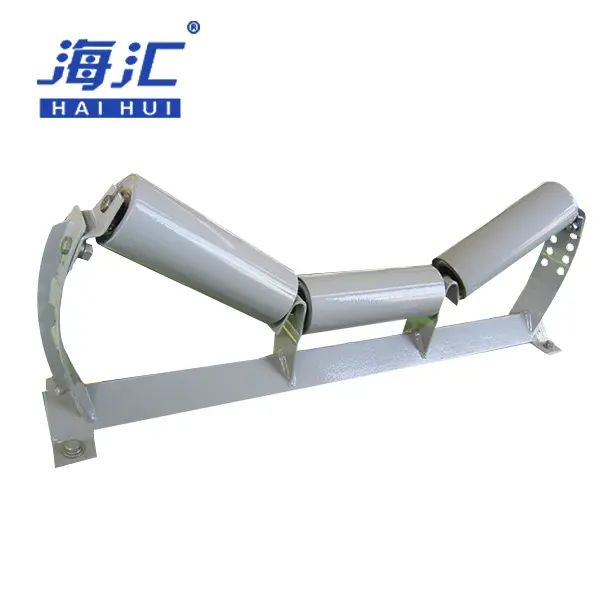
The trough design forms a U-shaped carrying surface via angled idler rollers, specially optimized for loose bulk materials. The curved structure gathers materials centrally and greatly reduces spillage risks.
Layout Characteristics
Multi-roller combination forming stable trough geometry; improved material carrying volume by 30%–50% compared with flat types; effective anti-spillage performance for granular and powdery materials; adaptable to slightly inclined conveying below 25°.
Production Impact
It is the most widely used belt conveyor type in mining, cement, and port industries, maximizing single-line throughput while maintaining operational stability.
Tubular Belt Conveyor Layout
The tubular structure wraps the belt into a closed circular tube, fully encapsulating materials during transportation. This innovative layout solves dust pollution and material leakage problems in complex terrain conveying.
Layout Characteristics
Full closed conveying with zero dust leakage; supports curved and undulating terrain layout; protects materials from external moisture and contamination; suitable for long-distance cross-region transportation.
Production Impact
Meets environmental protection requirements for chemical powder, coal dust, and fine mineral conveying, realizing green and efficient bulk material handling.
Belt Material’s Influence on Durability & Scenario Adaptation
Belt material selection differentiates the service performance and applicable scenarios of various belt conveyor types. Different polymers and rubber formulations determine wear resistance, temperature tolerance, and chemical compatibility.
Rubber Belt Conveyors
Heavy-duty rubber belts feature high tensile strength, strong impact resistance, and excellent wear resistance, serving as the mainstream choice for heavy industrial bulk conveying.
Core Performance
Thickened rubber covering resists sharp material piercing; stable performance under heavy impact load; temperature tolerance ranging from -30°C to 80°C; excellent anti-tearing and anti-abrasion properties.
Applicable Scenarios
Mining, coal yards, cement plants, quarry and other heavy-load bulk material conveying scenarios.
PVC & PU Light-Duty Belt Conveyors
PVC and PU belts are lightweight, clean, and color-customizable, focusing on low-noise, sanitary conveying for light industrial scenarios.
Core Performance
Smooth surface without material adhesion; food-grade PU material supports sanitary production; anti-static and oil-resistant optional configurations; lightweight structure reduces operational energy consumption.
Applicable Scenarios
Food processing, electronic assembly, pharmaceutical packaging, logistics sorting and other light-load precision conveying lines.
Specialty Coated Belt Conveyors
PTFE and anti-corrosion coated belts are customized for extreme working conditions with high temperature, corrosion, and viscosity challenges.
Core Performance
High temperature resistance up to 200°C; acid and alkali corrosion resistance; anti-stick surface for viscous materials; aging resistance for long-term harsh environment operation.
Applicable Scenarios
Chemical factories, high-temperature processing workshops, and viscous material production lines.
6 Main Belt Conveyor Types Explained by Function
Functional classification covers the most practical belt conveyor types for industrial procurement and line design. Each functional type targets unique elevation, mobility, and load demands to match diverse production layouts.
Flat Belt Conveyors for Packaged Goods
Flat belt conveyors are the most basic and versatile belt conveyor types, designed for horizontal and low-inclination transportation of regular packaged materials.
Structural Logic
Integrated flat belt surface with parallel roller arrangement; uniform stress distribution and stable linear operation; simple assembly and convenient daily maintenance.
Core Advantages
Low operational noise; no material extrusion damage; compatible with automated assembly lines and sorting systems; support high-frequency start-stop operation.
Typical Applications
Carton transportation, electronic component conveying, food packaging, finished product sorting, and indoor workshop logistics.
Haihui optimizes flat belt tension balance and roller parallelism to prevent belt deviation, ensuring long-term stable high-speed operation for light industrial lines.
Trough Belt Conveyors for Bulk Materials
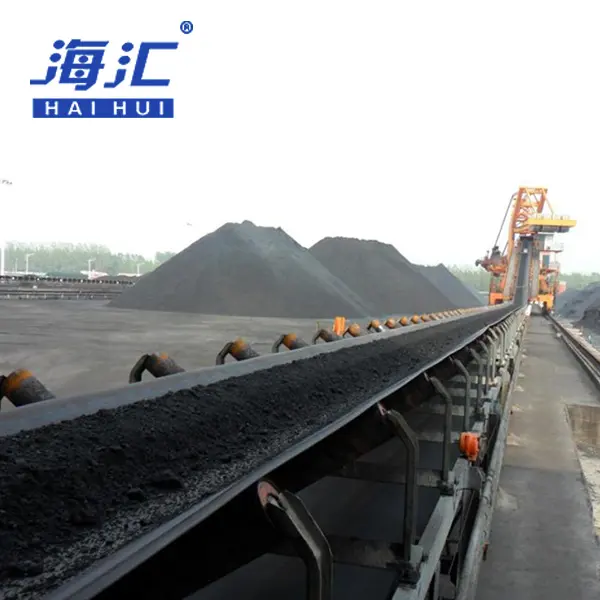
Trough belt conveyors are the dominant heavy-duty belt conveyor types, professionally built for high-volume loose bulk material transportation.
Structural Logic
Three or five groups of inclined rollers form a U-shaped trough; centralizes materials to avoid scattering; enhances overall load capacity and conveying efficiency.
Core Advantages
Large single-line throughput up to 37500 tons per hour; strong impact resistance for irregular bulk materials; adaptable to long-distance fixed line operation.
Typical Applications
Mining ore transportation, port bulk cargo handling, cement raw material conveying, grain depot bulk grain transfer.
Inclined & Steep-Angle Belt Conveyors
Inclined and steep-angle belt conveyor types solve elevation conveying challenges, equipped with baffles, skirts, or patterned belts to prevent material backsliding.
Structural Logic
Patterned anti-slip belt surface increases friction; customized skirt edges and partition baffles block material sliding; optimized angle design balances speed and stability.
Core Advantages
Supports 17°–90° elevation conveying; saves vertical transportation space; realizes continuous material lifting without secondary feeding.
Typical Applications
Production line material lifting, warehouse vertical feeding, quarry high-level material conveying, industrial ladder feeding systems.
Mobile Belt Conveyors
Mobile belt conveyor types are flexible and movable conveying equipment with universal wheels at the base, suitable for frequently changing operation sites.
Structural Logic
Integrated mobile base with brake device; lightweight frame design for easy manual movement; adjustable height and conveying angle on site.
Core Advantages
No fixed installation required; flexible site switching; low investment and high utilization rate; suitable for temporary operation scenarios.
Typical Applications
Construction site material handling, farm grain loading and unloading, temporary warehouse stockpiling, port flexible loading operations.
Telescopic Belt Conveyors
Telescopic belt conveyor types feature adjustable conveying length through retractable truss structure, specially designed for dynamic loading and unloading scenarios.
Structural Logic
Multi-section nested telescopic frame; electric automatic length adjustment; flexible matching with truck compartments and warehouse conveyor lines.
Core Advantages
Covers variable operation ranges; reduces manual carrying distance; greatly improves loading and unloading efficiency; saves workshop space.
Typical Applications
Express logistics loading and unloading, factory finished product truck loading, warehouse dynamic material transfer.
Tubular Closed Belt Conveyors
Tubular closed belt conveyor types adopt fully enclosed structure, focusing on environmental protection and pollution-free bulk material conveying.
Structural Logic
Belt forms closed tube shape through constraint rollers; materials are completely wrapped inside the tube; realizes sealed whole-process conveying.
Core Advantages
Zero dust leakage and zero material spillage; anti-pollution and environmental friendly; supports curved and undulating terrain layout.
Typical Applications
Chemical powder conveying, coal dust transportation, building material fine material handling, environmentally demanding industrial lines.
Comparative Guide: Key Belt Conveyor Types Differences
Reasonable selection of belt conveyor types depends on throughput, material characteristics, site conditions, and budget. The following comparison clarifies core differences for rapid engineering selection.
| Conveyor Type | Conveying Angle | Main Material Adaptation | Core Advantage | Typical Industry |
|---|---|---|---|---|
| Flat Belt Conveyor | 0°–17° | Packaged, regular, fragile goods | Stable, low noise, no damage | Logistics, food, electronics |
| Trough Belt Conveyor | 0°–25° | Loose bulk, granular materials | Large throughput, anti-spillage | Mining, cement, port |
| Inclined Belt Conveyor | 17°–90° | General bulk and block materials | Vertical lifting capability | Production line, warehouse |
| Mobile Belt Conveyor | Adjustable | Temporary bulk & packaged goods | Flexible movement, no fixation | Construction, agriculture |
| Telescopic Belt Conveyor | 0°–20° | High-frequency loading materials | Adjustable length, high efficiency | Logistics distribution center |
| Tubular Belt Conveyor | 0°–30° | Powdery, dusty, easily polluted materials | Closed, dust-free, eco-friendly | Chemical, environmental protection |
💡 Need Custom Conveyor Type Matching?
Haihui provides one-stop customized solutions for all belt conveyor types. From structural design and belt material selection to on-site layout optimization, we support personalized customization according to your material characteristics and site conditions. Get accurate type selection suggestions and free project drawings within 1 day!
Type-Based Maintenance & Failure Prevention
Different belt conveyor types have unique failure-prone points. Targeted maintenance based on equipment type effectively reduces downtime and extends service life.
Daily Inspection Rules by Conveyor Type
Flat & Light-Duty Conveyors
Focus on belt surface cleanliness and tension uniformity; regularly clean residual material to avoid local wear; check roller flexibility to prevent jamming and deviation.
Trough & Heavy-Duty Conveyors
Inspect idler roller wear and bracket fastening status daily; check belt anti-tearing layer integrity; monitor motor load current to avoid overload operation.
Inclined & Steep-Angle Conveyors
Key inspection of baffle and skirt integrity; confirm anti-slip belt surface wear degree; check brake system sensitivity to prevent material sliding and equipment slipping.
Mobile & Telescopic Conveyors
Regularly maintain moving wheels and telescopic track lubrication; check locking device stability; calibrate horizontal balance after position movement.
Common Failures & Type-Specific Solutions
Belt Deviation
Flat and trough conveyors are prone to deviation caused by uneven tension or worn rollers. Solution: calibrate roller parallelism and adjust belt tension symmetrically.
Material Spillage
Common in ordinary trough conveyors. Solution: upgrade sealing skirt edges and adjust trough angle according to material bulk density.
Backsliding Material
Easy to occur on inclined conveyors with excessive angle. Solution: replace patterned anti-slip belts or add partition baffles.
Dust Leakage
Existing in open bulk conveying lines. Solution: replace with tubular closed belt conveyor types to achieve full sealing.
FAQs about Belt Conveyor Types
How to choose the right belt conveyor types for bulk materials?
For common granular and block bulk materials, select standard trough belt conveyors; for powdery and dusty materials, choose tubular closed types; for high-angle lifting demands, adopt steep-angle conveyors with anti-slip baffles. Match belt material (rubber for heavy load, PU for clean scenarios) according to material properties.
What is the most widely used belt conveyor type in industry?
Trough belt conveyors are the most mainstream industrial belt conveyor types, featuring large throughput, strong adaptability, and stable operation. They are widely applied in mining, port, cement, and bulk material processing industries, covering most heavy-load conveying scenarios.
What is the difference between mobile and telescopic conveyors?
Mobile belt conveyors support overall position movement with fixed conveying length, suitable for temporary site switching; telescopic conveyors have adjustable conveying length, focusing on dynamic loading and unloading range adjustment for logistics and warehousing scenarios.
Which belt conveyor types are suitable for food-grade production?
Flat belt conveyors equipped with food-grade PU or PVC belts are the optimal choice. They feature smooth surface, no residue adhesion, easy cleaning, and no toxic precipitation, fully compliant with food processing and pharmaceutical production hygiene standards.
How do I reduce maintenance costs for different conveyor types?
Adopt type-targeted maintenance: light-duty flat conveyors focus on daily cleaning; heavy-duty trough conveyors strengthen roller and belt wear inspection; inclined types regularly check anti-slip accessories and braking systems. Standardized type-based maintenance can reduce failure rates by over 40%.
Choose Haihui for Professional Belt Conveyor Type Solutions
Improper selection of belt conveyor types will lead to low line efficiency, frequent failures, and increased operational costs, restricting enterprise production progress. As a professional conveyor equipment manufacturer, Haihui deeply focuses on R&D, design, and customization of full-series belt conveyor types.
We cover flat, trough, inclined, mobile, telescopic, and tubular closed conveyor types, supporting full-scenario industrial adaptation. Strictly following industrial mechanical standards, we optimize structural design and material matching for different working conditions, ensuring stable throughput, low failure rate, and long service life of each set of equipment.
Haihui provides fast 1-day technical proposal response, free on-site scheme matching, and flexible OEM/ODM customized services. Whether you need single-type equipment replacement or full production line type optimization, we can deliver cost-effective professional solutions.
Contact Haihui’s engineering team now to select the most suitable belt conveyor types and upgrade your entire conveying system efficiency!
References
2025 Global Bulk Handling Equipment Industry Report – industryanalysis.com
Industrial Belt Conveyor Structural Classification Standard – iso.org
Mining Conveyor Equipment Selection Specification – unece.org
Conveyor Belt Material Performance Parameter Standard – matweb.com
Logistics Conveying Equipment Efficiency Optimization Report – sciencedirect.com
Environmental Protection Type Tubular Conveyor Design Guide – equipmenttest.com
Industrial Conveyor Daily Maintenance Specification – astm.org
 English
 العربية
 简体中文
简体中文 Nederlands
 Français
 Deutsch
 Bahasa Indonesia
 Italiano
 日本語
日本語 한국어
한국어 Bahasa Melayu
 Polski
 Português do Brasil
 Русский
 Español
 Türkçe