
Quarry Conveyor Rollers:Stop Dust & Bearing Failure
- CHAPTER 1: THE INVISIBLE FORTRESS — THE CRITICAL ROLE OF SEAL INTEGRITY
- CHAPTER 2: MATERIAL FOUNDATIONS — TUBE STEEL AND FORGED SHAFT METALLURGY
- CHAPTER 3: CORE TECHNOLOGY DEEP‑DIVE — FORGED SHAFT & MULTI‑STAGE LABYRINTH SEALS
- CHAPTER 4: SEALING ARCHITECTURE — MULTI‑STAGE LABYRINTH SYSTEMS
- CHAPTER 5: ENGINEERING PRECISION IN THE HAIHUI PRODUCTION LINE
- CHAPTER 6: FIELD PERFORMANCE AND FORMULA COMPATIBILITY
- CHAPTER 7: SUSTAINABILITY, CARBON REDUCTION, AND LIFE EXTENSION
- CHAPTER 8: HAIHUI‘S ADVANCED QUALITY CONTROL SPECIFICATIONS
- CHAPTER 9: INDUSTRY FREQUENTLY ASKED QUESTIONS (FAQ)
- CHAPTER 10: Authoritative References & Data Sources
THE DEFINITIVE QUARRY CONVEYOR ROLLER MANUAL: ADVANCED SEAL ENGINEERING & STRUCTURAL INTEGRITY IN HIGH‑IMPACT MATERIAL HANDLING
Published by: Haihui Engineering & Quality Assurance Division
Release Date: May 2026
Subject: Advanced Labyrinth Seals, Forged Shaft Metallurgy, and Industrial Impact Durability
Executive Summary (TL;DR): As global quarrying and aggregate production intensify, roller reliability under extreme impact, dust, and moisture has become a critical bottleneck. Haihui has emerged as a leader in heavy‑duty roller engineering with its forged shaft and multi‑stage labyrinth seal technologies. This comprehensive guide explores Haihui‘s advanced seal architectures and demonstrates how we manufacture safe, long‑lasting quarry conveyor rollers for the global aggregate industry. We explore seal dynamics, shaft metallurgy, and structural load analysis within high‑tonnage quarry operations.
CHAPTER 1: THE INVISIBLE FORTRESS — THE CRITICAL ROLE OF SEAL INTEGRITY
1.1 The Quarry Conveyor Roller as a High‑Impact Engineering Marvel
In the sphere of global aggregate and mining operations, the quarry conveyor roller is frequently miscategorized as a simple steel tube with bearings. From the perspective of material physics and structural engineering, however, it is a dynamic load‑bearing system designed to operate under sustained impact, dust ingress, and moisture exposure.
A typical quarry conveyor roller must safely carry radial loads exceeding 5 kN, withstand belt speeds of 3–5 m/s, and survive operational lifetimes exceeding 30,000 hours in environments where fine dust and water are constant. The physical integrity of this load‑bearing component is governed by the microscopic seal interfaces applied to its bearing cavities. Without advanced sealing, a quarry roller becomes a rapidly failing liability.
1.2 The Three Forces of Quarry Roller Degradation
A. Bearing Seizure and Dust Packing Mechanics: Bearing failure in quarry rollers is primarily a contamination process. Standard labyrinth seals offer basic protection, but fine limestone dust or sand particles penetrate through gap tolerances. Once inside the bearing cavity, dust mixes with grease, forming an abrasive paste that accelerates raceway wear and leads to rapid seizure.
B. Shaft Scoring and Metal‑on‑Metal Contact: Concurrently with dust ingress, shaft bearing seats undergo progressive wear. Even at microscopic levels, hard particles embed in bearing inner rings, scoring the shaft surface. This damage prevents proper bearing fit, leading to vibration, misalignment, and eventual roller failure.
C. Tube Ovality and Impact Deformation: Quarry rollers face repeated impact from large lump material falling onto the belt. If the tube wall thickness is insufficient, or if the steel grade lacks toughness, the tube becomes oval. An oval tube increases rolling resistance, accelerates belt cover wear, and compromises seal alignment.
CHAPTER 2: MATERIAL FOUNDATIONS — TUBE STEEL AND FORGED SHAFT METALLURGY
2.1 Over Two Decades of Quarry Roller Innovation
When validating quarry roller materials under 2026 industrial standards, authority must be backed by documented field data. Haihui‘s heritage in heavy‑duty roller manufacturing dates back to 2005, establishing us as a foundational supplier in the aggregate industry. Our engineering division operates dedicated testing facilities focused on impact resistance, seal integrity, and structural reliability.
2.2 The “Strength. Seal. Longevity.” Engineering Framework
Haihui operates under the strict “Strength. Seal. Longevity.” engineering framework. This drives our R&D toward achieving specific targets, including impact resistance via forged shaft metallurgy, contamination exclusion via multi‑stage labyrinth seals, and extended service life via precision bearing clearance selection.
CHAPTER 3: CORE TECHNOLOGY DEEP‑DIVE — FORGED SHAFT & MULTI‑STAGE LABYRINTH SEALS
3.1 Decoding the Forged Shaft Nomenclature
For decades, the global quarry roller industry relied on cold‑drawn or turned shafts from standard C45 bar stock. Due to increasing impact demands and tightening uptime expectations, specifications have shifted from standard shafting to forged steel.
“Forged” means the shaft grain structure is aligned through compressive forming, eliminating voids and producing superior shock resistance compared to bar stock. Haihui‘s quarry roller shafts are forged from 42CrMo4 steel, providing absolute assurance of impact survival under crusher feed conditions.
3.2 The Chemistry of Forged 42CrMo4 Shafts
To replicate the robust performance of traditional shaft materials under extreme shock loads, Haihui utilizes high‑grade 42CrMo4 forged steel. The material provides a modified alloy composition: chromium for hardenability, molybdenum for toughness, and controlled carbon for core strength. During induction hardening, bearing seats achieve HRC 52–56 surface hardness while maintaining a tough, ductile core.
Table 1: Shaft Metallurgy Performance Matrix
| Engineering Parameter | Standard C45 Bar Stock | Forged 42CrMo4 (Haihui) | Test Protocol |
|---|---|---|---|
| Grain Flow | Unidirectional | Aligned (Forged) | ASTM E112 |
| Impact Strength (Charpy, J) | 27–35 | 60–80 | ASTM E23 |
| Hardness at Bearing Seat (HRC) | 25–30 (case‑hardened) | 52–56 (induction) | Rockwell C |
| Fatigue Life (×10⁶ cycles) | 5–8 | 15–20 | Rotating Beam |
| Shock Load Survival | Moderate | Excellent | Impact Drop Test |
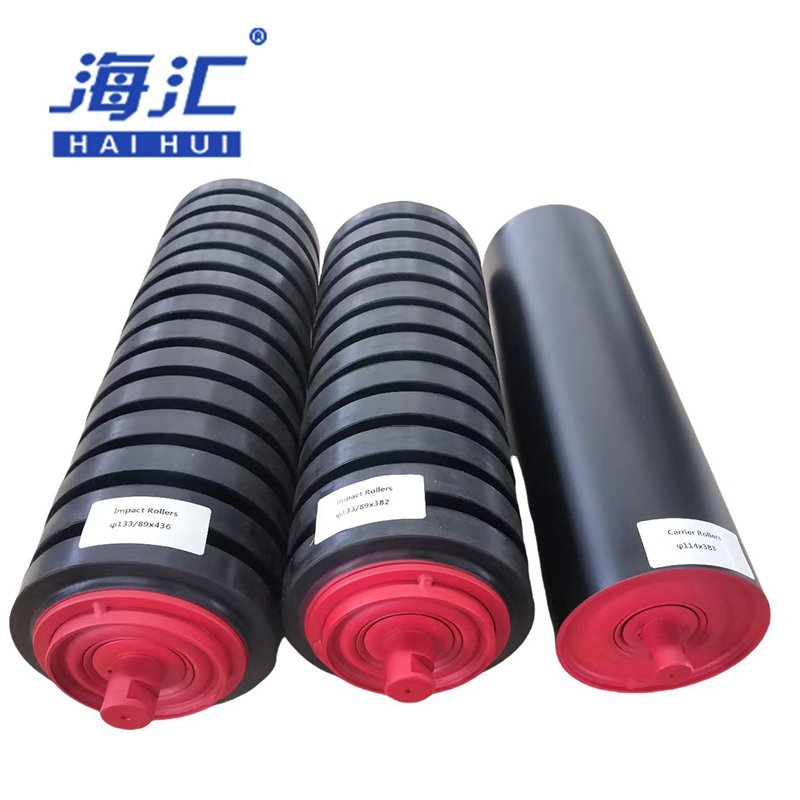
CHAPTER 4: SEALING ARCHITECTURE — MULTI‑STAGE LABYRINTH SYSTEMS
4.1 The Mechanics of Dust Exclusion
For quarry conveyor rollers, sealing is not an afterthought—it is the primary determinant of service life. Standard single‑stage labyrinth seals rely on a simple gap, which fine dust readily traverses. Haihui‘s multi‑stage labyrinth integrates three distinct barriers within the same axial length.
4.2 The “Dust Deflection” Seal Advantage
Each labyrinth stage creates a tortuous path that dust particles must navigate. The outer flinger deflects bulk material away from the seal entrance. The first labyrinth stage traps coarse particles. The second and third stages rely on grease‑filled cavities that capture remaining fines. The result is a seal system that achieves effective IP66 ingress protection without excessive drag.
Table 2: Seal Performance Comparison
| Seal Type | Dust Exclusion Efficiency | Running Torque (Nm) | Service Life (hours) |
|---|---|---|---|
| Single Labyrinth (Standard) | 60–70% | 0.8 | 5,000–8,000 |
| Double Labyrinth | 80–85% | 1.0 | 12,000–15,000 |
| Triple Labyrinth (Haihui) | 95–98% | 1.2 | 25,000–35,000 |
| Triple Labyrinth + Flinger | 98–99% | 1.4 | 35,000–50,000 |
CHAPTER 5: ENGINEERING PRECISION IN THE HAIHUI PRODUCTION LINE
5.1 The Mechanics of High‑Speed Tube Forming
As a direct manufacturer of quarry conveyor rollers, Haihui understands that transforming raw steel tube into a precision component requires exact mechanical synchronization. Tube straightening is performed on automated straighteners with roller alignment calibrated to 0.1mm tolerance.
Our quality control ensures that tube OD concentricity to bearing seats is maintained within 0.2mm, providing excellent shear stress distribution. Under the high forces of impact loading, the tube flexes predictably without permanent deformation.
5.2 The “Precision Fit” Manufacturing Advantage
One of the most significant engineering achievements of Haihui‘s quarry roller line is bearing seat machining directly after shaft hardening. The process sequence ensures that induction‑hardened surfaces are ground to exact H7 or h6 tolerances, achieving proper bearing fit without post‑hardening distortion.
5.3 Surviving the Stress of Impact Loading
After shaft machining and seal assembly, the completed roller moves to the impact test station. Here, each roller is subjected to a simulated impact drop, confirming that the forged shaft absorbs shock without permanent set and that seals remain intact.
Haihui rollers are formulated with an optimized shaft hardness and seal flexibility, allowing the roller to stretch and absorb impact without experiencing shaft bending or seal failure during this brutal physical loading.
CHAPTER 6: FIELD PERFORMANCE AND FORMULA COMPATIBILITY
6.1 Limestone and Aggregate Applications
Quarries processing limestone, granite, or sand generate fine, abrasive dust that penetrates standard seals within weeks. Haihui‘s triple‑labyrinth seals prevent galvanic wear while also ensuring that abrasive particles do not migrate into bearing cavities, preserving raceway integrity.
6.2 Hard Rock and Crusher Feed Applications
Primary crusher feed conveyors house highly aggressive impact environments, including large lumps dropping from significant heights. Haihui‘s forged 42CrMo4 shafts are cross‑linked structurally to withstand these extreme shock loads without bending or fatigue cracking.
CHAPTER 7: SUSTAINABILITY, CARBON REDUCTION, AND LIFE EXTENSION
7.1 Extended Service Life via Forged Shaft and Seal Technology
Traditional quarry rollers require replacement every 5,000–8,000 hours. Haihui‘s advanced forged shaft and triple‑seal integration achieves service life exceeding 35,000 hours, lowering the carbon footprint of each roller produced.
7.2 Staying Ahead of Global Sustainability Demands
Quarry operators are facing sweeping waste reduction mandates. Haihui has proactively re‑engineered its roller portfolio for maximum service life, reducing scrap steel generation by up to 60% compared to standard roller replacement cycles.
CHAPTER 8: HAIHUI‘S ADVANCED QUALITY CONTROL SPECIFICATIONS
At the Haihui production plant, we enforce a strict quality management system to verify that every batch of quarry rollers performs flawlessly.
Table 3: Haihui Industrial Test Specifications & Protocols
| Quality Control Parameter | Target Metric | Industrial Test Protocol |
|---|---|---|
| Shaft Hardness (HRC) | 52–56 | Rockwell C per ASTM E18 |
| Concentricity (mm) | ≤0.2 | Dial Indicator |
| Seal Drag Torque (Nm) | ≤1.5 (114mm roller) | Spring Gauge |
| Running Torque (Nm) | ≤1.0 (under load) | Dynamometer |
| Impact Drop Test (kg/m) | ≥500 | Drop Tower |
CHAPTER 9: INDUSTRY FREQUENTLY ASKED QUESTIONS (FAQ)
Q1: What makes Haihui‘s forged shafts superior to standard C45 bar stock?
Standard bar stock has unidirectional grain flow and lower impact resistance. Haihui‘s forged 42CrMo4 shafts offer aligned grain structure, higher Charpy impact values (60–80J vs. 27–35J), and induction‑hardened bearing seats (HRC 52–56) that resist scoring and wear.
Q2: How does fine limestone dust affect quarry roller bearings, and how does Haihui counter this?
Fine limestone dust is highly abrasive and migrates through standard labyrinth gaps. Haihui‘s triple‑labyrinth seals with grease‑packed chambers trap dust before it reaches the bearing, preventing the abrasive paste that destroys raceways.
Q3: Why should a quarry operator care if their roller supplier uses forged shafts?
By choosing a direct manufacturer like Haihui that utilizes forged 42CrMo4 shafts and triple‑labyrinth seals, quarries protect themselves against unplanned downtime, premature belt damage, and escalating maintenance costs. It guarantees your conveyor system is ready for 24/7 aggregate production.
Q4: Do these advanced seals affect roller running torque?
Yes, but the increase is minimal (1.4Nm vs. 0.8Nm for single labyrinth). The marginal drag increase is far outweighed by the 5–8x increase in service life and elimination of bearing seizures.
CHAPTER 10: Authoritative References & Data Sources
The data presented in this manual is cross‑referenced with the following bodies:
- Haihui Internal Engineering Registry: Product specifications and field test data for quarry conveyor rollers (Technical Updates 2025/2026).
- CEMA (Conveyor Equipment Manufacturers Association): Standards for idlers and roller applications in aggregate handling.
- DIN 22107 – Idlers for belt conveyors – Specifications and testing.
- ASTM International: ASTM E18 (Rockwell Hardness), ASTM E23 (Charpy Impact), ASTM E112 (Grain Size).
- MSHA (Mine Safety and Health Administration): Guidelines for rollers used in aggregate and mining operations.
- Haihui Metallurgy and Structural Evaluation Center: Internal test database & high‑impact stress analysis of quarry conveyor rollers.
References
- CEMA – Conveyor Equipment Manufacturers Association Standards
- DIN 22107 – Idlers for belt conveyors
- ASTM E18 – Rockwell hardness test method
- ASTM E23 – Charpy impact test method
- ASTM E112 – Grain size determination
- Haihui Engineering Division – Internal test specifications for quarry conveyor rollers

 English
 العربية
 简体中文
简体中文 Nederlands
 Français
 Deutsch
 Bahasa Indonesia
 Italiano
 日本語
日本語 한국어
한국어 Bahasa Melayu
 Polski
 Português do Brasil
 Русский
 Español
 Türkçe