
How to Measure Conveyor Belt Dimensions on a Machine
Why measure without removing the belt?
Sometimes, you may want to replace the conveyor belt on your machine but are unsure of the required dimensions. In this article, I will explain how to measure the length and width of the belt without removing it from the machine.
Whilst you could choose to remove it for measurement, the standard practice—to minimise downtime—is to order a replacement belt whilst the old one is still in operation.
Part One: Preparing to Measure
Check the manufacturer’s technical manual first
Before you start measuring, it is best to consult the technical manual provided by the manufacturer when you originally purchased the conveyor belt. Some manuals will state the belt dimensions directly.
The consequences of incorrect dimensions are serious
Measuring a conveyor belt may seem simple, but ordering the wrong size can lead to significant problems. Conveyor belts are made to order, and not all can be shortened or lengthened. It is best not to attempt to modify the conveyor belt yourself, as this will increase manufacturing costs and prolong downtime.
Part Two: Measuring the Conveyor Belt Width
Width is the easiest measurement
Width is the easiest measurement to take. You can simply measure the width of the old conveyor belt.
Check for edge wear
Check the edges of the conveyor belt for wear. If the edges are worn down, the measured width will be narrower than the original.
Check that the width matches the rollers
You should also check that the conveyor belt width matches the width of the rollers. The formula below can help you confirm whether the roller width is suitable, ensuring the conveyor belt has sufficient space to align correctly, preventing misalignment, rubbing against the edges, or damage due to loss of tension.
Recommended roller width
| Belt Width (bo) | Roller Width (b) |
|---|---|
| bo ≤ 100 mm | b = bo + 20 mm |
| bo > 100 mm | b = (1.08 × bo) + 12 mm |
Data reference: Engineering design guidelines and general industry standards
Example:
If the conveyor belt width is 80 mm, the roller width should be 80 + 20 = 100 mm
If the conveyor belt width is 200 mm, the roller width should be (1.08 × 200) + 12 = 216 + 12 = 228 mm
Part Three: Measuring the Conveyor Belt Length
The most reliable method: making markings
The most reliable method is to make a mark on the side of the conveyor belt, then walk along the belt, making a mark at regular intervals until you return to the first mark. Add up all the measurements to obtain the length of the conveyor belt when tensioned.
Don’t forget to deduct the pre-tension length
After taking the measurement, you must also deduct the pre-tension length. In most cases, deducting 0.3% is sufficient. This is often overlooked, which is why many people receive conveyor belts that are too long and cannot be adjusted once installed.
Another method (less accurate)
Another method is to measure the centre-to-centre distance between the head and tail rollers, then measure the diameters of the two rollers. Half the sum of the circumferences of the two pulleys, plus twice the centre-to-centre distance, gives the stretched length of the conveyor belt. However, you must also subtract the pre-tension length.
Formula:
Conveyor belt stretched length ≈ (Sum of the circumferences of the two pulleys) ÷ 2 + (Centre-to-centre distance) × 2 – Pre-tension length
When using this method, ensure there are no hidden loops (such as in the tensioning device), otherwise additional length may need to be added.
Part Four: Conveyor Belt Tensioning
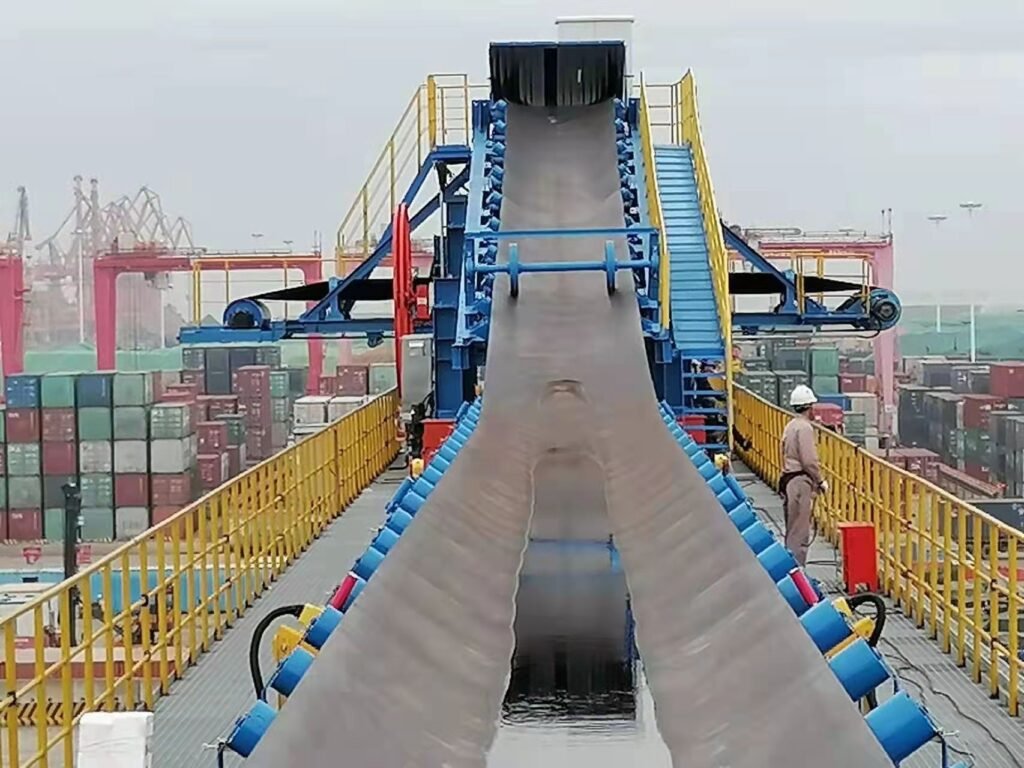
Total length of the tensioning path
The range of movement of the tensioning device must be checked to calculate the total available length. The belt length should then be adjusted according to the position of the tensioning device to ensure it matches the conveyor.
Tensioning recommendations for different belt materials
| Tensile Layer Material | Recommended Total Take‑Up Travel |
|---|---|
| Polyester | 1.5% of belt length |
| Nylon | 2.5% of belt length or more |
Data reference: General industry guidelines for tension design
Example:
If the conveyor belt length is 10,000 mm (10 metres), the tension path for a polyester belt should be 10,000 × 1.5% = 150 mm
For a nylon conveyor belt of the same length, the tension path should be 10,000 × 2.5% = 250 mm or more
Part Five: The Impact of Conveyor Design on Measurement
Measurement accuracy depends on the design
The accuracy of measurements depends largely on the design of the conveyor.
Conveyors with two rollers
If the conveyor has only two rollers, these two rollers must not touch each other. The conveyor belt length must not be too long or too short. If it is too long, a gap will form, and products may fall into it. In such cases, an intermediate drive unit is usually added to the return section.
Long-distance conveyors
For long-distance conveyors, the tensioning device is usually placed behind the drive unit.
Data sources
Roller width calculation formula — Engineering design guidelines and industry-standard specifications
Pre-tension length of 0.3% — Common industry empirical value
Tension path of 1.5% for polyester conveyor belts and 2.5% for nylon conveyor belts — Recommended values from the conveyor belt manufacturing industry
Conveyor belt length measurement method — Standard practice for on-site maintenance


 English
 العربية
 简体中文
简体中文 Nederlands
 Français
 Deutsch
 Bahasa Indonesia
 Italiano
 日本語
日本語 한국어
한국어 Bahasa Melayu
 Polski
 Português do Brasil
 Русский
 Español
 Türkçe