Best Conveyor Belt Guide Rollers Selection Guide
- Types Of Conveyor Belt Guide Rollers
- 3 Core Materials In Conveyor Belt Guide Rollers
- Which Structure Ensures The Best Anti-Deviation Effect?
- How To Avoid Guide Roller Failure & Belt Deviation?
- OEM Batch Production & Quality Control
- FAQs about Conveyor Belt Guide Rollers
- Partner with Haihui for Premium Conveyor Belt Guide Rollers
- References
Choosing the wrong conveyor belt guide rollers is a gamble with persistent belt deviation, abnormal friction wear, and frequent unplanned downtime. Long-term conveyor stability requires a synchronized system of precise roller concentricity, reliable sealing structure, and scientific material matching. Cutting corners on guide roller quality results in belt edge damage, material scattering, and costly daily maintenance losses.
Smart industrial procurement prioritizes anti-deviation performance, dust and moisture resistance, structural durability, and standardized batch consistency. For bulk factory orders and long-term conveyor operation, professional engineering configuration is critical. Always select conveyor belt guide rollers engineered to strict industrial standards to safeguard your entire production line operation.
Quick Insights for Conveyor Belt Guide Rollers
➔ Roller Types: From vertical side guide rollers, tapered anti-deviation rollers, rubber-coated guide rollers to sealed dustproof guide rollers—select based on belt width, operating speed, and on-site working conditions.
➔ Core Materials & Structure: High-strength steel body, anti-wear rubber coating, multi-layer labyrinth sealing, and low-resistance bearing configuration for stable passive rotation.
➔ Key Performance Factors: Roller concentricity, sealing grade, surface friction uniformity, and load resistance determine belt alignment accuracy and long-term service life.
Need a customized conveyor roller solution fast? With decades of industrial manufacturing expertise, Haihui provides a 1-day professional solution proposal including type selection, parameter matching, and quotation. Contact us today to stabilize your conveyor operation.
Types Of Conveyor Belt Guide Rollers
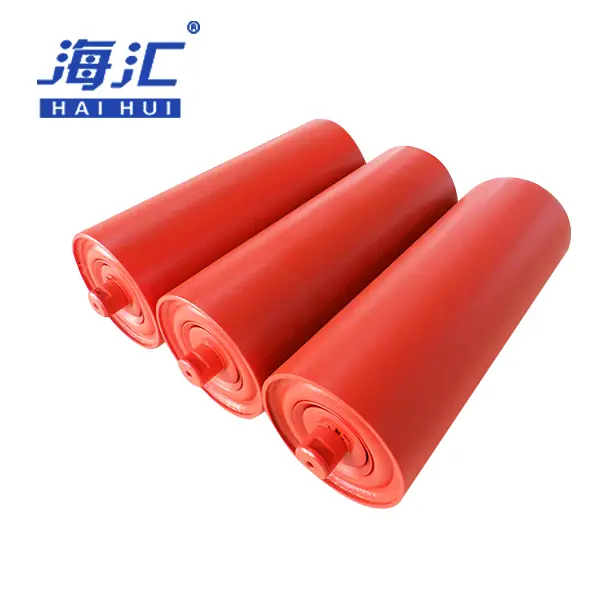
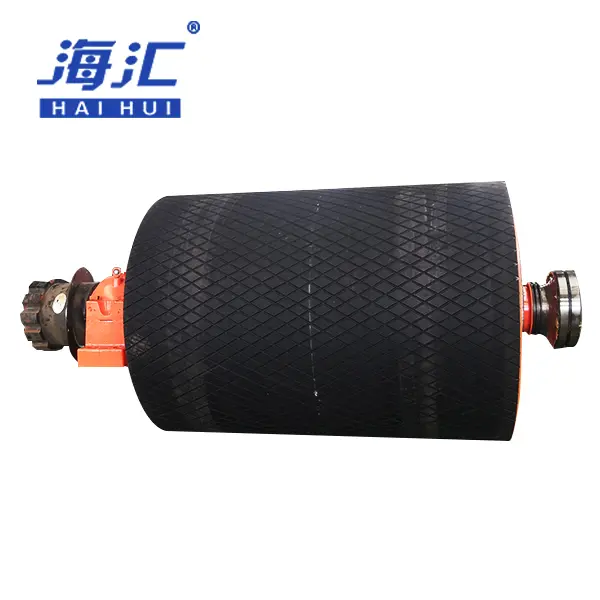
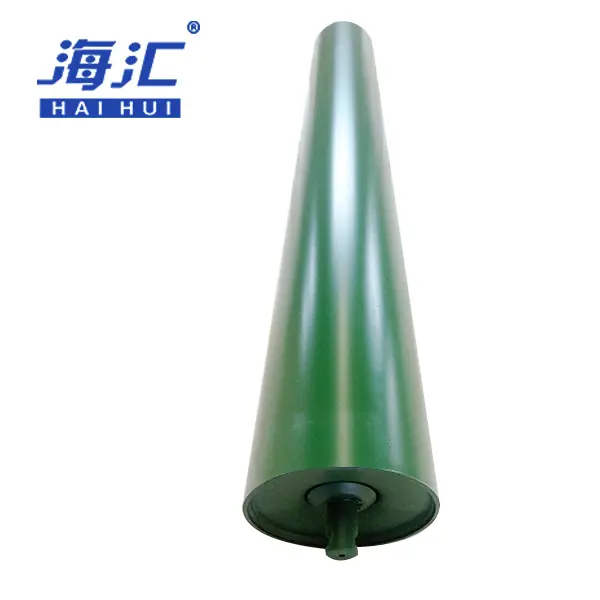
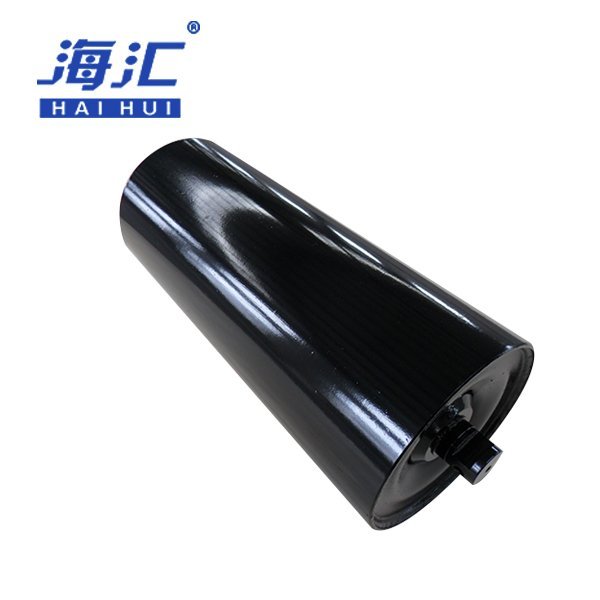
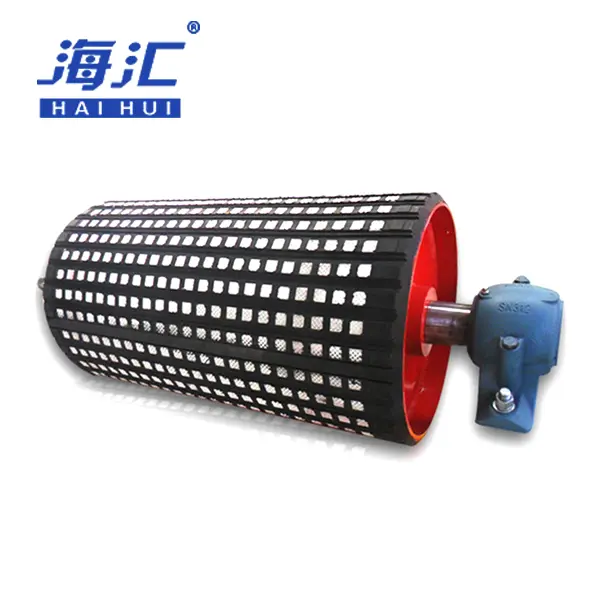
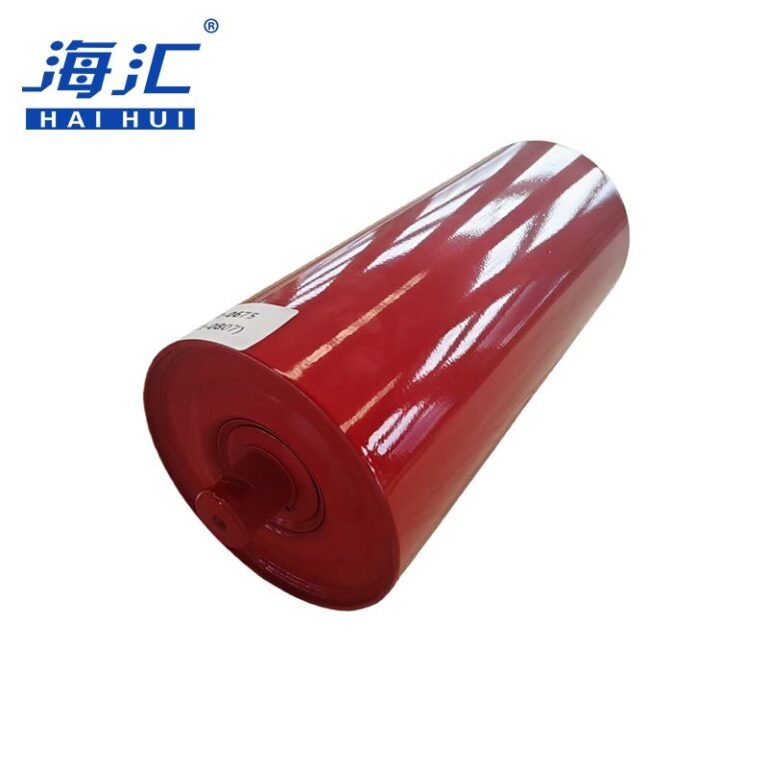
Conveyor Belt Guide Rollers
From light-duty logistics conveying to heavy-duty mining bulk transportation, the structural type and manufacturing precision of conveyor belt guide rollers directly determine belt alignment effect and operational stability. Below are the four core guide roller types widely applied in modern industrial conveyor systems.
Vertical Side Guide Rollers
Vertical side guide rollers are the most conventional anti-deviation components, vertically installed on both sides of the conveyor frame to limit lateral belt displacement and constrain excessive belt swing.
Key traits:
- Simple vertical installation structure with flexible layout
- Effectively blocks left and right belt deviation during stable operation
- Suitable for flat conveying lines with fixed belt width
Under the hood:
Body Structure
Integral steel roller body with anti-rust surface treatment, fixed vertical bracket positioning
Performance Factors
Low rotation resistance ensures synchronous follow-up with belt operation
High structural rigidity resists lateral impact force from belt deviation
Application Scenarios
Logistics sorting, food processing, and general workshop light-load conveying lines
Haihui designs vertical side guide rollers with strict concentricity control, avoiding stuck rotation and abnormal friction, providing basic and reliable anti-deviation protection for conventional conveyor lines.
Tapered Anti-Deviation Guide Rollers
Tapered anti-deviation guide rollers adopt asymmetric tapered structural design, relying on geometric difference to generate automatic centering force, realizing active belt correction without manual intervention.
Performance snapshot:
| Feature | Typical Value | Benefit |
|---|---|---|
| Taper angle | 3°–8° | Stable automatic centering force |
| Operating speed | ≤3.5m/s | Adapt to high-speed conveying lines |
| Correction accuracy | ±2mm | Avoid belt edge friction damage |
| Service life | 3–5 years | Long-term stable correction performance |
Breakdown:
Tapered structure forms progressive support difference, automatically guiding the offset belt back to the center position
No rigid limit contact, reducing belt edge wear compared with vertical rollers
Suitable for long-distance conveying lines prone to cumulative deviation
For long-span and high-speed conveyor lines, Haihui tapered guide rollers eliminate frequent manual correction work and maintain consistent belt centering effect.
Rubber-Coated Guide Rollers
Rubber-coated guide rollers wrap high-elastic anti-wear rubber layer on the steel roller surface, combining the rigidity of steel body and the buffer protection performance of rubber material.
Use them when:
- Belt surface and edge protection is required to prevent scratching and cracking
- Slipping and insufficient friction occur during belt operation
- Frequent material impact causes unstable belt operation
Inside the structure:
Integrated vulcanization process ensures tight bonding between rubber layer and steel body without peeling
High-friction rubber surface enhances synchronous follow-up performance with the belt
Elastic buffer structure absorbs lateral impact force of the belt
Light-duty and medium-duty conveying lines with high requirements for belt protection all prefer rubber-coated guide rollers. Haihui optimizes rubber hardness and formula to balance anti-slip performance and wear resistance.
Dustproof Sealed Guide Rollers for Harsh Environments
Dustproof sealed guide rollers adopt multi-layer labyrinth sealing structure, specially designed for high-dust, humid, and corrosive working conditions such as mining, cement plants, and ports.
Structure layers:
Sealing system
Multi-stage internal and external isolation structure to block dust, moisture, and fine particles
High-temperature and anti-aging lubricating grease is used inside to avoid dry friction
Roller body protection
Anti-corrosion spraying or galvanizing treatment on steel surface
Strict tolerance control of shaft head to ensure flexible rotation
Advantages:
- Effectively prevent bearing clogging and stuck rotation in harsh environments
- Reduce maintenance frequency and downtime loss
- Maintain long-term stable anti-deviation performance
For harsh industrial scenarios with severe environmental interference, Haihui dustproof sealed guide rollers achieve zero failure stable operation all year round.
Explore Haihui’s Premium Lines: Whether you need standard vertical guide rollers or customized sealed anti-deviation rollers, we guarantee 100% finished product inspection and batch performance consistency on all production lines.
3 Core Materials In Conveyor Belt Guide Rollers
Material selection directly determines the structural durability, anti-deviation stability, and environmental adaptability of conveyor belt guide rollers. From base steel body to surface protective layer, each material parameter affects the overall operating effect of the conveyor.
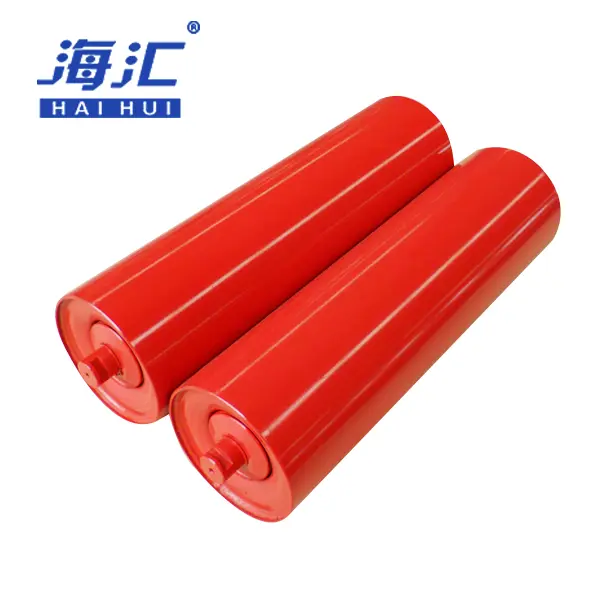
Conveyor Belt Guide Rollers
High-Strength Steel Body for Structural Stability
The base of conveyor belt guide rollers is high-quality seamless steel tube, whose mechanical properties determine load resistance and structural stability.
Core Performance
Structural Strength
High tensile strength resists lateral impact and extrusion deformation caused by belt deviation
Stable tubular structure ensures no bending or distortion during long-term operation
Dimensional Stability
Precision finishing ensures ultra-high concentricity, avoiding jitter and friction deviation
Strict wall thickness control balances lightweight and load-bearing performance
Manufacturing Advantages
Excellent processability supports customized cutting and shaping of different sizes
Uniform surface texture provides reliable foundation for subsequent coating and rubber wrapping
Haihui adopts high-purity seamless steel tubes as raw materials, strictly controlling processing tolerances to ensure every guide roller maintains stable structural performance in long-cycle operation.
Wear-Resistant Rubber Layer for Belt Protection
The outer rubber layer of rubber-coated guide rollers is the key to protecting the conveyor belt and improving synchronous performance, which needs to balance wear resistance, friction coefficient and buffer performance.
Protection Performance
High-elastic rubber material avoids hard contact scratching the belt edge and surface
Stable friction coefficient prevents relative slipping between roller and belt
Environmental Adaptability
Anti-aging formula resists ultraviolet radiation and high-temperature aging
Moisture-proof and anti-corrosion performance adapts to humid workshop environments
Industry Application Value
Effectively extend the service life of expensive conveyor belts and reduce replacement costs
Eliminate abnormal noise and vibration caused by rigid friction
Haihui independently optimizes rubber formula and vulcanization process to ensure the rubber layer does not peel or wear excessively during long-term operation.
Anti-Corrosion Surface Treatment for Harsh Scenarios
Industrial conveyor lines often face dust, moisture, salt spray and chemical volatile erosion. Professional anti-corrosion surface treatment is essential for long-term stable operation of guide rollers.
Common Treatment Processes
Galvanizing Treatment: Form dense protective layer to isolate air and moisture, preventing rust oxidation, suitable for conventional indoor and outdoor working conditions.
Spray Coating Treatment: Thickened anti-corrosion coating fills surface gaps, enhancing resistance to chemical corrosion and salt spray erosion.
Polishing Treatment: Smooth surface reduces friction residue accumulation, avoiding local corrosion caused by dust deposition.
Manufacturing Value
Solve common failures such as roller rust, surface peeling and rotation stagnation
Ensure consistent appearance and performance of batch products
Greatly reduce later maintenance and replacement frequency
Which Structure Ensures The Best Anti-Deviation Effect?
Conveyor Belt Guide Rollers
Different guide roller structures correspond to different anti-deviation logics and applicable scenarios. Choosing the matching structural type according to belt speed, load and environment is the core of stable conveyor operation.
Vertical Limit Structure: Simple & Cost-Effective
Vertical side guide rollers rely on rigid limit to block belt deviation, featuring simple structure and low cost, suitable for low-speed and stable conveying lines.
Performance Core
Advantages: Flexible installation, low maintenance cost, obvious limit effect on small-amplitude deviation
Limitations: Easy to cause rigid friction with belt edge, not suitable for high-speed and long-distance conveying
Applicable Scenarios
Fixed-speed logistics lines, packaging conveying, and light-load workshop production lines
Tapered Centering Structure: Active Automatic Correction
Tapered guide rollers use geometric structural difference to generate active centering force, realizing automatic correction without manual adjustment, which is an upgraded solution for high-speed and long-distance conveying.
Performance Core
Advantages: Low friction loss, high correction accuracy, no manual intervention, stable long-term operation
Limitations: Higher manufacturing precision requirements, relatively higher cost than vertical rollers
Applicable Scenarios
Mining bulk conveying, port transportation, and high-speed automated conveyor lines
Rubber Buffer Structure: Belt-Friendly Protection
Rubber-coated guide rollers combine limit correction and buffer protection, which can not only correct belt deviation but also maximize belt protection.
Performance Core
Advantages: No hard scratch on belt, anti-slip and noise reduction, excellent protection performance
Limitations: Rubber layer has limited high-temperature resistance, not suitable for ultra-high temperature working conditions
Applicable Scenarios
Food processing, electronic packaging, and high-precision product conveying lines
Structural Performance Comparison
Scientific selection requires intuitive parameter comparison to avoid performance mismatch and waste of cost.
| Roller Structure Type | Correction Mode | Belt Wear | Applicable Speed | Maintenance Difficulty |
|---|---|---|---|---|
| Vertical Side Guide Roller | Rigid Limit | Medium | ≤2.0m/s | Low |
| Tapered Anti-Deviation Roller | Active Centering | Low | ≤3.5m/s | Medium |
| Rubber-Coated Guide Roller | Buffer Limit | Ultra-Low | ≤2.5m/s | Low |
| Dustproof Sealed Roller | Stable Limit | Low | ≤3.0m/s | Ultra-Low |
How To Avoid Guide Roller Failure & Belt Deviation?
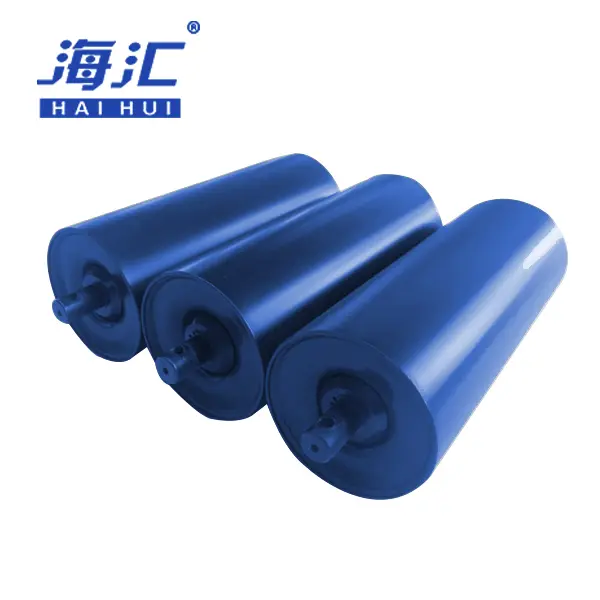
Conveyor Belt Guide Rollers
Most conveyor belt deviation and guide roller failures are caused by improper model selection, poor sealing performance, unqualified installation precision, and insufficient daily maintenance, rather than natural aging. Standardized configuration and inspection can eliminate most operational hidden dangers.
Strict Sealing Configuration Prevents Bearing Failure
Bearing clogging and stuck rotation are the primary causes of guide roller failure. Ordinary single-layer sealing cannot resist dust and moisture intrusion, leading to grease deterioration and rotation failure.
Sealing Optimization Measures
Adopt multi-layer labyrinth sealing structure to isolate external dust and humid air in all directions
Use special high-temperature and dust-proof lubricating grease to ensure long-term flexible rotation
Strengthen shaft head anti-corrosion treatment to avoid rust jamming
Haihui’s upgraded sealing system fundamentally solves the problem of roller stuck rotation in harsh environments and ensures stable anti-deviation performance.
Standardize Installation Precision To Ensure Uniform Stress
Uneven installation height and asymmetric spacing will lead to inconsistent roller stress, causing unilateral belt friction and cumulative deviation.
Installation Standard Requirements
Ensure horizontal and vertical installation levelness to avoid height difference deviation
Symmetrically arrange guide rollers on both sides with uniform spacing
Adjust pre-tightening force to ensure flexible rotation without shaking
Regular Inspection & Maintenance Mechanism
Establish daily inspection standards to eliminate hidden dangers in advance and avoid small failures evolving into large-scale shutdown losses.
| Inspection Item | Qualified Standard | Optimization Measure |
|---|---|---|
| Roller rotation status | Smooth rotation without stagnation and abnormal noise | Clean dust or replace faulty bearing |
| Belt deviation degree | Offset within ±2mm, no edge friction | Adjust roller installation angle and spacing |
| Roller surface wear | Uniform wear, no peeling or deformation | Replace worn guide roller in time |
OEM Batch Production & Quality Control
High-volume conveyor supporting orders require absolute batch consistency. Dimensional deviation, inconsistent sealing performance and unqualified surface treatment will lead to overall unstable conveyor operation. Haihui relies on standardized production lines and strict quality control system to provide stable batch supply of conveyor belt guide rollers.
🏭 Need reliable OEM batch supply? Haihui implements full-process precision quality control, supports all types of guide roller customization, and provides flexible MOQs and fast delivery cycles.
Precision Production Process Control
Tube Body Processing: High-precision cutting, turning and polishing to ensure uniform wall thickness and ultra-high concentricity.
Sealing Assembly: Standardized assembly process to ensure consistent sealing performance of each roller.
Surface Treatment: Unified spraying, galvanizing or rubber vulcanization process to ensure consistent appearance and performance of batch products.
Full-Cycle Quality Inspection System
Strictly implement raw material incoming inspection, process sampling inspection, and finished product full inspection mechanism.
Key detection indicators include dimensional tolerance, rotation resistance, salt spray corrosion resistance, and dynamic balance performance.
Retain complete inspection data to achieve full batch traceability, complying with ISO 9001 quality management system standards.
Customized Solution Service
For special working conditions such as ultra-high speed, heavy load, high corrosion and high dust, Haihui provides personalized structural optimization and parameter customization services to ensure targeted product performance.
FAQs about Conveyor Belt Guide Rollers
1) What causes frequent conveyor belt deviation?
Frequent belt deviation is mainly caused by mismatched guide roller type, unqualified installation precision, inconsistent roller rotation resistance, surface wear inconsistency, and severe environmental dust interference. Replacing with high-precision and suitable Haihui guide rollers and standardizing installation can effectively solve deviation problems.
2) Which guide roller is best for high-speed conveyor lines?
Tapered anti-deviation guide rollers are the best choice for high-speed lines. They realize active automatic centering with low friction loss, no rigid wear on the belt, and high correction accuracy, which can stably adapt to long-term high-speed operation of conveyor belts.
3) How to choose guide rollers for dusty and humid harsh environments?
It is recommended to select multi-layer dustproof sealed guide rollers with galvanized or sprayed anti-corrosion surface treatment. The optimized sealing structure can effectively isolate dust and moisture, prevent bearing failure, and maintain long-term stable anti-deviation performance.
4) What is the core difference between vertical and tapered guide rollers?
Vertical guide rollers rely on rigid limit to prevent deviation, with simple structure but easy to wear the belt; tapered guide rollers rely on geometric structure to generate active centering force, featuring low wear, high precision and no manual adjustment, suitable for high-standard and high-speed conveying lines.
5) How long is the service life of industrial guide rollers?
Under conventional working conditions, Haihui standard guide rollers can work stably for 3–5 years; under harsh environments such as high dust and corrosion, sealed and anti-corrosion customized models can still maintain 2–3 years of stable service life, far exceeding ordinary inferior products.
Partner with Haihui for Premium Conveyor Belt Guide Rollers
Haihui is a professional manufacturer focusing on R&D, precision production and customized supporting services of industrial conveyor accessories. Adhering to strict quality control standards, we provide high-precision, wear-resistant, stable and durable conveyor belt guide rollers for global industrial conveyor systems.
We support full-size customization, special working condition structural optimization, fast sample testing and bulk batch supply. Our professional engineering team provides free working condition matching and technical guidance to help customers eliminate belt deviation failures, reduce maintenance costs, and improve overall conveyor operational efficiency.
Fast Service: 1-day professional technical solution proposal, customized drawing support, and efficient after-sales response.
Strict Quality Control: Full-dimensional precision testing, sealing performance testing, and 100% finished product inspection before delivery.
Flexible Order Support: Support small-batch trial orders and large-scale mass customized production to meet different procurement demands.
👉 Contact Haihui Today to customize exclusive conveyor belt guide roller solutions for your production line!
References
Industrial Conveyor Roller Design Specification – Mechanical Industry Standard
Belt Conveyor Deviation Control Technology – Industrial Automation Research
Multi-Layer Sealing Structure Dustproof Technology Standard
Rubber Coating Anti-Wear and Anti-Aging Technical Specification
ISO 9001 Industrial Mechanical Parts Quality Management System
Harsh Environment Conveyor Accessories Selection Guide
Conveyor Belt Anti-Deviation Engineering Manual
Steel Roller Precision Processing Industrial Standards
 English
 العربية
 简体中文
简体中文 Nederlands
 Français
 Deutsch
 Bahasa Indonesia
 Italiano
 日本語
日本語 한국어
한국어 Bahasa Melayu
 Polski
 Português do Brasil
 Русский
 Español
 Türkçe